
Microsoft Certified: AI Transformation Leader (AB-731): Who Should Take It?
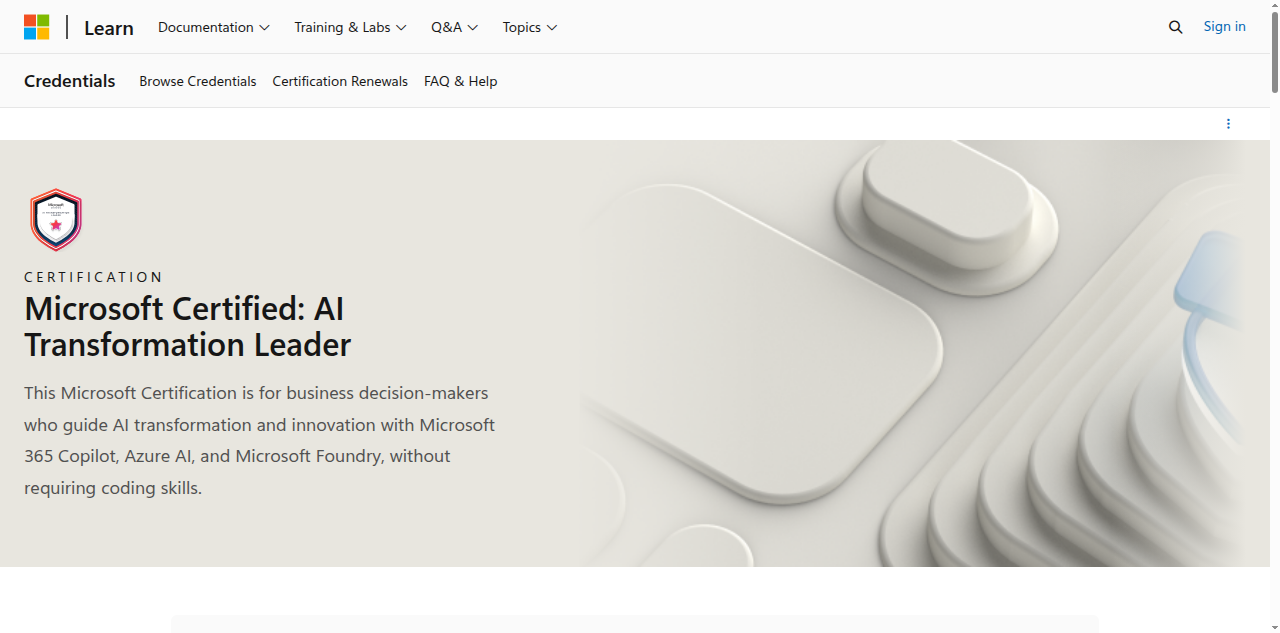
AB-731 is a Microsoft credential for people who must turn AI interest into organizational adoption—not a coding or agent-building exam. It is most useful when your role includes selecting business opportunities, setting adoption direction, championing responsible AI, or coordinating change across teams.[9][11]
Quick verdict
| Question | Verified answer |
|---|---|
| Credential / exam | Microsoft Certified: AI Transformation Leader / AB-731 [9][10] |
| Level / role | Beginner / Business Leader [9] |
| Coding expected? | Microsoft says candidates are not expected to write code [9][11] |
| Exam time | 45 minutes; proctored, with possible interactive components [10] |
| Passing score | 700 or higher [11][15] |
| Price | Microsoft’s page currently displays $99 USD; the actual exam price depends on the country or region where it is proctored [10] |
| Recommended background | Experience leading adoption or change management; familiarity with Microsoft 365, Microsoft Foundry, and general AI concepts [9][11] |
| Best fit | Business decision-makers, transformation leads, adoption owners, and business-facing IT leaders |
| Poor fit | Someone seeking proof of hands-on model development, production agent engineering, or detailed tenant administration |
What the exam actually measures
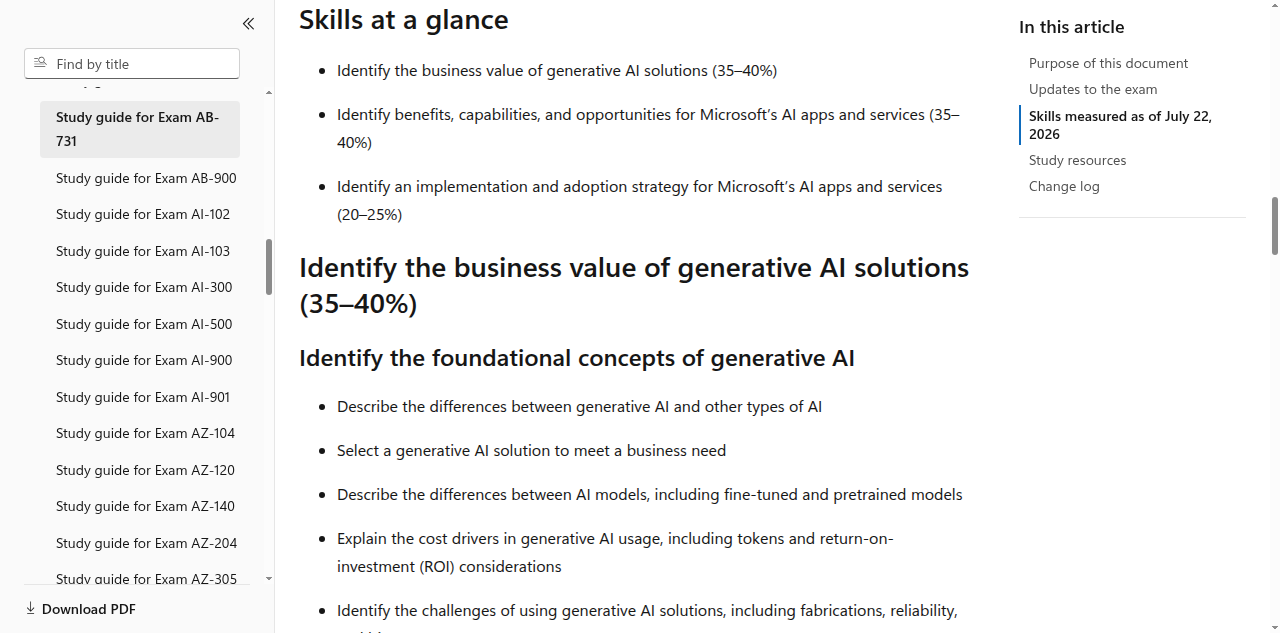
The Microsoft study guide labels its skills outline “as of July 22, 2026” and groups AB-731 into three areas:[11]
| Skill area | Weight | Practical interpretation |
|---|---|---|
| Identify the business value of generative AI solutions | 35–40% | Recognize where AI can create value, assess costs and risks, and distinguish a plausible opportunity from technology-led enthusiasm. |
| Identify benefits, capabilities, and opportunities for Microsoft AI apps and services | 35–40% | Match Copilot, Copilot Studio, Foundry, and related services to business tasks; understand capabilities, limits, licensing, and build/buy/extend choices. |
| Identify an implementation and adoption strategy for Microsoft AI apps and services | 20–25% | Plan stakeholders, change management, responsible-AI governance, adoption, and how results will be measured. |
The official audience description is unusually clear: candidates guide AI transformation and innovation, should be able to evaluate opportunities and align investment with business goals, and are not expected to write code.[9][11] That makes this a leadership and adoption credential—not a substitute for AB-100 architecture depth or AB-900’s Microsoft 365 Copilot/agent administration foundation.
The study guide’s topics go beyond “AI strategy” slogans. They include mapping business processes to Copilot, comparing Copilot experiences and capabilities, deciding when to build, buy, or extend, responsible-AI principles, adoption teams and barriers, and Copilot licensing models.[11] A strong candidate should be able to explain the decision and its evidence, not simply recite product names.
Turn the study into an adoption artifact
Choose one real process your organization is allowed to discuss—for example, summarizing internal service-desk requests or preparing a first draft of a recurring management report. Do not use confidential customer or employee data in a public demo.
Create a one-page AI opportunity brief with these fields:
| Field | What to write down |
|---|---|
| Business problem | The task, who performs it, how often, and where the delay or quality issue occurs. |
| Baseline | The current time, quality, rework, or service-level measure. State how it was measured. |
| Candidate solution | Which Microsoft capability could help, and why it fits better than a simpler workflow or no AI. |
| Data and risk | The source data, access boundary, sensitive information, human review point, and responsible-AI concerns. |
| Pilot design | A small user group, owner, success metric, failure/stop condition, and feedback loop. |
| Value case | Expected benefits and total costs, including licenses, implementation, support, and review time. Mark assumptions clearly. |
This is a suggested work product, not a Microsoft exam requirement. It is more credible than claiming a generic percentage productivity gain: it shows that you can define a measurable pilot, establish a baseline, and decide what would make the project stop.
A useful two-week preparation plan
Microsoft’s official learning material offers several paths. Transform your business with Microsoft AI is listed as a 2-hour-34-minute, four-module path. The page also links shorter paths on the business value of generative AI and driving value with AI solutions; their displayed durations are 1 hour 2 minutes and 1 hour 8 minutes respectively.[12][13][14] These are provider seat-time estimates, not a guarantee of exam readiness.
A practical plan—our recommendation, not Microsoft’s schedule—is:
- Days 1–2: Opportunity and value. Select one business process. Define the baseline, expected outcome, cost categories, and the people who will judge success.
- Days 3–4: Match capability to work. Compare the relevant Copilot, Copilot Studio, and Foundry capabilities. Record why a simpler option would or would not work.
- Days 5–6: Risk and governance. Identify data access, privacy, security, quality, human-review, and responsible-AI controls. Name the accountable owner.
- Days 7–9: Adoption plan. Identify sponsors, users, training, feedback, and likely barriers. Make the deployment sequence small enough to measure.
- Days 10–12: Business case. Separate observed baseline data from forecasts; state licensing, support, and operating-cost assumptions. Choose one adoption and one outcome measure.
- Days 13–14: Readiness check. Take Microsoft’s practice assessment, review gaps in the study guide, and use the exam sandbox before scheduling.[10][11]
Microsoft’s practice assessment helps candidates check readiness and question familiarity.[10]
The separate practice-assessment guidance says its questions are examples—not live exam items—and are not a replacement for training or product experience.[16]
The study guide states that 700 or greater is the passing score; that is a scaled score and should not be interpreted as a simple 70-percent-correct rule.[11][15]
Who should take AB-731—and who should not
Take it if you lead AI adoption, business transformation, process improvement, or workplace-AI enablement and need a Microsoft-specific framework for evaluating opportunities and organizing responsible rollout. You do not need to be a software developer, but you should have real business-context change or adoption experience.[9][11]
Do not treat it as a technical build credential. If you need to show that you can architect, secure, integrate, deploy, and operate agentic solutions, AB-731 is too leadership-focused. Consider the AB-100 solution-architect path instead. If your goal is practical individual Copilot use in Microsoft 365, see the AB-730 review. If your responsibility is tenant-level administration, compare it with AB-900.
Final answer
AB-731 is worth considering for the person accountable for adoption—not for the person who wants to prove they can build the AI system. Its value is a structured way to discuss opportunity selection, responsible AI, investment, and organizational change. Pair the credential with a measured pilot brief and a real adoption plan; the certification alone does not prove that a transformation delivered business value.
Sources
[9] https://learn.microsoft.com/en-us/credentials/certifications/ai-transformation-leader — Microsoft Certified: AI Transformation Leader [10] https://learn.microsoft.com/en-us/credentials/certifications/exams/ab-731 — Exam AB-731 [11] https://learn.microsoft.com/en-us/credentials/certifications/resources/study-guides/ab-731 — AB-731 study guide [12] https://learn.microsoft.com/en-us/training/paths/transform-your-business-with-microsoft-ai — Transform your business with Microsoft AI [13] https://learn.microsoft.com/en-us/training/paths/explore-business-value-generative-ai-solutions — Explore the business value of generative AI solutions [14] https://learn.microsoft.com/en-us/training/paths/drive-value-generative-ai-solutions — Drive business value with AI solutions [15] https://learn.microsoft.com/en-us/credentials/certifications/exam-scoring-reports — Exam scoring and score reports [16] https://learn.microsoft.com/en-us/credentials/certifications/practice-assessments-for-microsoft-certifications — Practice Assessments for Microsoft Certifications