
Microsoft Certified: Agentic AI Business Solutions Architect Expert (AB-100): What the Exam Requires
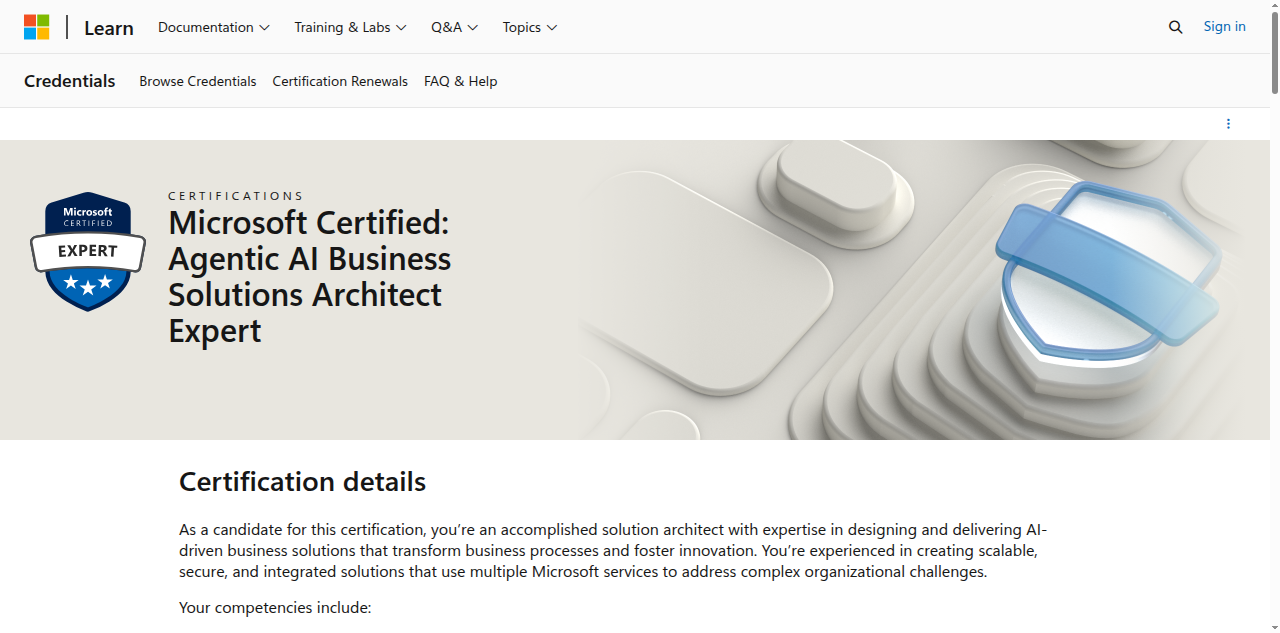
AB-100 is a solution-architect credential, not a first-step agent-builder badge. Microsoft requires candidates to pass the AB-100 exam and hold at least one eligible Associate certification. The exam outline spans business solution planning, architecture, deployment, security, ALM, agent telemetry, and ROI.[6][7][8]
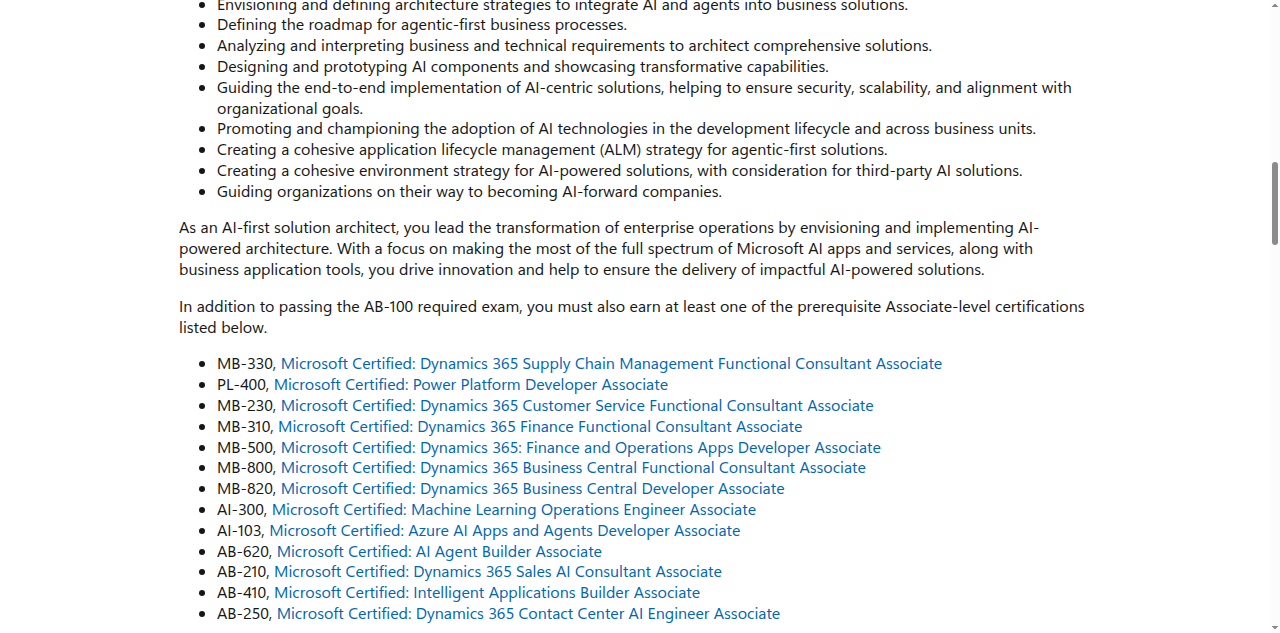
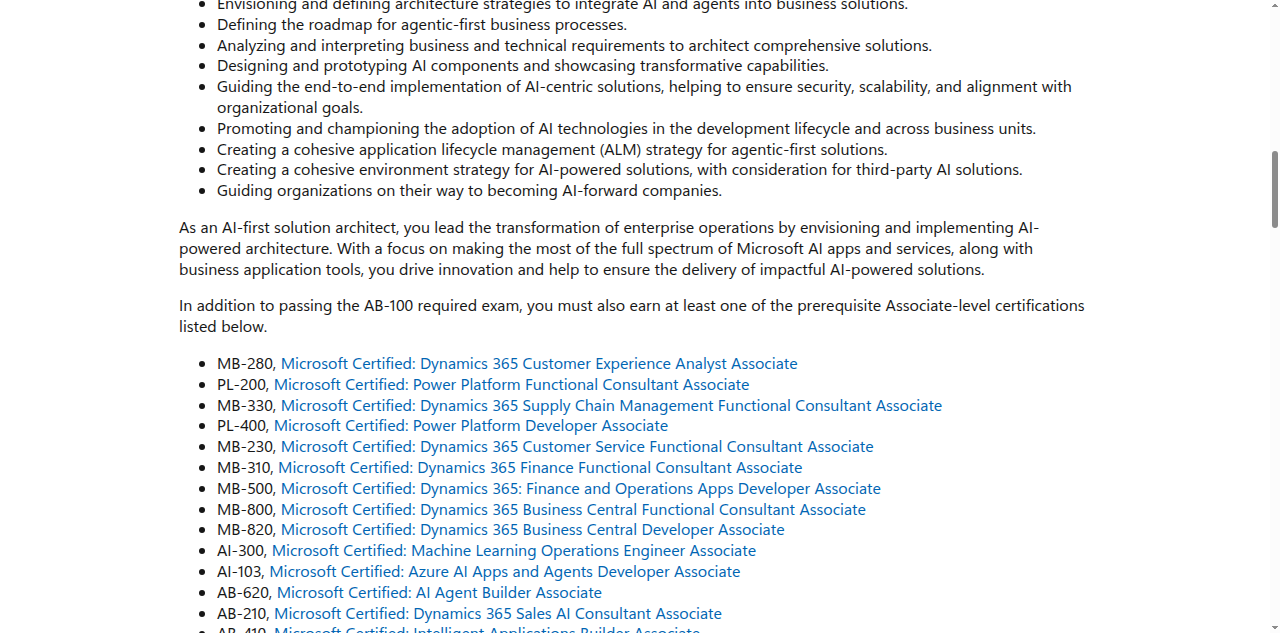
Important documentation check (reviewed October 5, 2026): Microsoft’s credential overview and AB-100 exam page show different Associate prerequisite lists. The exam-specific page includes MB-280 and PL-200; the credential overview page we checked does not. If your eligibility depends on either credential, confirm with Microsoft Credentials or the exam-registration flow before paying or scheduling.[6][7]
Quick verdict
| Question | Verified answer |
|---|---|
| Credential | Microsoft Certified: Agentic AI Business Solutions Architect Expert [6] |
| Required exam | AB-100: Agentic AI Business Solutions Architect [7] |
| Level / role | Expert / Solution Architect [6] |
| Additional credential requirement | At least one eligible Associate certification, as well as passing AB-100 [6][7] |
| Passing score | 700 or higher [8] |
| Exam time / price | I found no duration or single global fee in the official AB-100 page content reviewed; confirm current terms in the Microsoft scheduling flow before booking.[7] |
| Best fit | Architects who already design and deliver complex, secure business solutions across Microsoft platforms |
| Main caution | The English exam page says its version is scheduled to update on October 14, 2026. Use the study guide that matches your actual exam date.[7][8] |
Check the prerequisite before you plan your study time
Microsoft’s AB-100 exam page says the Expert credential requires the AB-100 exam plus at least one of the listed Associate certifications.[7] It is not enough to pass AB-100 and assume the Expert title will follow automatically.
The exam-specific page currently lists these eligible Associate credentials:[7]
| Track | Listed prerequisite certifications |
|---|---|
| Dynamics 365 and business applications | MB-230 Customer Service Functional Consultant; MB-280 Customer Experience Analyst; MB-310 Finance Functional Consultant; MB-330 Supply Chain Management Functional Consultant; MB-500 Finance and Operations Apps Developer; MB-800 Business Central Functional Consultant; MB-820 Business Central Developer; AB-210 Sales AI Consultant; AB-250 Contact Center AI Engineer |
| Power Platform and AI | PL-200 Power Platform Functional Consultant; PL-400 Power Platform Developer; AI-103 Azure AI Apps and Agents Developer; AI-300 Machine Learning Operations Engineer; AB-620 AI Agent Builder; AB-410 Intelligent Applications Builder |
There is a real documentation mismatch: the credential overview list we captured omits MB-280 and PL-200, while the exam-specific list includes them.[6][7] The screenshots below preserve what each Microsoft page showed when checked. Do not make an eligibility decision from a third-party article or an old saved screenshot; verify the current exam page and registration workflow.
What AB-100 asks an architect to do
The study guide groups the exam into three domains:[8]
| Domain | Weight | Practical interpretation |
|---|---|---|
| Plan AI-powered business solutions | 25–30% | Translate business goals into requirements, data readiness, adoption choices, and measurable outcomes. |
| Design AI-powered business solutions | 25–30% | Choose architectures, agents, models, connectors, grounding sources, and build/buy/extend options. |
| Deploy AI-powered business solutions | 40–45% | Guide implementation, integration, security, lifecycle management, telemetry, governance, and continuous improvement. |
The detailed objectives are broader than “write a prompt.” Microsoft lists agentic-first and multi-agent solution design; Copilot Studio and Microsoft Foundry; model routing; Dynamics 365 and Power Platform integration; MCP and A2A; agent flows and Computer Use; ALM; data grounding; responsible AI; security controls; monitoring; and ROI/TCO analysis.[6][8]
That makes the credential most relevant to someone accountable for the whole solution: why an agent is needed, what data and actions it can access, how a human intervenes, how it is tested, how it is governed after launch, and what business measure determines success.
A practice case that turns study into architecture evidence
Use a fictional service-request triage process. Label it as a practice case—not a real Microsoft deployment—and produce these artifacts:
- Problem and baseline: Define one measurable outcome, such as time to route a request or the share of requests returned for missing information. Record the baseline and how it will be measured.
- Agent boundary: Map the user, agent identity, knowledge sources, connectors, actions, and approval steps. State which tasks remain human-owned.
- Build / extend / buy decision: Compare extending Microsoft 365 Copilot, creating a Copilot Studio agent, using a Foundry-based component, or not using an agent. Explain the trade-offs rather than defaulting to “multi-agent.”
- Grounding and evaluation: Define source-of-truth documents, freshness/accuracy checks, test cases, refusal behavior, and what happens when a source is missing or conflicting.
- Security and operations: Document least-privilege access, data residency needs, prompt-manipulation defenses, audit evidence, release/rollback process, telemetry, and a named service owner.
- ROI and go/no-go: Estimate total cost of ownership and expected benefit using stated assumptions. Set a threshold for continuing, changing, or stopping the pilot.
These are recommended portfolio artifacts, not extra Microsoft exam requirements. They help an employer see whether you can turn the exam’s architecture language into an operational decision record.
A practical four-week preparation plan
Microsoft’s study guide recommends training and hands-on experience. It also provides a study guide, practice assessment, and exam sandbox; the guide states that a score of 700 or greater is required to pass.[7][8]
- Week 1 — Prerequisite and baseline: Confirm the Associate eligibility requirement and select the AB-100 study-guide version matching your exam date. Map one business process, its stakeholders, data sources, and success measures.
- Week 2 — Plan and design: Work through the planning/design domains. For the practice case, compare Copilot extension, Copilot Studio, and Foundry approaches; include a model-selection rationale and grounding plan.
- Week 3 — Deploy and govern: Build the test matrix, agent/action boundaries, security controls, human approvals, ALM stages, monitoring, and rollback criteria. Focus extra time here because deployment is the largest weighted domain.[8]
- Week 4 — Prove trade-offs: Complete the practice assessment and sandbox, review missed concepts, then present the architecture in a short design review. Be ready to defend the chosen scope, cost assumptions, security boundary, and failure behavior.
Treat this as a study framework, not a promised four-week pass plan. The prerequisite Associate credential and your real architecture experience can change the time required substantially.
Who should take AB-100—and who should wait
Strong fit: experienced solution architects, Dynamics 365/Power Platform architects, and AI solution leads already able to own requirements, security, integration, deployment, and operational outcomes. The prerequisite Associate certification is a hard planning gate, not an optional recommendation.[6][7]
Wait or choose a different path if: you have not yet earned an eligible Associate certification; you want an introductory AI credential; or you are looking for a narrow developer exam rather than end-to-end solution architecture. Consider an applicable Associate credential first, such as AI-103 or AB-620, then reassess the Expert path.
Exam update timing
Microsoft’s AB-100 exam page says the English version will be updated on October 14, 2026; the linked study guide’s change table compares the pre-update and as-of-October-14 objectives.[7][8] Confirm which version applies to your appointment. Do not treat the future-dated outline as if it were already effective on October 5.
Bottom line
AB-100 can be a strong Expert credential if you already meet the Associate prerequisite and can demonstrate architecture judgment beyond the exam. Use it to validate a portfolio of business-aligned, secure, testable agentic solutions—not as a substitute for the design decisions and delivery evidence employers expect from a solution architect.
Sources
[6] https://learn.microsoft.com/en-us/credentials/certifications/agentic-ai-business-solutions-architect — Microsoft Certified: Agentic AI Business Solutions Architect Expert [7] https://learn.microsoft.com/en-us/credentials/certifications/exams/ab-100 — Exam AB-100 [8] https://learn.microsoft.com/en-us/credentials/certifications/resources/study-guides/ab-100 — AB-100 study guide