Microsoft Certified: AI Agent Builder Associate (AB-620): Worth It for IT Pros?
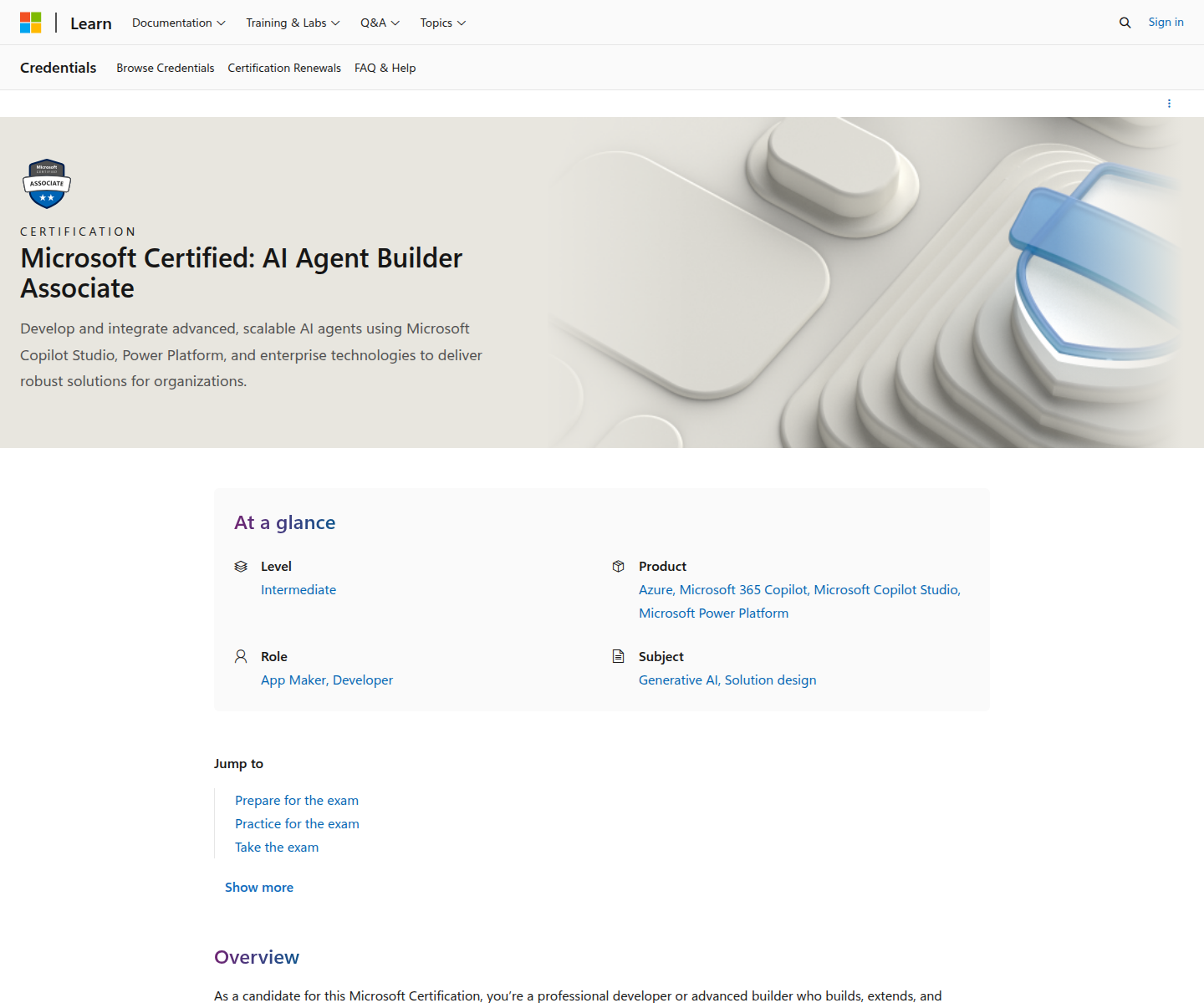
Microsoft Certified: AI Agent Builder Associate is an intermediate certification for professionals who develop and integrate enterprise AI agents with Microsoft Copilot Studio, Power Platform, Microsoft 365, and Microsoft Foundry. Its required assessment is AB-620.
This is a more direct AI credential than a general Azure administration certification, but it is not a generic prompt-engineering badge. The useful question for an IT professional is whether building, integrating, testing, and governing agents is becoming part of the job.
Quick verdict
| Category | Verdict |
|---|---|
| Provider | Microsoft |
| Certification | Microsoft Certified: AI Agent Builder Associate |
| Exam | AB-620 |
| Level | Intermediate |
| Exam time | 120 minutes |
| Delivery | Proctored; interactive components may be included |
| Main products | Copilot Studio, Power Platform, Microsoft 365, Microsoft Foundry |
| Practice assessment | Not currently available on the official page |
| Best fit | Developers, consultants, advanced agent builders, and IT pros moving into enterprise automation |
| AI relevance | Direct: agent design, orchestration, APIs, connectors, knowledge, testing, and lifecycle management |
| ROI | Strong when the employer uses Microsoft’s agent stack; limited outside that ecosystem |
What Microsoft says the credential covers
Microsoft describes the target candidate as an advanced builder or developer who creates scalable agents for organizations. The expected background includes Power Fx, Dataverse, Power Platform environments, Microsoft 365 Copilot, Microsoft Foundry, and adaptive cards. Microsoft also calls out intermediate generative-AI concepts including retrieval-augmented generation, Model Context Protocol, Agent2Agent protocol, prompt engineering, and REST integration patterns.
That positioning matters. This is not primarily a help-desk productivity certification. It is aimed at people who can turn business requirements into agents, connect those agents to enterprise systems, and operate them responsibly.
The AB-620 assessment domains
Microsoft lists three assessed areas:
- Plan and configure agent solutions — translate requirements into an agent design, choose the right environment, configure knowledge and instructions, and plan the supporting components.
- Integrate and extend agents in Copilot Studio — connect APIs, custom connectors, Microsoft Foundry, Microsoft Fabric, MCP servers, and other enterprise systems.
- Test and manage agents — validate behavior, manage deployment and lifecycle concerns, monitor outcomes, and apply administration and governance practices.
The page states that AB-620 is a 120-minute proctored assessment and may include interactive components. Candidates should therefore prepare to reason through configuration and integration scenarios, not only memorize product definitions.
Why it matters for IT professionals
It turns AI adoption into an integration job
An agent that can answer a question is easy to demonstrate. An agent that can safely retrieve a ticket, call an API, update a record, or hand off to a human is an IT integration problem. AB-620’s emphasis on connectors, APIs, knowledge sources, and enterprise platforms matches the work behind that second version.
It connects Copilot Studio to existing administration skills
IT pros already understand identity, permissions, change control, service ownership, and support processes. Those skills become valuable when an agent needs access to SharePoint, Dataverse, ServiceNow, SAP, or internal APIs. The certification does not replace identity or security expertise; it gives those disciplines an agent-building context.
It makes governance part of the build
Microsoft’s scope includes enterprise technologies, testing, and management rather than just authoring. Before approving an agent, an administrator still needs to ask: what data can it retrieve, which identity does it use, what actions can it take, how are failures logged, and how is the agent retired? Those questions are the difference between a useful pilot and an unmanaged automation risk.
A practical preparation plan
- Build one small Copilot Studio agent. Use a narrow knowledge source and document its intended audience, permissions, and escalation path.
- Practice integrations. Work through a custom connector or REST API, then test authentication, errors, timeouts, and least-privilege access.
- Learn the Power Platform substrate. Review Dataverse, environments, solutions, Power Fx, connectors, and deployment concepts.
- Study agent patterns. Understand grounding, RAG, tool use, orchestration, MCP, adaptive cards, and human handoff well enough to select the right pattern.
- Test like a support engineer. Create ambiguous requests, unauthorized requests, missing-data cases, API failures, and prompt-injection attempts. Record expected and actual behavior.
- Use the AB-620 study guide and exam sandbox. Microsoft links the official study guide from the certification page. The practice assessment was not available when checked, so the sandbox and hands-on work are especially important.
What this certification does not prove
AB-620 does not by itself prove that a candidate can:
- administer a complete Microsoft 365 tenant;
- secure every identity, connector, or data source in production;
- train or fine-tune foundation models;
- design a GPU platform or an ML pipeline;
- guarantee that an agent’s answers are factually correct;
- replace an organization’s AI risk, privacy, or change-management process.
Treat the credential as evidence of agent-building capability in Microsoft’s ecosystem, not as a universal AI engineering qualification.
Career fit and ROI
AB-620 is a sensible target for a developer, consultant, Power Platform professional, or senior IT administrator whose organization is standardizing on Copilot Studio and Microsoft 365 agents. It can also help an infrastructure professional move toward automation architecture if they build a portfolio project alongside the exam preparation.
The ROI is weaker if the target role is exclusively endpoint support, traditional Azure operations, data science, or AWS-native application development. In those cases, a certification aligned to the actual platform and job responsibilities will usually produce clearer hiring signal.
Bottom line: Microsoft Certified: AI Agent Builder Associate is worth considering for IT pros who will build and integrate governed agents, especially in Microsoft-heavy environments. The strongest evidence will be the combination of AB-620 and a working agent that demonstrates secure data access, API integration, testing, monitoring, and a clear human fallback.