Microsoft Certified: AI Business Professional (AB-730): Worth It for IT Pros?
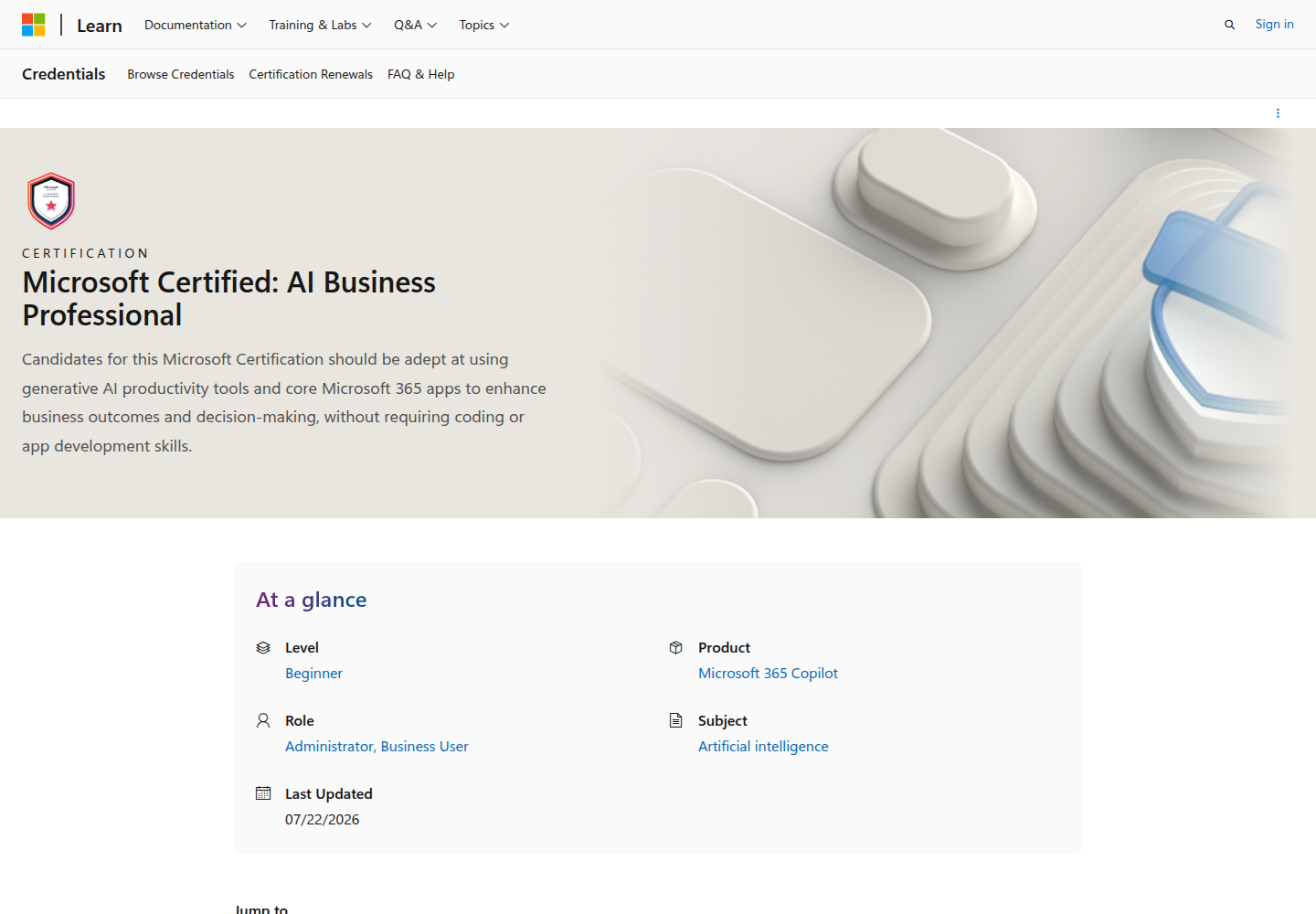
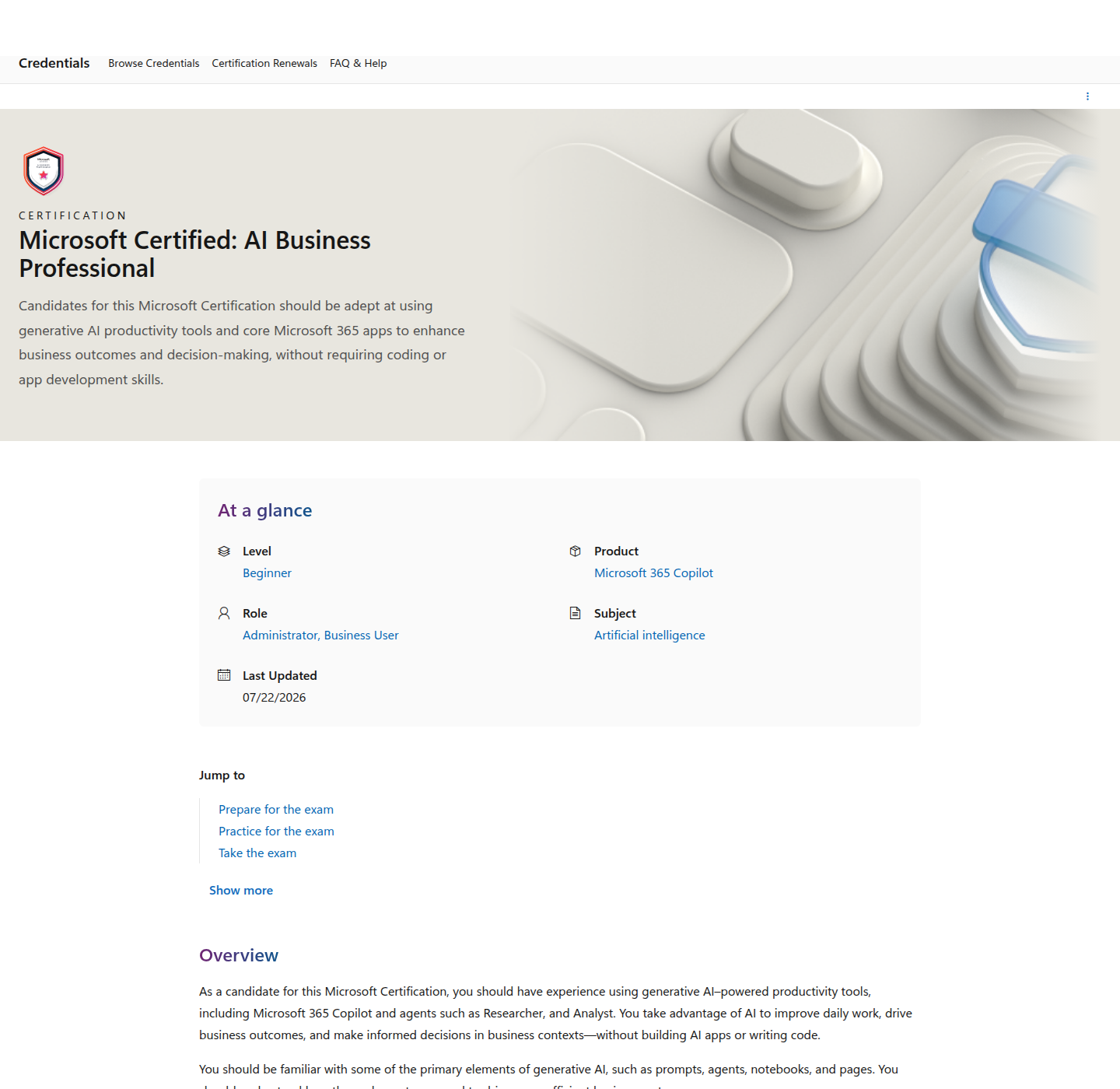
Microsoft Certified: AI Business Professional is a new, beginner-level certification for using generative-AI productivity tools and Microsoft 365 apps to improve business outcomes. It is deliberately not a coding credential. The exam is AB-730, and Microsoft says candidates should be able to use Microsoft 365 Copilot and agents such as Researcher and Analyst without building AI applications or writing code.
Quick verdict
| Category | Verdict |
|---|---|
| Provider | Microsoft |
| Certification | Microsoft Certified: AI Business Professional |
| Exam | AB-730 |
| Level | Beginner |
| Exam duration | 45 minutes |
| US price shown | $99 USD, subject to region |
| Core tools | Microsoft 365 Copilot, Researcher, Analyst, Outlook, Word, Teams, PowerPoint, Excel |
| Coding required | No |
| Best fit | IT support, desktop, service-desk, M365 administrators, and business-facing technologists |
| ROI | Good as an AI-adoption signal; limited as a hands-on engineering credential |
What this certification actually validates
Microsoft’s official certification page frames the credential around three practical areas:
- Understanding generative-AI fundamentals. You need working knowledge of prompts, agents, notebooks, pages, and the way these building blocks support daily work.
- Managing prompts and conversations with AI. This is about giving Copilot useful context, refining requests, and judging whether the result is reliable enough for the task.
- Drafting and analyzing business content with AI. The examples include email, presentations, images, documents, spreadsheets, and other common Microsoft 365 work.
That scope is intentionally different from AI-102, AI-103, or an AWS developer exam. It does not test model training, Python, APIs, vector databases, deployment pipelines, or cloud architecture. It tests whether a professional can use AI-enabled work tools responsibly and productively.
Why an IT professional might care
The absence of coding does not make the certification irrelevant to IT. Microsoft 365 environments increasingly require people who can translate AI features into repeatable, supportable work practices.
For a desktop engineer or service-desk analyst, that can mean using Copilot to summarize incident history, draft a user-facing explanation, turn meeting notes into an action list, or create a first-pass knowledge article. For an M365 administrator, it can mean helping teams understand what Copilot can do while setting expectations around permissions, data access, and human review.
The credential can provide a useful baseline for four career moves:
- AI-enabled support: document how an AI draft is checked before it reaches a user.
- M365 adoption: coach departments on practical, repeatable Copilot workflows rather than generic prompt tricks.
- Service management: use AI to improve ticket summaries, change communications, and post-incident documentation.
- Governance conversations: understand why prompts, agents, notebooks, pages, and connected business data need clear ownership and review.
The certificate is strongest when paired with a small portfolio of real workflows. A one-page runbook showing a prompt, the source material used, validation checks, and the final human approval step is more persuasive than the badge alone.
Preparation: a short path, but not a free pass
Microsoft lists Transform business workflows with generative AI as the preparation course. The page shows a learning path with six modules and about four hours 30 minutes of learning time. That is a reasonable starting point for someone already comfortable with Microsoft 365, but it should not be mistaken for the total preparation required.
A practical study plan is:
- Complete the official learning path and make notes on the terminology.
- Practice the same task in more than one Microsoft 365 app: draft an email in Outlook, summarize a document in Word, and turn source notes into slides in PowerPoint.
- Rewrite weak prompts by adding audience, context, constraints, desired format, and verification requirements.
- Test the difference between a useful answer and a confident but unsupported answer.
- Use Microsoft’s practice assessment and exam sandbox before booking the exam.
For a Microsoft 365 power user, 6–10 focused hours may be enough for an initial attempt. An IT professional who rarely uses Word, Excel, PowerPoint, or Teams should budget more time for the application workflows, not just the AI vocabulary.
Exam format and what to expect
Microsoft states that AB-730 gives candidates 45 minutes to complete a proctored assessment. The page also warns that interactive components may be included. The exam is offered in English plus Arabic (Saudi Arabia), Chinese (Simplified and Traditional), French, German, Indonesian, Italian, Korean, Japanese, Portuguese (Brazil), Russian, and Spanish.
The short duration favors practical familiarity over long technical calculations. Expect questions that test judgment: which prompt is clearer, which Copilot output needs checking, which workflow is appropriate for a business task, and how AI can support a result without replacing the user’s responsibility.
Microsoft’s page shows a US price of $99 USD, with the final price based on the country or region where the exam is proctored. Register with a personal Microsoft account when possible; Microsoft warns that exam records can be lost if they are tied only to an organizational account and the person later leaves that organization.
Where the credential is weaker
This is not the right certification if your goal is to prove that you can:
- develop an Azure AI application;
- call a model through an API;
- build RAG or agent orchestration;
- secure and monitor an AI workload;
- train or evaluate machine-learning models; or
- design a production cloud architecture.
Those goals require a developer, data, security, or cloud credential and hands-on evidence. AB-730 may complement those paths, but it does not substitute for them.
It is also not a substitute for learning Microsoft 365 administration. Knowing how to write a good prompt does not grant access to another user’s mailbox, remove the need for least privilege, or prove that a Copilot answer is safe to publish. IT professionals should treat the certification as an adoption and fluency signal, then build governance knowledge around it.
Recommended path for IT professionals
If you support a Microsoft 365 environment and need a fast, accessible AI credential, AB-730 is a sensible first step. Build three artifacts while studying:
- a Copilot-assisted ticket-summary workflow with a human verification checklist;
- a short user guide explaining acceptable and unacceptable business data handling; and
- a before-and-after example showing how AI reduces documentation time without hiding uncertainty.
Then decide whether your next step should be an M365 administrator certification, an Applied Skills lab, or a developer/AI-engineering certification. The answer depends on whether you want to enable users, govern the platform, or build the AI system.
Final answer: worth it?
Yes, for the right IT audience. Microsoft Certified: AI Business Professional is a low-friction way for service-desk, desktop, M365, and business-facing IT professionals to demonstrate practical generative-AI fluency. The 45-minute AB-730 exam, beginner level, and no-code scope make it approachable.
Its value is narrower than an engineering certification. It will not prove that you can deploy an agent or operate an Azure AI workload. Treat it as a foundation credential: earn the badge, demonstrate two or three verified workflows, and use that evidence to move toward the technical or governance path your role actually needs.