
Microsoft AI Agents: From Foundations to Applications on Coursera — Worth It for Desktop Engineers & SysAdmins?
If you are a desktop engineer or sysadmin, the AI credential market is noisy in a very specific way: most programs are either too shallow to matter, too academic to use, or too cloud-engineering-heavy to fit your actual job.
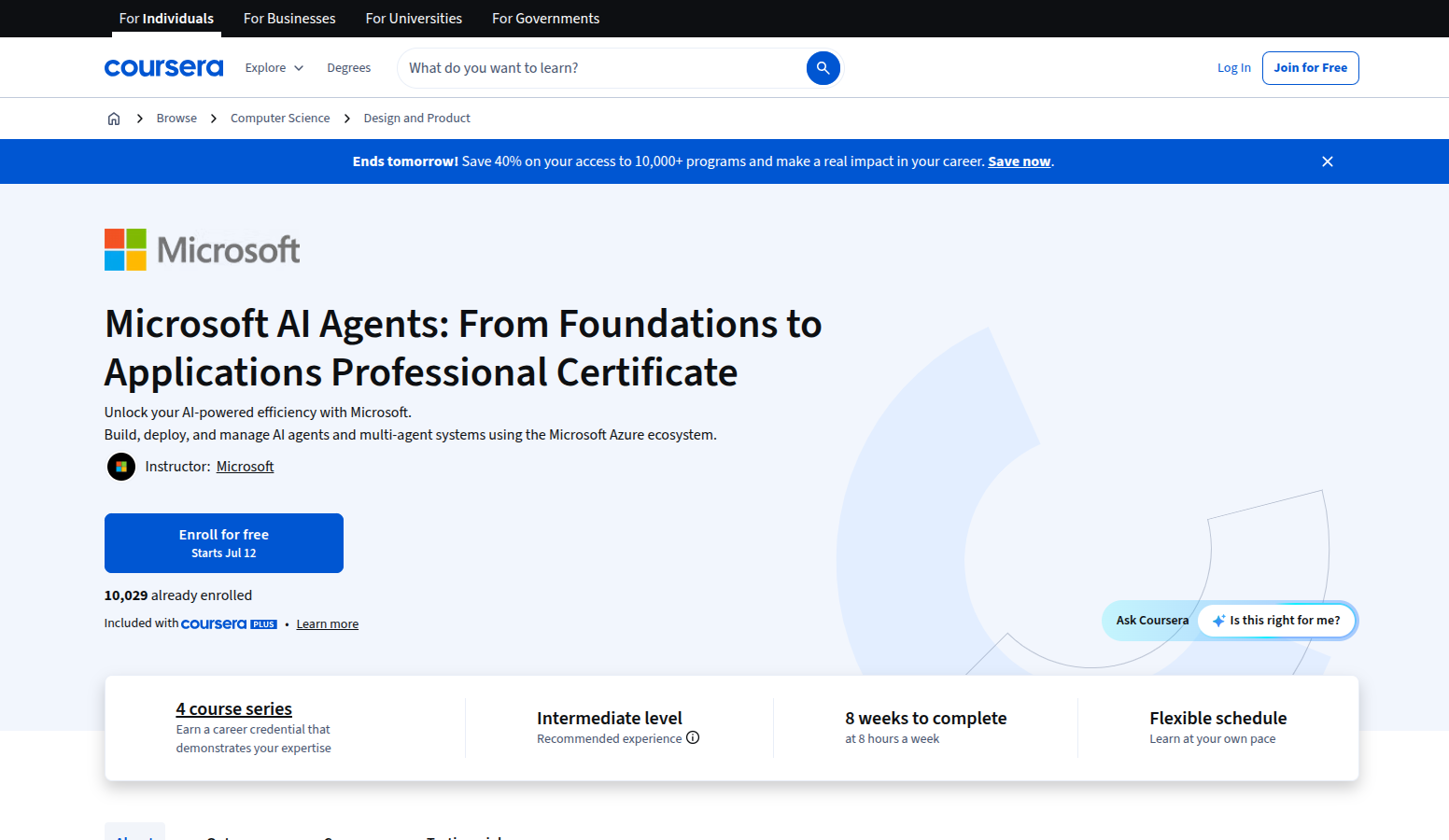
Microsoft AI Agents: From Foundations to Applications is different enough to deserve attention. It is a Coursera Professional Certificate built by Microsoft, and the page is explicit about what it targets: building, deploying, and managing AI agents and multi-agent systems using the Microsoft Azure ecosystem.
That puts it squarely in the lane that matters to Microsoft-first IT teams: internal automation, support agents, knowledge assistants, governed AI workflows, and the kind of practical agent work that is now bleeding into endpoint, help desk, and platform operations.
Quick verdict
| Category | Verdict |
|---|---|
| Best for | Microsoft-first IT pros who want a real build-oriented AI credential |
| Provider | Microsoft on Coursera |
| Credential type | Professional Certificate |
| Level | Intermediate |
| Time estimate | 8 weeks at 8 hours/week |
| Format | 4-course series |
| Practical ROI | High if you want Azure-flavored agent building, deployment, and portfolio proof |
| Biggest limitation | More technical than a classic AI fundamentals cert |
| My recommendation | Strong choice if you want hands-on AI agent skills, not just AI vocabulary |
What Coursera and Microsoft are actually offering
The Coursera listing is unusually concrete.
It says the credential is a shareable certificate, taught by Microsoft, and designed for learners with programming basics and cloud-computing familiarity. The page also shows a 4-course series, intermediate level, and an estimate of 8 weeks to complete at 8 hours a week.
Coursera also shows that this is a new program with 10,029 already enrolled and a 3.3 rating from 30 reviews at the time I checked. That rating is not a red flag by itself; it is more likely a sign that the program is still new and the review pool is tiny. For a fresh Microsoft certificate, I care more about the curriculum than the early star average.
The value proposition is also clear:
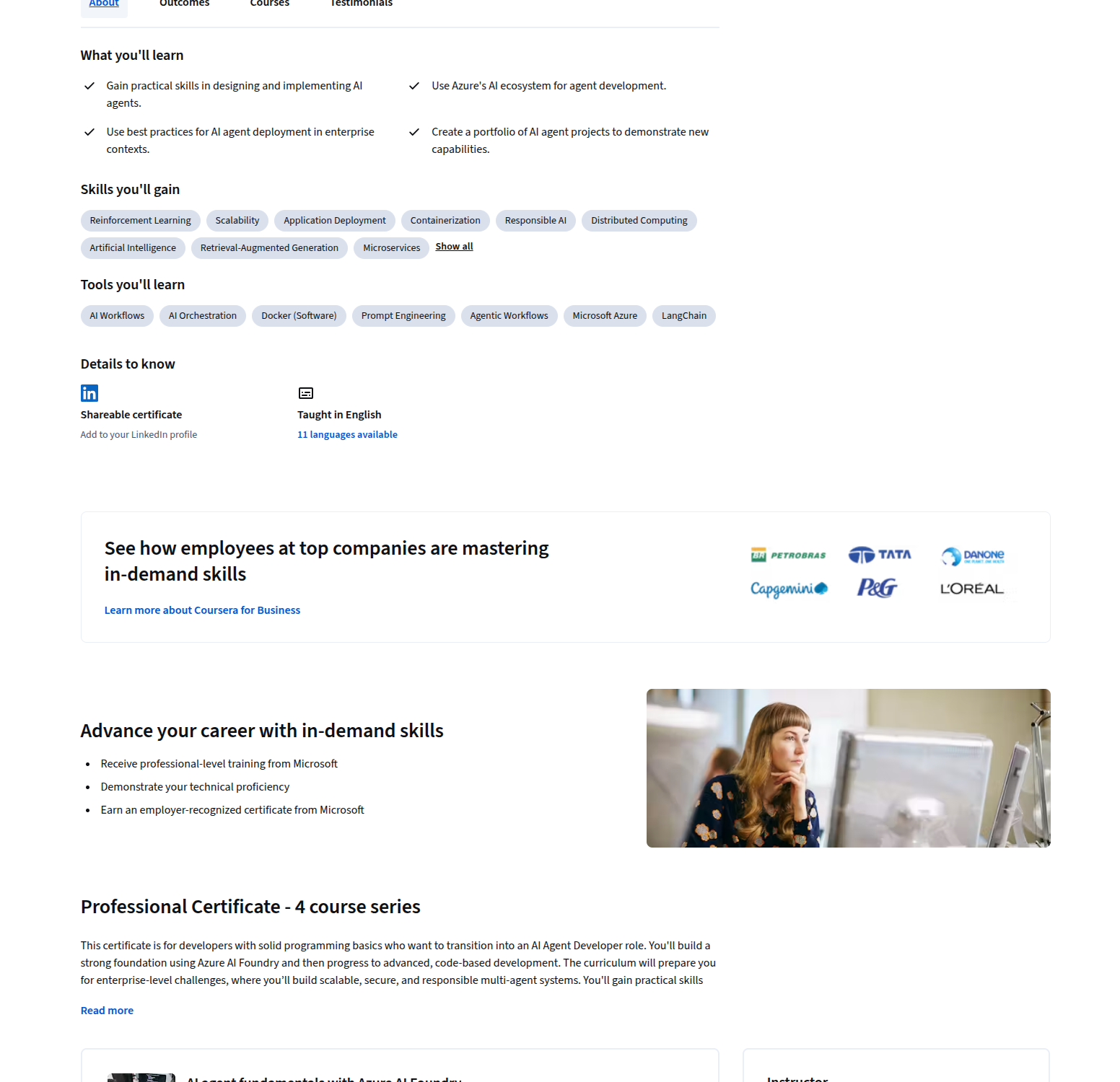
- design and implement AI agents
- use Azure’s AI ecosystem for agent development
- apply best practices for enterprise deployment
- produce portfolio projects you can point to later
That is a much better story for an IT professional than a generic “learn AI” badge.
Why this matters for desktop engineers and sysadmins
Desktop engineers and sysadmins are not being hired to train foundation models. They are being asked to do something more practical:
- automate support work
- build internal copilots and assistants
- connect AI tools to enterprise data and workflows
- deploy things safely
- understand the security, compliance, and scale implications
This certificate maps to that reality.
The learning outcomes are not theoretical. Microsoft says learners will:
- gain practical skills in designing and implementing AI agents
- use Azure’s AI ecosystem for agent development
- use best practices for AI agent deployment in enterprise contexts
- create a portfolio of AI agent projects to demonstrate new capabilities
That is exactly the kind of signal that can help an IT pro move from “I manage the tools” to “I can help shape the AI workflow that sits on top of them.”
For Microsoft-heavy environments, that matters because the next wave of work is not just Copilot adoption. It is also agent governance, workflow design, deployment control, and supportability.
The curriculum looks more hands-on than most AI credentials
The course series is where this certificate becomes interesting.
The four courses
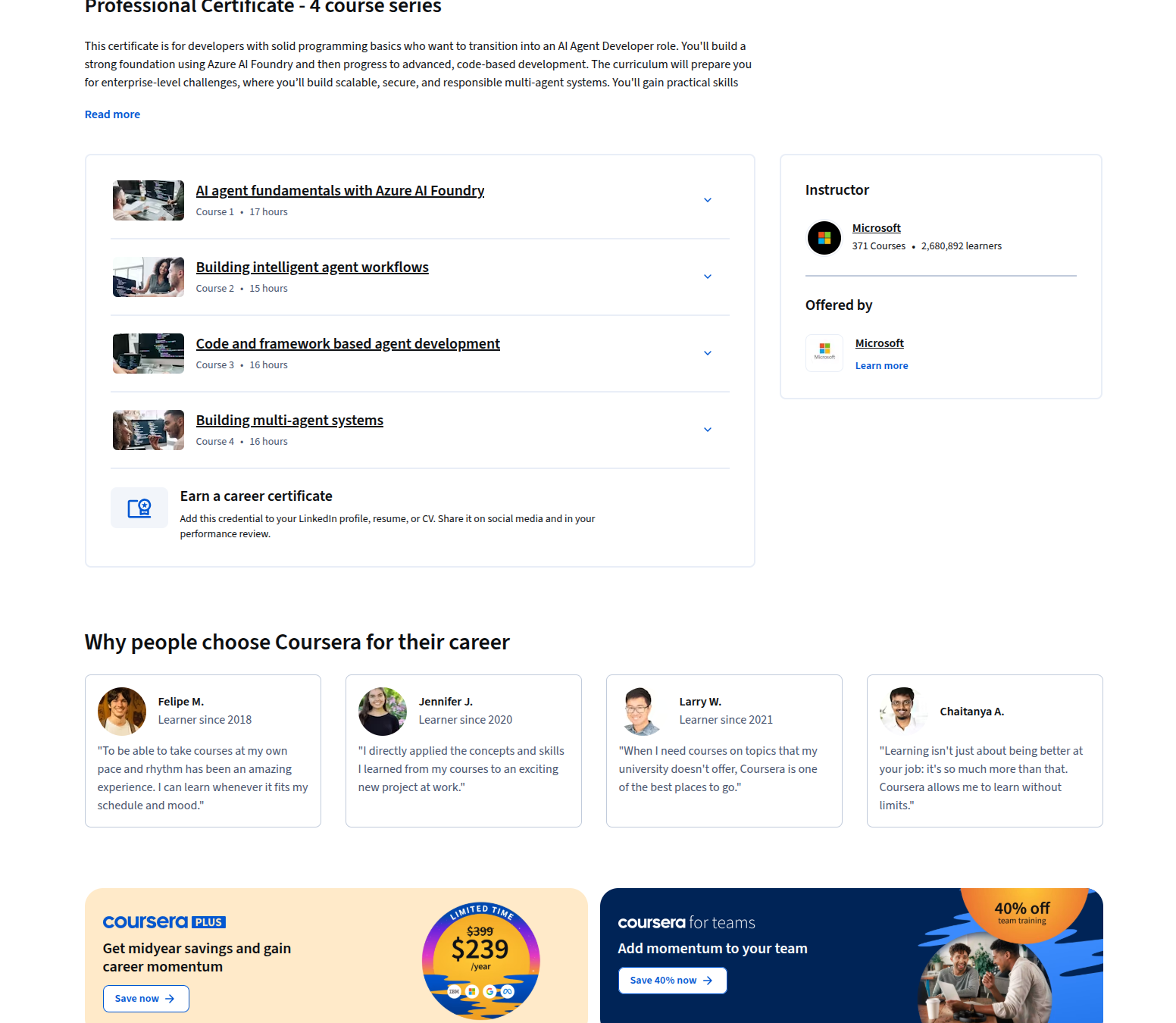
- AI agent fundamentals with Azure AI Foundry — 17 hours
- Building intelligent agent workflows — 15 hours
- Code and framework based agent development — 16 hours
- Building multi-agent systems — 16 hours
That is not a “watch a few videos and take a quiz” structure. It is a real path from foundation concepts to production-oriented agent work.
The course titles alone tell you a lot:
- Azure AI Foundry for the platform layer
- agent workflows for orchestration
- code and framework based agent development for implementation depth
- multi-agent systems for more advanced architecture
The listed tools and skills make the positioning even clearer:
- prompt engineering
- agentic workflows
- AI orchestration
- Docker
- LangChain
- Microsoft Azure
- retrieval-augmented generation
- containerization
- application deployment
- responsible AI
That is a much better fit for IT pros than a generic beginner AI certificate, because it starts to look like a real operations problem instead of just an abstract AI lesson.
The practical ROI for IT pros
Here is the simplest way to think about it:
- AWS Certified AI Practitioner is a better branding-first foundational exam if you want broad AI vocabulary and AWS alignment.
- Google Cloud Generative AI Leader is a better low-friction “I understand gen AI” signal.
- Coursera AI Mastery for Professionals is better if you want fast, vendor-neutral productivity skills.
- Microsoft AI Agents: From Foundations to Applications is better if you want to learn how to build and deploy agentic systems in the Microsoft ecosystem.
That last distinction matters.
Desktop engineers and sysadmins often get trapped in the middle of AI adoption. Business teams want AI outcomes. Security teams want guardrails. Engineering teams want integrations. Operations teams want something supportable. A credential like this is useful because it sits close to the actual implementation layer.
If your environment is already Microsoft-heavy, the certificate can support work around:
- internal help desk assistants
- knowledge-search agents
- agent-based automation for repetitive support tasks
- workflow tools built on Azure services
- proof-of-concept agent systems you can show in interviews or internal reviews
Where it sits versus Microsoft, AWS, Google Cloud, and Coursera alternatives
This is where the comparison gets useful.
| Credential | Type | Best for | Why it loses to Microsoft AI Agents |
|---|---|---|---|
| AWS Certified AI Practitioner | Foundational exam | Cloud-curious IT pros who want broad AI vocabulary | Better for brand signaling, but less hands-on agent-building depth |
| Google Cloud Generative AI Leader | Foundational exam | People who want the fastest low-friction AI credential | Great for literacy, but not a build path |
| Coursera AI Mastery for Professionals | Specialization | IT pros who want practical AI productivity skills quickly | Strong for prompt/workflow fluency, but less Microsoft- and deployment-specific |
| Microsoft AI Agents: From Foundations to Applications | Professional Certificate | Microsoft-first IT pros who want agent building, deployment, and portfolio projects | Best fit here because it is more technical and more implementation-oriented |
If you want the broadest, easiest credential to explain to a manager, Google Cloud Generative AI Leader is still hard to beat.
If you want the safest first paid AI exam for cloud-adjacent generalists, AWS Certified AI Practitioner is still a sensible option.
If you want the most immediately useful workflow credential and you do not care about vendor branding, Coursera AI Mastery for Professionals is probably a faster win.
But if your career direction includes Azure, Copilot-style workflows, agent orchestration, and enterprise deployment, Microsoft AI Agents is the most ambitious and arguably the most relevant of the group.
Who should take this certificate
Take it if you are one of these people:
- a desktop engineer who keeps getting AI automation requests
- a sysadmin who wants to move into platform engineering or AI operations
- a Microsoft 365 or Azure-heavy admin who needs more than theory
- an IT pro who wants portfolio evidence, not just a badge
- someone who wants a practical bridge into AI agent development
Who should skip it
Skip it if you are one of these people:
- you want the cheapest possible AI signal with minimal effort
- you are brand new to programming and cloud concepts
- you only need a classic exam-style certification name on your resume
- your job is still mostly on-prem support and you do not expect to touch Azure or agent tooling
In those cases, Google Cloud Generative AI Leader, AWS Certified AI Practitioner, or even a simpler Microsoft AI fundamentals path may be a better first move.
The bottom line
Microsoft AI Agents: From Foundations to Applications is one of the more interesting AI credentials for Microsoft-first IT pros because it aims at the part of AI that actually matters in real workplaces: building and operating useful agent systems.
It is not a beginner-lite badge. It is not a theory-heavy certificate. It is a real attempt to teach deployment-minded, enterprise-friendly agent work inside the Microsoft Azure ecosystem.
That makes it a good fit for desktop engineers and sysadmins who want to move beyond “AI awareness” and into practical AI implementation.
My verdict: if you want a Microsoft-branded, project-based, agent-focused credential that can support real internal automation work, this Coursera certificate is worth serious consideration.