Microsoft AI & ML Engineering Professional Certificate: Worth It for Desktop Engineers and SysAdmins?
Most AI credentials for IT professionals still miss the mark.
They are either too shallow, too academic, or too far away from the actual work desktop engineers and sysadmins do every day: deploying tools, managing workflows, handling data, and making sure new AI features do not break governance or supportability.
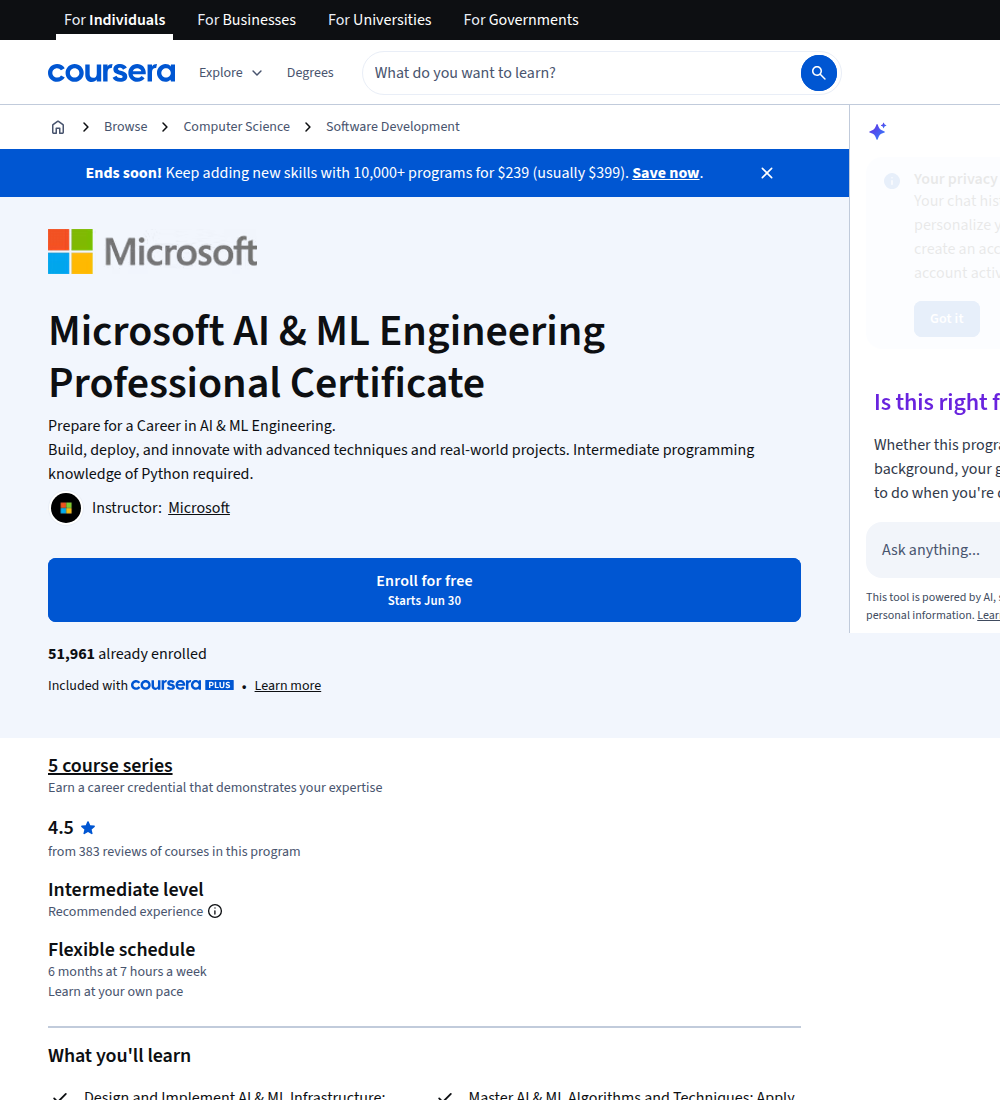
The Microsoft AI & ML Engineering Professional Certificate on Coursera is interesting because it sits closer to real implementation work than most beginner AI programs. It is not just about prompting a chatbot. It covers AI/ML infrastructure, model techniques, troubleshooting agents, Azure workflows, and a capstone project.
Quick verdict
| Category | Verdict |
|---|---|
| Best for | Microsoft-first IT pros who want a structured path into AI/ML engineering concepts |
| Provider | Microsoft on Coursera |
| Credential type | Professional Certificate |
| Format | 5-course series with hands-on projects |
| Duration | About 6 months at 7 hours per week |
| Difficulty | Intermediate |
| Practical ROI | High if you want Azure-aligned AI/ML skills and a real portfolio signal |
| Biggest risk | It is more technical than most desktop engineers expect |
| My recommendation | Strong for Microsoft-centric admins moving toward AI platform work; not the easiest first AI credential |
Official Coursera page: https://www.coursera.org/professional-certificates/microsoft-ai-and-ml-engineering
Why this certificate stood out after comparing Microsoft, AWS, Google Cloud, and Coursera
Before choosing this topic, I compared several practical AI paths that IT professionals are likely to consider:
- Microsoft AI & ML Engineering — a 5-course Coursera program aimed at AI/ML infrastructure, algorithms, agents, and Azure workflows.
- Microsoft Generative AI Engineering — a more prompt- and gen-AI-focused Microsoft certificate with a narrower scope.
- AWS Certified AI Practitioner — a foundational exam for people who understand AI/ML concepts but do not necessarily build them.
- Google Cloud Professional Machine Learning Engineer — a deeper Google Cloud exam for people already operating in production ML environments.
- Google AI Professional Certificate — a more beginner-friendly Coursera path for general AI literacy.
For desktop engineers and sysadmins, the Microsoft AI & ML Engineering program lands in a useful middle ground.
It is more substantial than a beginner AI literacy certificate, but it is still more approachable than a hard production cert like Google Cloud Professional ML Engineer or an implementation-heavy AWS role certification.
What Microsoft and Coursera say this program teaches
Coursera lists the program as a 5-course series with an intermediate level and a flexible schedule.
The page says you will learn to:
- design and implement AI & ML infrastructure
- master AI & ML algorithms and techniques
- develop intelligent troubleshooting agents
- leverage Microsoft Azure for AI & ML workflows
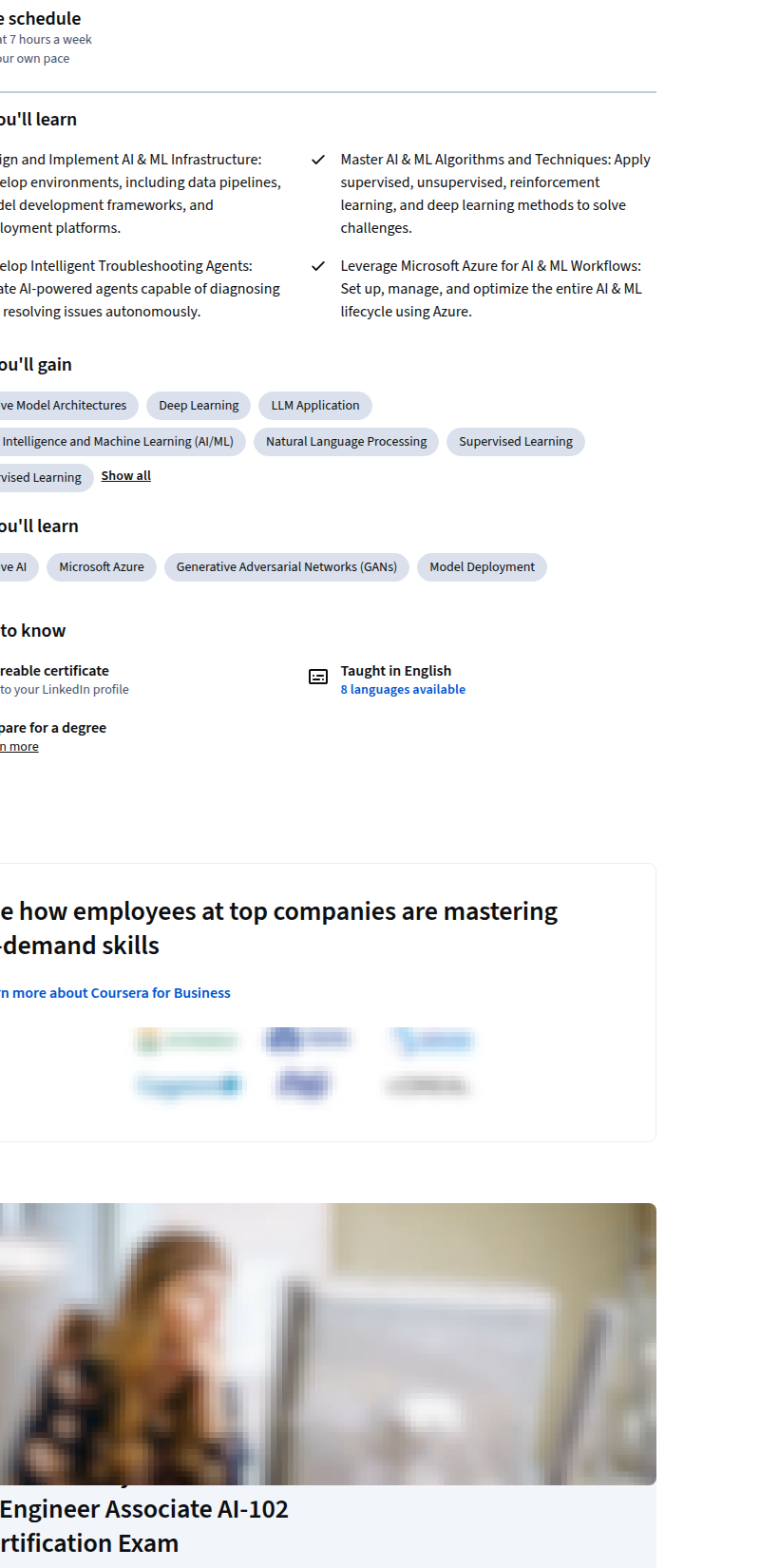
It also shows the skills and tools you will practice, including:
- Generative Model Architectures
- Deep Learning
- LLM Application
- Artificial Intelligence and Machine Learning (AI/ML)
- Natural Language Processing
- Supervised Learning
- Unsupervised Learning
- Microsoft Azure
- Generative AI
- Model Deployment
That mix matters. It is not just theory. It points toward actual engineering work: building environments, moving data, deploying models, and iterating on workflows.
The five-course breakdown
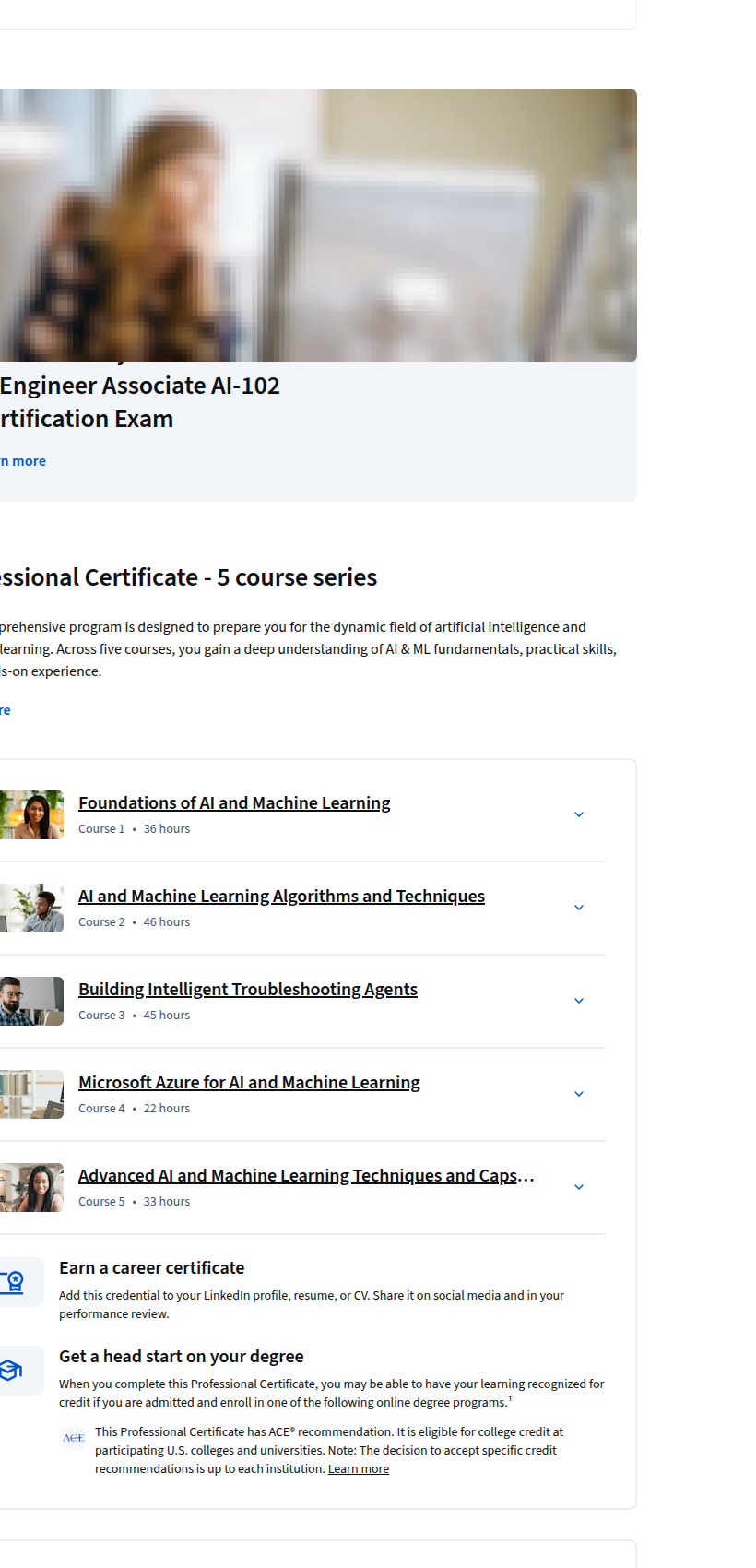
Coursera describes the program as a 5 course series.
The course titles are a good clue to the depth of the credential:
- Foundations of AI and Machine Learning — 36 hours
- AI and Machine Learning Algorithms and Techniques — 46 hours
- Building Intelligent Troubleshooting Agents — 45 hours
- Microsoft Azure for AI and Machine Learning — 22 hours
- Advanced AI and Machine Learning Techniques and Capstone — 33 hours
For IT pros, course 3 is the most interesting one on paper. “Building Intelligent Troubleshooting Agents” is the kind of phrasing that immediately maps to service desk automation, self-service support, incident triage, and internal tooling.
Why this is relevant to desktop engineers and sysadmins
This certificate is not built for endpoint management in the same direct way that an Intune or Purview credential is.
But it still matters to IT teams because the job is changing.
Desktop engineers and sysadmins increasingly get pulled into:
- AI-assisted support workflows
- internal knowledge assistants
- service desk automation
- ticket triage and summarization
- AI-backed documentation and runbooks
- Azure-based pilot projects
- governance conversations around what can and cannot be automated
This certificate gives you a structured way to talk about those things with more than buzzwords.
If your org is already:
- standardizing on Microsoft Azure
- experimenting with internal copilots or assistants
- building automation around support data
- exploring AI agents for diagnostics or routing
then this certificate has real value.
If your environment is still mostly classic endpoint management with no AI roadmap, the ROI drops.
Where it beats other practical AI credentials
Here is the short version of how this certificate compares to other options.
Versus AWS Certified AI Practitioner
AWS AI Practitioner is a solid foundational exam, but AWS says it is intended for people who are familiar with AI/ML concepts rather than people who build solutions with them. AWS also frames the target audience around business analysts, IT support, and managers.
That makes AWS AI Practitioner easier to justify as a first AI credential, but it is less hands-on than Microsoft AI & ML Engineering.
AWS details from the official page:
- Foundational level
- 90 minutes
- 65 questions
- $100 USD
- intended for people familiar with AI/ML technologies on AWS, not necessarily builders
Versus Google Cloud Professional Machine Learning Engineer
Google Cloud’s Professional Machine Learning Engineer certification is more production-oriented. Google says the role builds, evaluates, productionizes, and optimizes AI solutions using Google Cloud, and the exam expects serious hands-on Google Cloud experience.
That makes it excellent for platform engineers, but it is a much harder sell for a desktop engineer who is just getting started with AI engineering concepts.
Google Cloud details from the official page:
- 2 hours
- $200
- 50–60 multiple choice and multiple select questions
- 3+ years of industry experience recommended
- 1+ year designing and managing solutions using Google Cloud recommended
Versus Google AI Professional Certificate
Google AI Professional Certificate is easier to recommend to brand-new learners. It is a better entry point if you want broad AI literacy and a lower-friction start.
But the Microsoft AI & ML Engineering certificate is more technical and more Azure-aligned, so it offers a stronger signal if you want to move beyond “I understand AI” and into “I can help implement AI workflows.”
Versus Microsoft Generative AI Engineering
Microsoft Generative AI Engineering is narrower and more focused on modern gen-AI workflows, prompt engineering, orchestration, and Azure DevOps-style delivery.
Microsoft AI & ML Engineering is broader and better if you want an overall AI/ML engineering foundation instead of just a generative AI slice.
For desktop engineers and sysadmins, that broader base is often the better long-term bet.
What the practical ROI really looks like
This certificate has the best ROI when you treat it as a bridge, not as an endpoint.
It can help you:
- understand AI/ML project vocabulary when your org starts piloting tools
- work more confidently with Azure-based AI initiatives
- evaluate whether an internal assistant is supportable
- contribute to automation or troubleshooting-agent discussions
- build a more credible resume if you want to move from endpoint work into platform or AI-adjacent engineering
It will not magically turn a desktop engineer into a machine learning engineer.
That is a good thing. It means the credential is honest about the work it supports.
Who should take it
Take this certificate if you are:
- a Microsoft-first desktop engineer
- a sysadmin moving toward Azure or automation work
- an IT generalist who wants a real AI/ML foundation
- a support lead who expects AI-assisted workflows in the near future
- a technician who wants a stronger signal than a lightweight AI intro course
Skip it for now if you want:
- the quickest possible AI badge
- a non-technical overview only
- a pure endpoint-management credential
- a beginner-friendly course with almost no coding or infrastructure concepts
Final verdict
The Microsoft AI & ML Engineering Professional Certificate is one of the better AI certificate choices for Microsoft-heavy IT pros who want something more serious than AI literacy and less punishing than a production certification.
Its strengths are the ones that matter most for desktop engineers and sysadmins:
- Azure alignment
- hands-on structure
- troubleshooting-agent angle
- real engineering vocabulary
- a clear path from curiosity to practical AI work
If you are already living in the Microsoft stack and you want an AI credential that can actually help you join the conversation about internal copilots, AI workflows, and automation, this is a strong pick.
If you want the easiest first step into AI, start with a lighter credential first. If you want the strongest long-term bridge into AI engineering, this certificate is worth a serious look.