Microsoft Azure AI Fundamentals (AI-901): Is It Worth It for Desktop Engineers?
If you searched for AI-900, Microsoft has already moved the goalposts.
The Azure AI Fundamentals certification is now AI-901, and the retired AI-900 exam page explicitly says the old exam was retired on June 30, 2026 and replaced by AI-901. For desktop engineers and sysadmins, that matters because the credential is no longer just a generic AI literacy badge. Microsoft has shifted it toward AI solution concepts and Microsoft Foundry workflows.
That makes the cert more relevant than the old AI-900 version, but it still sits in a very specific lane: it is a foundational Microsoft AI certification, not a hands-on engineering badge and not a replacement for deeper Azure AI or Copilot build credentials.
Quick verdict
| Category | Verdict |
|---|---|
| Current exam | AI-901 |
| Retired exam | AI-900 |
| Provider | Microsoft Learn |
| Difficulty | Junior |
| Best for | Microsoft-heavy desktop engineers and sysadmins who want a recognizable baseline AI cert |
| Practical ROI | Moderate to high for AI literacy and vendor signal, lower for hands-on build proof |
| Biggest limitation | Still foundational; not enough on its own to prove implementation skill |
| Worth doing? | Yes, if you want Microsoft AI branding and a current baseline cert |
Official certification page: https://learn.microsoft.com/en-us/credentials/certifications/azure-ai-fundamentals/
Official exam page: https://learn.microsoft.com/en-us/credentials/certifications/exams/ai-901/
Why this cert matters in 2026
A lot of AI credentials fall into one of two traps:
- They are too abstract to help in real IT work.
- They are too broad to give you any clear career signal.
AI-901 is interesting because Microsoft has narrowed it to a practical business-technical baseline for AI work in Azure. The current exam page says candidates should know:
- AI workloads and considerations
- machine learning fundamentals on Azure
- computer vision workloads on Azure
- NLP workloads on Azure
- generative AI workloads on Azure
The updated exam page also shows the exam now includes a more solution-oriented angle, with assessed areas that mention Microsoft Foundry. That is a much better fit for modern desktop engineers and sysadmins who are already bumping into Copilot, internal support bots, and AI-assisted automation.
What changed from AI-900 to AI-901
This is the part that matters most if you are deciding whether the cert is worth your time.
The retired AI-900 page says the certification requirements changed and that AI-900 was retired on June 30, 2026. The replacement exam is AI-901.
That tells you two things:
- Microsoft is actively refreshing the credential instead of leaving it frozen as a legacy fundamentals badge.
- The credential is now closer to the current Microsoft AI stack than older blog posts or study guides may suggest.
So if you are comparing old writeups about AI-900 against what Microsoft actually ships now, be careful. The current cert is not identical to the old one.
What Microsoft expects you to know
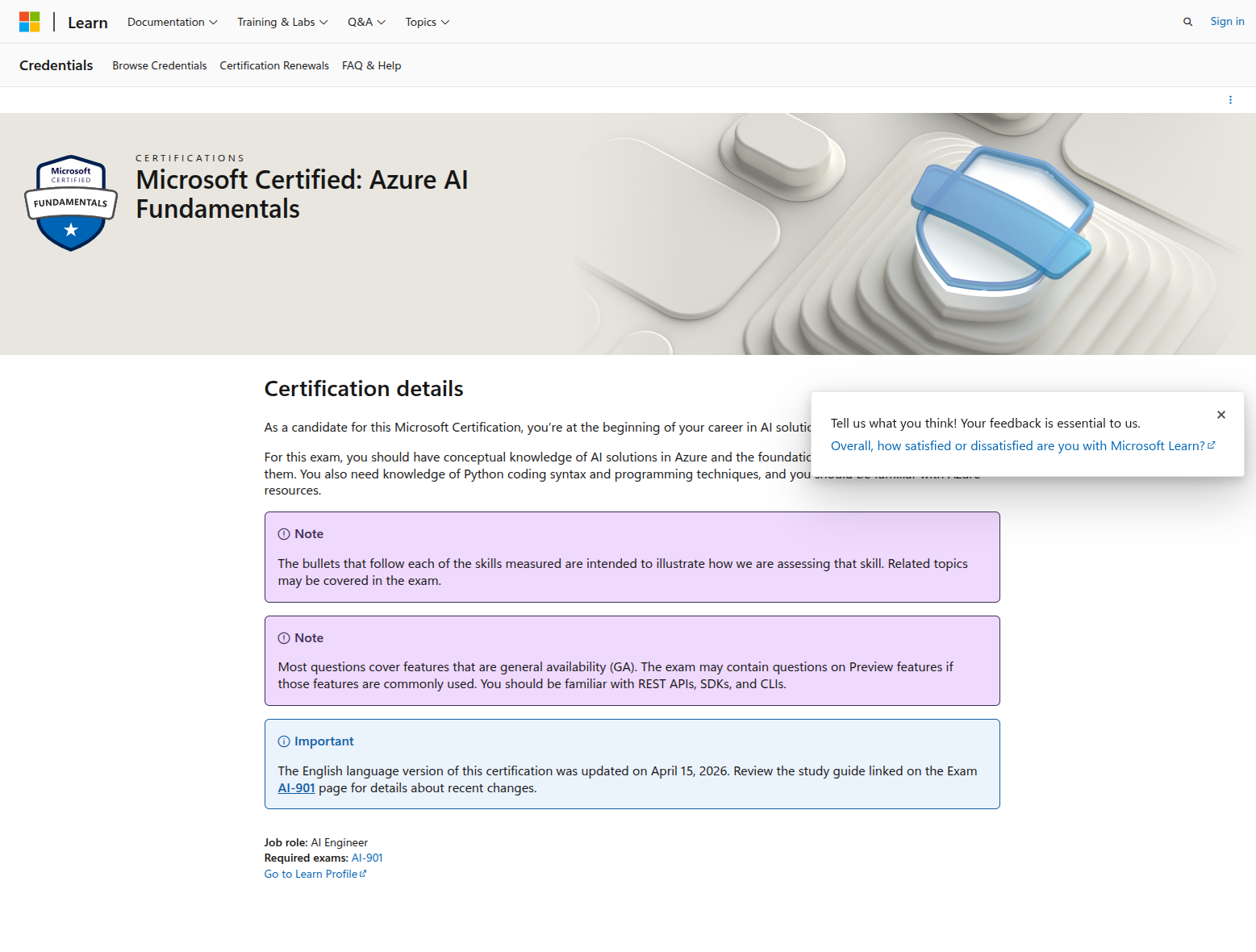
Microsoft frames the certification as suitable for people at the beginning of their AI solution-development journey.
The certification page says you should have:
- conceptual knowledge of AI solutions in Azure
- foundational technical skills to work with them
- knowledge of Python coding syntax and programming techniques
- familiarity with Azure resources
That is a good signal for desktop engineers because it lands in the middle ground between pure business literacy and full developer depth.
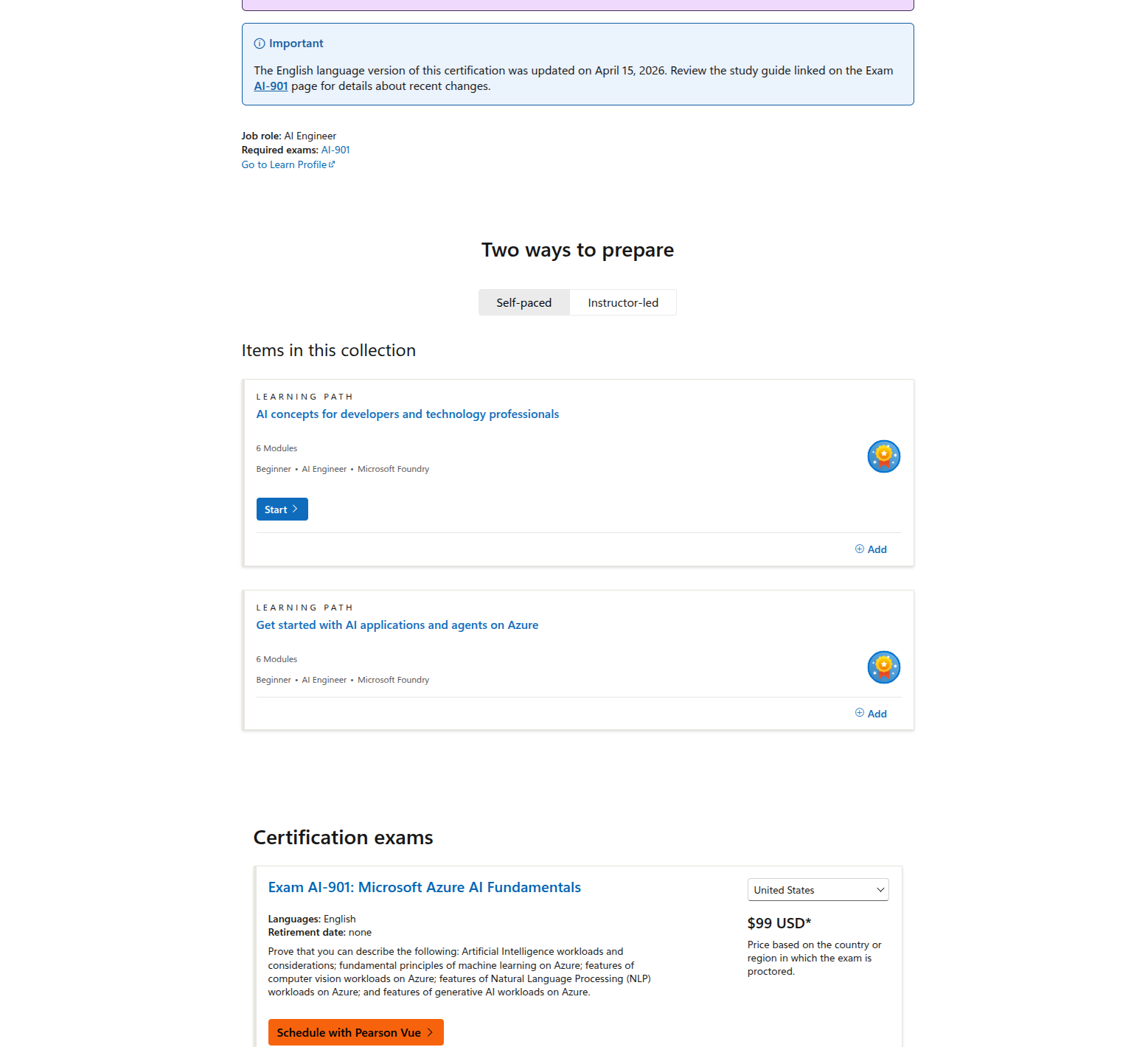
The current certification page also shows two self-paced learning paths:
- AI concepts for developers and technology professionals
- Get started with AI applications and agents on Azure
That is exactly the kind of prep path I want to see for an IT audience. It is not a full semester of theory, and it is not a one-page quiz badge. It is just enough structure to get you into the Microsoft AI vocabulary without making the credential feel like theater.
Why desktop engineers and sysadmins should care
Desktop engineers do not usually get hired because they know a little AI trivia.
They get hired because they can support users, standardize environments, reduce operational friction, and move tools from pilot to production safely.
That is where AI literacy starts to matter. In real environments, you are increasingly asked to judge things like:
- whether a Copilot-style feature is actually useful
- whether an AI workflow touches sensitive data
- whether a vendor’s “AI” pitch is real or just marketing
- whether support teams could benefit from a conversational assistant
- whether Azure-based AI features fit your identity, security, and compliance model
AI-901 helps with all of that at the vocabulary and architecture level.
It does not make you a builder by itself. But it does make you more credible in meetings where AI is part of the roadmap and you need to speak plainly about what is possible.
When it is worth it
AI-901 is worth it if you are one of these people:
- a Microsoft-heavy desktop engineer
- a sysadmin who already lives in Azure, Entra, Intune, or Microsoft 365
- an IT support lead who needs stronger AI vocabulary for internal projects
- a technician or endpoint engineer moving toward Azure-adjacent work
- someone who wants a recognizable Microsoft AI cert after completing more practical learning first
When it is not worth it
Skip or delay it if:
- you still need core PowerShell, Intune, or endpoint troubleshooting depth
- you want a lab-based credential that proves you can build, not just explain
- you work in a non-Microsoft environment and care more about cloud neutrality
- you expect an entry-level cert to replace real implementation experience
If that sounds like you, a hands-on Microsoft Applied Skills badge may give you more immediate ROI than AI-901.
AI-901 versus AWS Certified AI Practitioner
This is the most relevant cloud comparison for many IT pros.
AWS Certified AI Practitioner is also foundational, and AWS says it validates knowledge of AI, ML, and generative AI concepts and use cases. It is a good choice if your career is moving toward AWS or broader cloud operations.
But for desktop engineers who are already Microsoft-first, AI-901 is the cleaner fit.
Choose AI-901 if:
- your environment is mainly Microsoft
- you want stronger AI vocabulary for Azure and Microsoft 365 conversations
- you care about Microsoft branding more than AWS branding
Choose AWS Certified AI Practitioner if:
- your environment is mixed-cloud or AWS-heavy
- you want a broader cloud path later
- you care more about AWS credibility than Microsoft alignment
My short take: AWS AI Practitioner is a better cloud-broadening move, but AI-901 is the better Microsoft-native move.
AI-901 versus Google Cloud Generative AI Leader
Google Cloud’s Generative AI Leader is a useful comparison because it is clearly aimed at business-level knowledge rather than deep technical delivery.
Google says the credential is for anyone in any role, even without hands-on technical experience, and the exam focuses on:
- fundamentals of gen AI
- Google Cloud gen AI offerings
- techniques to improve model output
- business strategies for a successful gen AI solution
That makes it a very accessible certification. It is great if you want AI literacy and leadership language.
But if your day job is Microsoft-heavy endpoint work, AI-901 is a better ecosystem match.
Choose Google Cloud Generative AI Leader if:
- you want the easiest vendor AI credential to explain
- you care more about AI adoption language than technical Microsoft alignment
- you are not deeply tied to Azure
Choose AI-901 if:
- your world is Microsoft-first
- you want Azure AI vocabulary, not just generic gen AI language
- you want the cert to match what you already support every day
AI-901 versus Coursera AI programs
Coursera is a different category entirely, and that distinction matters.
Coursera programs like Google AI, IBM AI Developer, or Microsoft AI & ML Engineering are better when you want a learning pathway with more depth and portfolio-building potential. They are useful, but they usually take longer to complete and do not carry the same exam-style certification signal as Microsoft, AWS, or Google Cloud credentials.
That means Coursera is often better for:
- building actual understanding over time
- learning prompt patterns, RAG, agents, and AI workflows in context
- creating something you can talk about in interviews
But if your immediate goal is a recognizable Microsoft AI baseline for your résumé, AI-901 is the more direct signal.
How I would rank the options for desktop engineers
If I am being practical about ROI for desktop engineers and sysadmins, I would rank them like this:
- Microsoft Applied Skills if you want hands-on proof quickly
- AI-901 if you want a current Microsoft AI baseline cert
- AWS Certified AI Practitioner if you are cloud-broadening beyond Microsoft
- Google Cloud Generative AI Leader if you want the easiest low-friction AI signal
- Coursera AI programs if your main goal is learning depth and portfolio projects
That ranking is not about prestige. It is about fit.
My actual verdict
AI-901 is worth it for desktop engineers when you want one thing above all else: a current Microsoft AI credential that is easy for hiring managers to recognize and easy for your current team to understand.
It is not the most practical credential in the sense of hands-on build validation. It is not the deepest. It is not the fastest proof that you can ship a real AI solution.
But it is a solid baseline Microsoft AI signal, especially now that Microsoft has replaced AI-900 with AI-901 and nudged the exam closer to current Azure AI and Foundry workflows.
If you are Microsoft-heavy and you want to show that you are not ignoring the AI shift, this certification makes sense.
If you want pure engineering ROI, do a practical Applied Skills badge first, then come back to AI-901 for the brand signal.
FAQ
Is AI-900 still valid?
No. Microsoft says AI-900 was retired on June 30, 2026, and replaced by AI-901.
Is AI-901 hard?
Not really. It is a junior-level fundamentals cert, but it is still worth studying because Microsoft expects conceptual fluency, not just memorization.
Is AI-901 hands-on?
Less hands-on than an Applied Skills badge. It is more about understanding AI concepts, Azure AI services, and current Microsoft AI workflows.
Should I do AI-901 before AI-102?
Usually no. AI-901 is the better foundation. AI-102 is the deeper Azure AI engineering path.
Is this better than a Coursera certificate?
For certification signal, yes. For learning depth, often no.
Related reading on Zakitpro
- Microsoft Applied Skills: Build a Generative AI Chat App — Worth It for SysAdmins?
- AWS Certified AI Practitioner for IT pros: worth it or skip?
- Google Cloud Generative AI Leader: Worth It for Desktop Engineers and SysAdmins?
- Microsoft Generative AI Engineering Professional Certificate: Worth It for Desktop Engineers?