IBM Generative AI Engineering Professional Certificate: Worth It for Desktop Engineers and SysAdmins?
Most AI certifications still split into two extremes.
One side gives you lightweight AI literacy with almost no technical depth. The other side assumes you are already a machine learning engineer with time to spare, a math-heavy background, and a tolerance for certification paths that do not map cleanly to real IT work.
IBM Generative AI Engineering Professional Certificate is interesting because it lands in the middle.
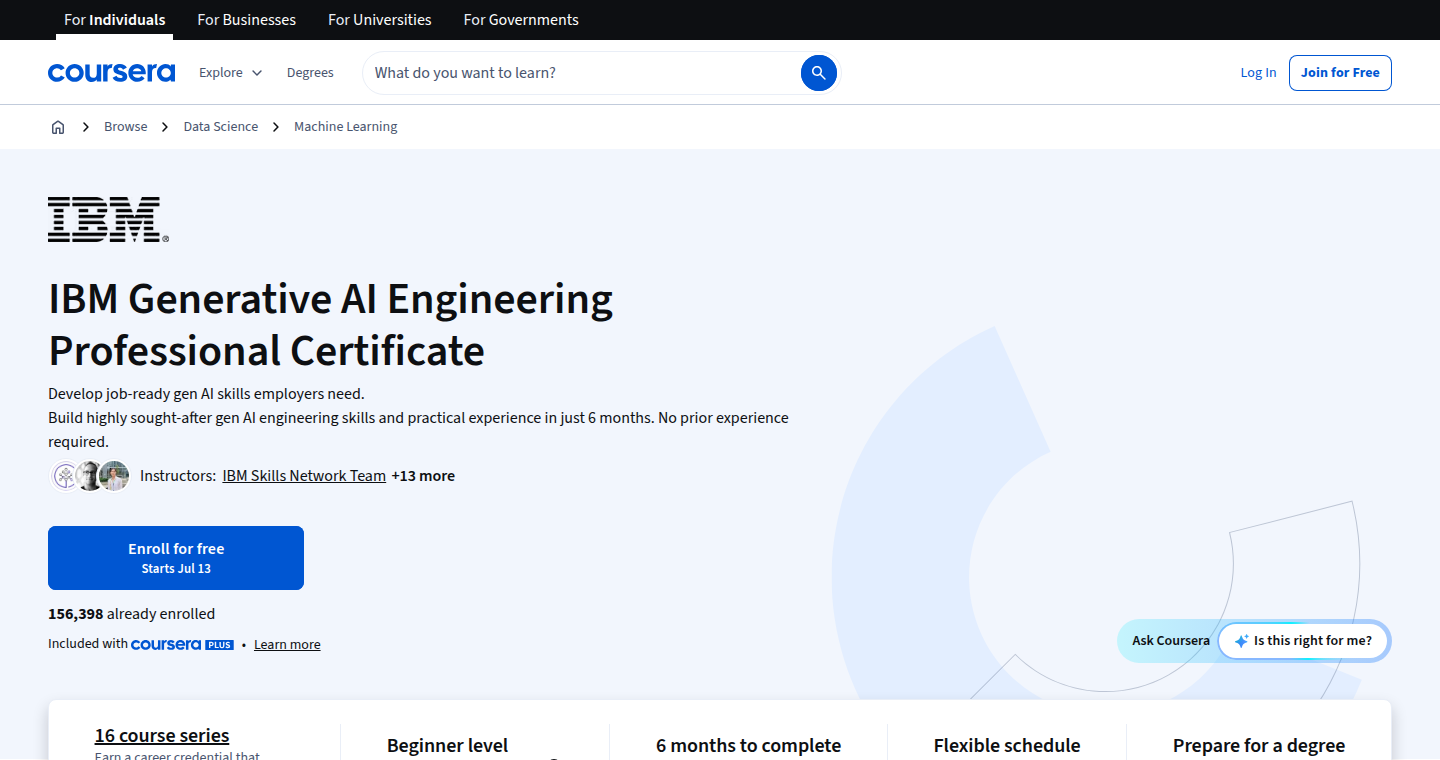
It is a Coursera Professional Certificate from IBM with a 16-course series, beginner level positioning, and a clear focus on prompt engineering, Python, machine learning, deep learning, RAG, LangChain, transformers, and LLM application building. For desktop engineers and sysadmins who want to move from “I use AI tools” to “I can build and explain AI workflows,” this is one of the stronger hands-on options.
Quick verdict
| Category | Verdict |
|---|---|
| Best for | IT pros who want a real hands-on gen AI credential without jumping straight into production ML certs |
| Worst for | People who want a quick AI badge with minimal time commitment |
| Format | Coursera Professional Certificate, 16-course series |
| Level | Beginner |
| Time estimate | 6 months at 6 hours a week |
| Social proof | 156,398 already enrolled |
| Practical ROI | High if you want Python, RAG, LangChain, and model-building credibility |
| Biggest limitation | Less directly tied to Microsoft, AWS, or Google Cloud operations than vendor-specific certs |
What IBM and Coursera are actually offering
Coursera’s current page is unusually concrete.
It shows:
- 16 course series
- Beginner level
- 6 months to complete at 6 hours a week
- Flexible schedule
- Shareable certificate
- English plus 19 languages available
- 156,398 already enrolled
- an ACE recommendation for eligible college credit
That matters because it tells you this is not just a vague “learn AI” badge.
It is a structured credential with enough depth to produce real portfolio output, but still approachable enough for an IT professional who is not trying to become a full-time data scientist.
What you actually learn
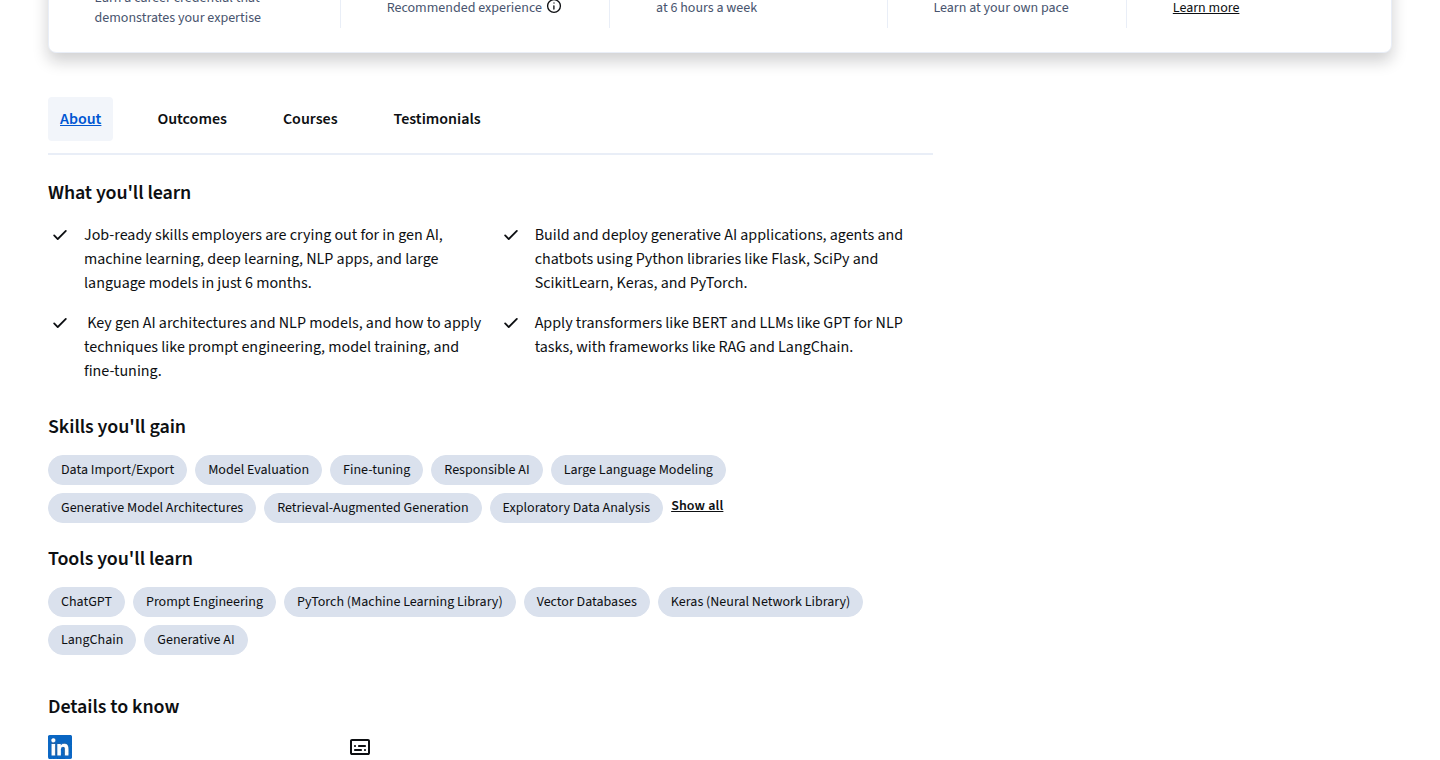
Coursera summarizes the program around four core outcomes:
- Build and deploy generative AI applications, agents, and chatbots using Python libraries like Flask, SciPy, scikit-learn, Keras, and PyTorch
- Learn key gen AI architectures and NLP models and apply prompt engineering, model training, and fine-tuning
- Apply transformers like BERT and LLMs like GPT for NLP tasks
- Use RAG and LangChain for practical application development
That is the right shape for a useful IT-focused AI credential.
It does not stop at “here is what a prompt is.” It moves into the parts that matter when you want to build internal tools or support AI-enabled workflows:
- data prep
- model evaluation
- fine-tuning
- vector databases
- retrieval-augmented generation
- responsible AI
- prompt engineering
- agent-style application design
The skills list reinforces that practical angle:
- Data Import/Export
- Model Evaluation
- Fine-tuning
- Responsible AI
- Large Language Modeling
- Generative Model Architectures
- Retrieval-Augmented Generation
- Exploratory Data Analysis
The tools list is even more relevant to sysadmins and desktop engineers who have been pushed into AI-adjacent work:
- ChatGPT
- Prompt Engineering
- PyTorch
- Vector Databases
- Keras
- LangChain
- Generative AI
Course structure: why the long series matters
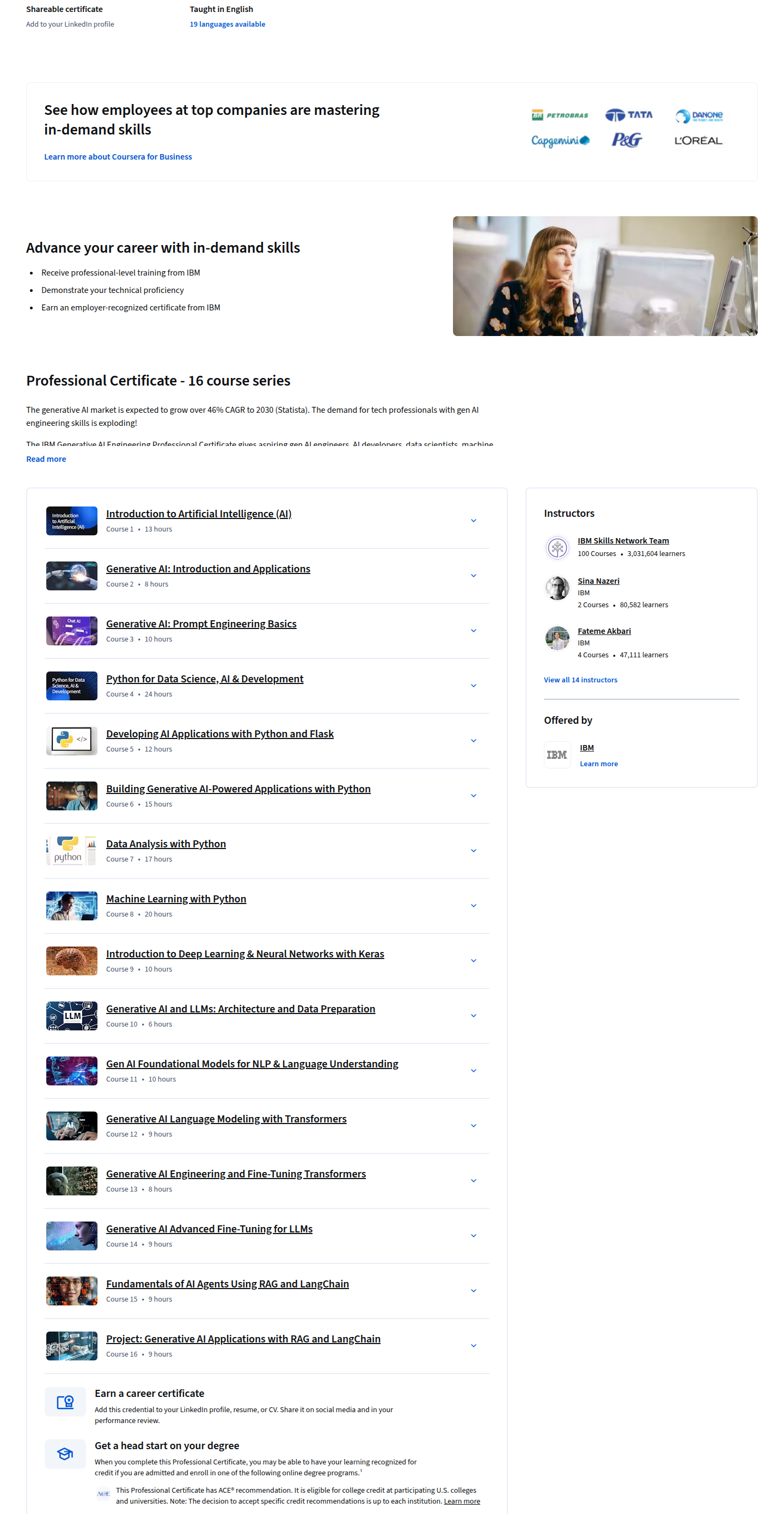
The certificate is a 16-course series, and that is the biggest clue that IBM is aiming for more than a surface-level credential.
The early courses build foundational language:
- Introduction to Artificial Intelligence
- Generative AI: Introduction and Applications
- Generative AI: Prompt Engineering Basics
- Python for Data Science, AI & Development
Then the program moves into the practical build side:
- Developing AI Applications with Python and Flask
- Building Generative AI-Powered Applications with Python
- Data Analysis with Python
- Machine Learning with Python
- Introduction to Deep Learning & Neural Networks with Keras
The later courses are where the certificate starts to feel especially useful for IT work:
- Generative AI and LLMs: Architecture and Data Preparation
- Gen AI Foundational Models for NLP & Language Understanding
- Generative AI Language Modeling with Transformers
- Generative AI Engineering and Fine-Tuning Transformers
- Generative AI Advanced Fine-Tuning for LLMs
- Fundamentals of AI Agents Using RAG and LangChain
- Project: Generative AI Applications with RAG and LangChain
That capstone matters. A lot of AI programs stop before the part where you actually wire the pieces together. This one ends with a real project centered on RAG and LangChain, which is exactly the kind of artifact you can talk about in interviews.
Why this is relevant to desktop engineers and sysadmins
If you are in endpoint support, desktop engineering, or sysadmin work, AI ROI usually shows up in a few places:
- internal knowledge assistants
- runbook generation
- ticket summarization
- log and incident analysis
- workflow automation
- support tooling that pulls from approved knowledge sources
- AI governance conversations with security and compliance teams
This certificate helps because it teaches enough of the mechanics to move beyond casual AI usage.
You are not just learning how to ask better questions. You are learning how to:
- structure a prompt pipeline
- use Python to build simple AI apps
- connect retrieval to an LLM
- understand why vector databases matter
- evaluate outputs instead of blindly trusting them
- explain what fine-tuning changes and when to avoid it
That is especially useful in Microsoft-heavy environments where support teams increasingly need to understand how external AI tooling, internal knowledge bases, and security boundaries interact.
How it compares with Microsoft, AWS, and Google Cloud
This is where the ROI question gets interesting.
Versus Microsoft AI & ML Engineering
Microsoft’s Coursera certificate is the better choice if your day job is firmly Azure-centered.
It is shorter, more Azure-specific, and better aligned with teams that already live in Microsoft 365, Intune, Entra ID, and Azure.
Pick Microsoft if:
- your employer is Azure-first
- you want an obvious Microsoft stack signal
- you care more about Azure workflows than broad Python-based AI building
Pick IBM if:
- you want a broader, platform-neutral build path
- you care about Python, RAG, LangChain, and LLM app design
- you want a longer portfolio-style program
Versus AWS Generative AI and AI Agents with Amazon Bedrock
AWS’s Coursera certificate is more AWS-native and more directly tied to Bedrock, Q Developer, and AWS agent workflows.
It is excellent if your role is moving toward cloud automation, platform engineering, or AWS implementation work.
Pick AWS if:
- you live in AWS already
- you want Bedrock and agent workflow familiarity
- you need a certificate that maps to cloud implementation work
Pick IBM if:
- you want broader gen AI foundations before specializing
- you care about coding and model workflow literacy
- you are still deciding which cloud stack will own your AI path
Versus Google Cloud Generative AI Leader
Google Cloud Generative AI Leader is the fastest and lowest-friction credential in this comparison.
It is great for AI literacy and executive-level understanding, but it is not the same kind of hands-on technical path.
Pick Google Cloud if:
- you want a low-friction AI credential
- you need something quick for resume signaling
- you do not want to code heavily
Pick IBM if:
- you want a real hands-on engineering track
- you care about build projects and Python work
- you want a stronger technical story than a foundation badge
My practical ranking for desktop engineers and sysadmins
If I rank the common paths by practical ROI for IT pros, it looks like this:
| Rank | Certification | Why it ranks there |
|---|---|---|
| 1 | IBM Generative AI Engineering Professional Certificate | Best balance of breadth, hands-on depth, and employer-friendly project evidence |
| 2 | Microsoft AI & ML Engineering Professional Certificate | Best if you are Azure/Microsoft-first |
| 3 | AWS Generative AI and AI Agents with Amazon Bedrock Professional Certificate | Best for AWS and platform engineering tracks |
| 4 | Google Cloud Generative AI Leader | Best quick credential, but lighter technically |
That ranking is not about brand value alone. It is about how much practical AI skill you can demonstrate afterward.
IBM wins here because it gives you:
- real build work
- Python exposure
- LLM concepts
- RAG and LangChain
- a capstone you can reference
Who should take it
Take this certificate if you are:
- a desktop engineer moving toward AI-assisted automation
- a sysadmin who wants to understand LLM workflows
- an IT support lead building internal knowledge tooling
- a Microsoft-first admin who wants broader AI literacy before specializing
- someone who wants a Coursera credential that is more than an intro badge
Who should skip it
Skip it if you are:
- looking for a fast exam-only credential
- only interested in Microsoft Copilot administration
- already deep into production ML engineering and want a more advanced cert
- not willing to invest the time for a 16-course program
If your goal is a quick credential, Google Cloud Generative AI Leader or AWS AI Practitioner may be a better fit.
If your goal is Azure-specific implementation, Microsoft’s certs are usually a tighter match.
Final verdict
IBM Generative AI Engineering Professional Certificate is worth it for desktop engineers and sysadmins who want real hands-on AI engineering skills.
It is not the lightest credential, and it is not the most cloud-specific one. But it is one of the most balanced options if you want practical exposure to Python, RAG, LangChain, fine-tuning, transformers, and capstone-based AI app building.
If your long-term path is moving from endpoint support into internal automation, AI tooling, or platform engineering, this is a strong Coursera certificate to add to your roadmap.
If you want the fastest possible AI badge, choose something lighter. If you want a credential that can actually support your next job move, IBM’s program is the better bet.