IBM AI Engineering Professional Certificate: Worth It for Desktop Engineers and SysAdmins?
Most AI certifications for IT pros fall into one of two buckets.
One bucket is too light: a badge that gives you vocabulary, but not much you can actually use at work. The other bucket is too deep: a build-heavy track that assumes you already live in Python notebooks and model training workflows.
IBM AI Engineering Professional Certificate sits much closer to the second bucket. That makes it interesting for desktop engineers and sysadmins who are being pulled toward AI-adjacent work, but it also means this is not the easiest first AI credential.
If you want a credential that helps you understand how AI systems are built, deployed, and extended with RAG and LangChain, this is one of the stronger Coursera options.
Quick verdict
| Category | Verdict |
|---|---|
| Best for | IT pros who want real hands-on AI engineering depth |
| Worst for | People who only need a quick AI literacy badge |
| Format | Coursera Professional Certificate, 13-course series |
| Level | Intermediate |
| Time estimate | About 4 months at 10 hours a week |
| Social proof | 4.6 stars from 22,104 reviews |
| Practical ROI | High if you want Python, ML, deep learning, and RAG credibility |
| Main weakness | Less directly tied to Microsoft, AWS, or Google Cloud operations than vendor-native certs |
Bottom line: IBM AI Engineering is worth it if you want to move from AI curiosity into actual AI engineering work. If you only need enough AI knowledge to survive vendor meetings, there are faster options.
What Coursera and IBM are actually offering
The current Coursera page is specific about what this program does.
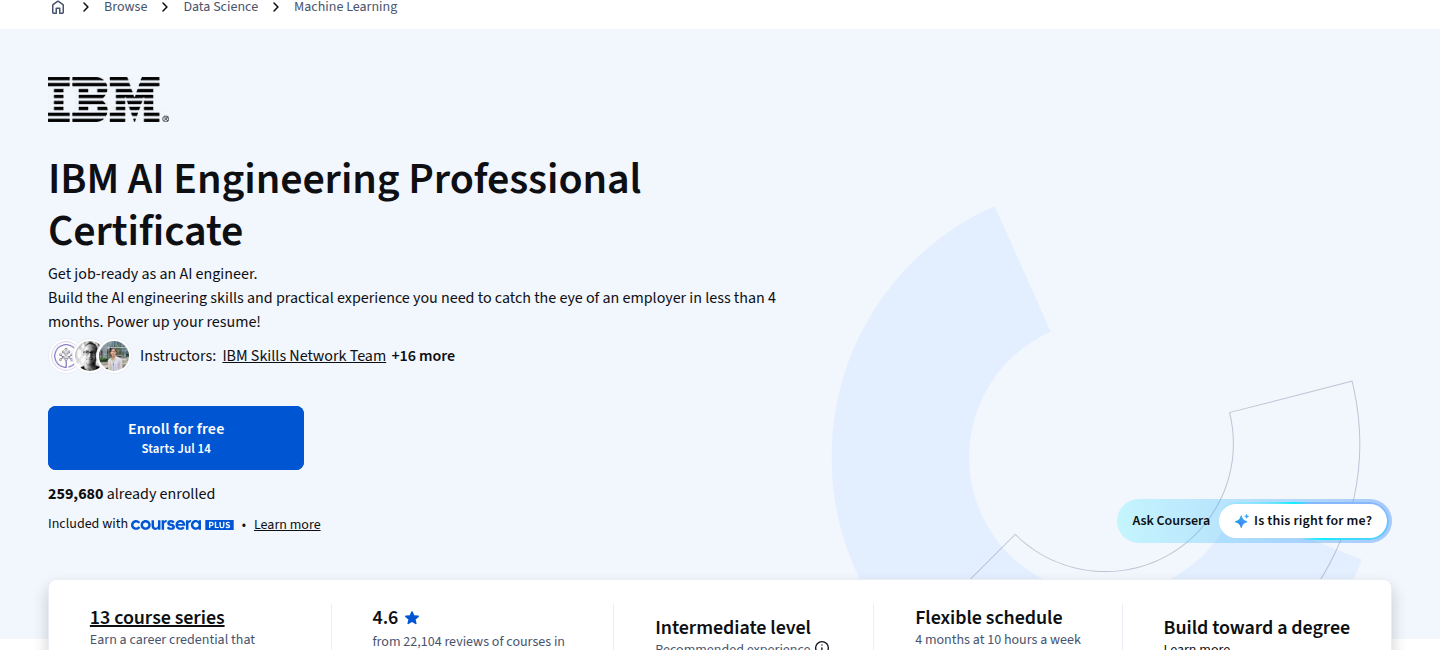
It is a Professional Certificate with a 13-course series, intermediate positioning, and a completion estimate of 4 months at 10 hours a week. Coursera also shows a 4.6 rating from 22,104 reviews of courses in this program.
That matters because this is not positioned like a casual “AI for everyone” badge. IBM is clearly aiming this at people who want to build job-ready engineering skills.
The page says the program is designed to help you:
- get job-ready as an AI engineer
- build, train, and deploy deep architectures
- work with convolutional neural networks, recurrent networks, autoencoders, and LLMs
- use Python, SciPy, ScikitLearn, Keras, PyTorch, and TensorFlow
- apply AI to object recognition, computer vision, image and video processing, text analytics, NLP, and recommender systems
- build generative AI applications using LLMs and RAG with Hugging Face and LangChain
- work through hands-on labs and projects
That is a strong mix for technical IT professionals who want practical AI exposure instead of slide-deck learning.
What you actually learn
This is where IBM AI Engineering starts to justify its time investment.
The program does not stop at prompt engineering or a basic overview of AI concepts. It goes into the mechanics of model building and application delivery.
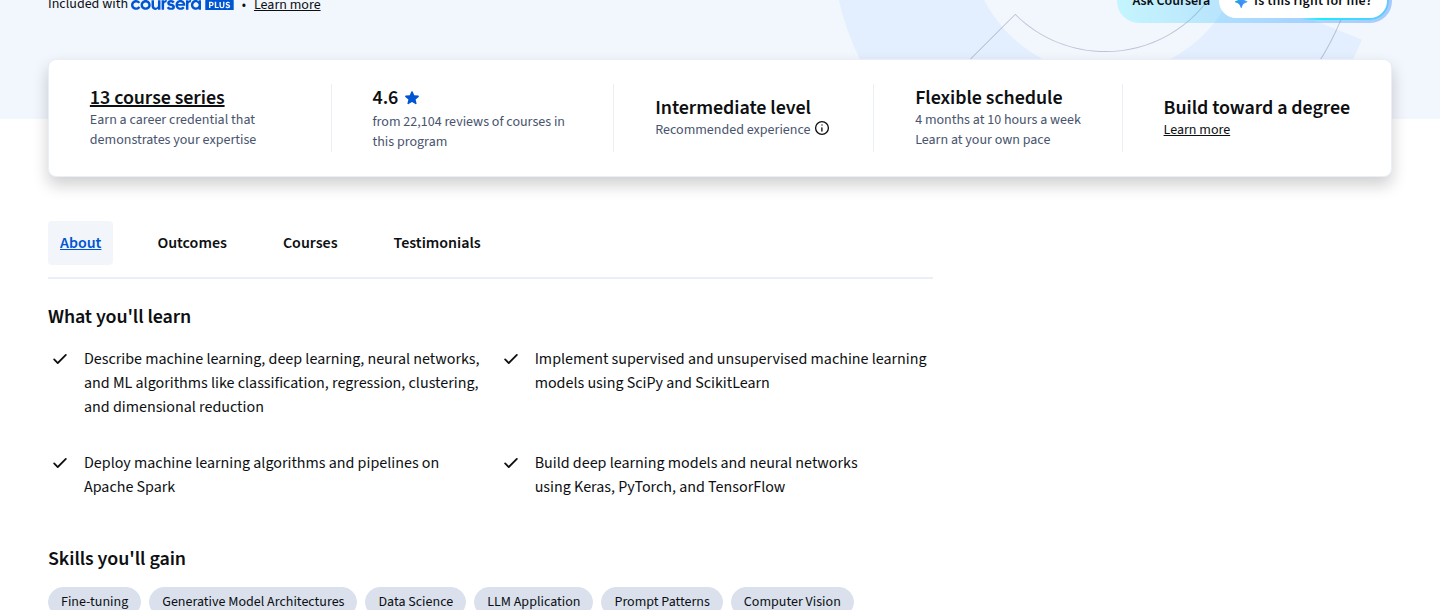
The learning outcomes shown on the page are especially relevant for IT pros who want to understand how AI systems behave in practice:
- describe machine learning, deep learning, neural networks, and ML algorithms like classification, regression, clustering, and dimensional reduction
- implement supervised and unsupervised machine learning models using SciPy and ScikitLearn
- deploy machine learning algorithms and pipelines on Apache Spark
- build deep learning models and neural networks using Keras, PyTorch, and TensorFlow
The skills and tools list adds even more practical signal:
- Fine-tuning
- Generative Model Architectures
- Data Science
- LLM Application
- Prompt Patterns
- Computer Vision
- Supervised Learning
- Machine Learning
- Retrieval-Augmented Generation
- Python Programming
- PySpark
- Keras
- Apache Spark
- Prompt Engineering
- Generative AI
- Vector Databases
- PyTorch
For a desktop engineer or sysadmin, that means the certificate is teaching you enough to talk intelligently about the AI stack, not just use it.
Why the course series matters
A lot of AI certificates are too short to feel coherent.
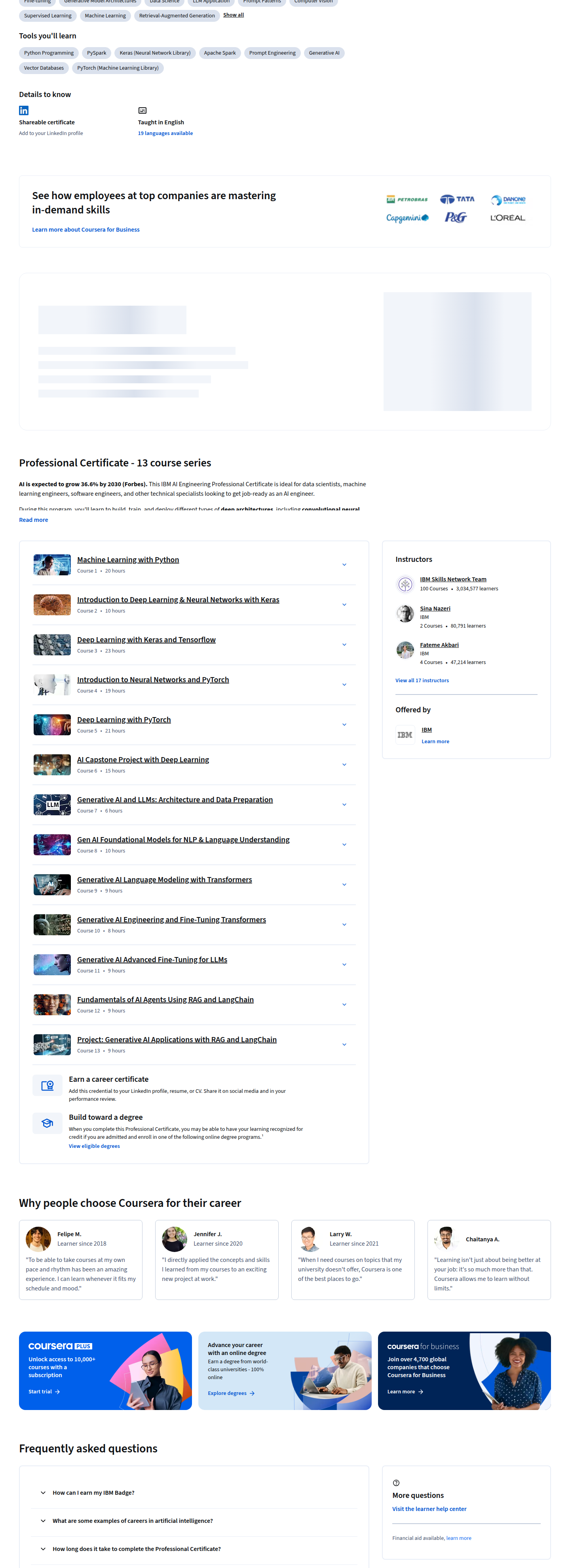
IBM AI Engineering is different because the 13-course sequence is arranged like a real progression:
- Machine Learning with Python — 20 hours
- Introduction to Deep Learning & Neural Networks with Keras — 10 hours
- Deep Learning with Keras and Tensorflow — 23 hours
- Introduction to Neural Networks and PyTorch — 19 hours
- Deep Learning with PyTorch — 21 hours
- AI Capstone Project with Deep Learning — 15 hours
- Generative AI and LLMs: Architecture and Data Preparation — 6 hours
- Gen AI Foundational Models for NLP & Language Understanding — 10 hours
- Generative AI Language Modeling with Transformers — 9 hours
- Generative AI Engineering and Fine-Tuning Transformers — 8 hours
- Generative AI Advanced Fine-Tuning for LLMs — 9 hours
- Fundamentals of AI Agents Using RAG and LangChain — 9 hours
- Project: Generative AI Applications with RAG and LangChain — 9 hours
That structure tells you something important:
- IBM starts with classical ML and deep learning foundations
- it moves into PyTorch, TensorFlow, and model training
- it ends with modern gen AI topics like RAG, LangChain, and AI agents
That is a much more serious path than a “prompting only” certificate.
The final project also matters. A lot of certs never give you a clean artifact to talk about in interviews. This one gives you a project centered on Generative AI Applications with RAG and LangChain, which is the kind of thing you can actually mention in a portfolio or job conversation.
Why this matters to desktop engineers and sysadmins
If you work in endpoint support, desktop engineering, or systems administration, AI ROI usually shows up in a few places:
- internal knowledge assistants
- helpdesk triage and summarization
- runbook generation
- incident and log analysis
- AI-enabled search across internal documents
- workflow automation that touches approved data sources
- governance discussions with security and compliance teams
This certificate is useful because it teaches enough of the underlying mechanics to make those conversations less abstract.
You are not just learning how to ask a model a better question. You are learning how to:
- structure AI workflows
- reason about model pipelines
- understand the difference between classical ML and generative AI
- work with RAG and vector databases
- explain where fine-tuning helps and where it is probably overkill
- evaluate whether an AI feature is actually feasible in your environment
That is valuable if you are the kind of IT pro who gets asked, “Can we automate this?” or “Can we add AI to this workflow?” and then has to help sort out the answer.
How it compares with Microsoft, AWS, and Google Cloud
If you are trying to decide where IBM AI Engineering fits, the best comparison is not “which certificate has the biggest brand name.” It is “which credential gives me the best return for the way I actually work.”
| Provider | Stronger option for IT pros | Why it may be better |
|---|---|---|
| Microsoft | AI-900 or an Applied Skills path | Faster payoff in Microsoft 365, Intune, Entra ID, and Azure-heavy environments |
| AWS | AWS Certified AI Practitioner | Good for AWS-first teams that need AI vocabulary and governance quickly |
| Google Cloud | Generative AI Leader | Best if you want a short, resume-friendly credential with light technical depth |
| IBM | AI Engineering Professional Certificate | Best if you want a hands-on build track with Python, ML, deep learning, and RAG |
Microsoft
If you live inside Microsoft 365, Intune, Entra ID, and Defender all day, Microsoft credentials usually produce faster work-relevance.
A Microsoft-focused path is often the better first move when your goal is to support Copilot, security workflows, or Azure-based AI services.
AWS
AWS Certified AI Practitioner is lighter than IBM AI Engineering, but that is the point. It gets you to AI vocabulary and cloud-service mapping quickly.
If your environment is AWS-first, that may be a better ROI than spending months on a broader engineering certificate.
Google Cloud
Google Cloud Generative AI Leader is the quickest of the major vendor options for most IT pros.
It is good for AI literacy and leadership conversations. It is not the best choice if you want deep build skills.
IBM
IBM AI Engineering wins when your priority is practical depth.
It is the strongest fit if you want to be able to explain, prototype, and support AI workflows instead of only talking about them.
Who should take it
Take IBM AI Engineering if you are:
- a desktop engineer or sysadmin moving toward AI platform work
- comfortable learning Python basics or already using Python lightly
- interested in machine learning, deep learning, and gen AI together
- trying to build portfolio evidence, not just a badge
- working toward internal AI tooling, RAG, or automation projects
Who should skip it
Skip it if you are:
- looking for the fastest possible AI credential
- only trying to get conversational AI literacy for meetings
- in a Microsoft shop and need something that maps directly to M365 or Azure operations
- not ready to spend real time on Python, ML, and model concepts
If that sounds like you, Microsoft AI-900, an Applied Skills badge, or Google Cloud Generative AI Leader will probably give you better immediate ROI.
Final recommendation
IBM AI Engineering Professional Certificate is a strong certificate, but it is not a casual one.
For desktop engineers and sysadmins, I would rank it like this:
- Best if you want real AI engineering depth
- Best if you want a Coursera credential that can lead to portfolio work
- Best if you want to understand modern gen AI beyond prompting
- Not best if you just need a quick AI checkbox for your résumé
If your goal is to become the person who can help plan or support AI tooling in the enterprise, this is a serious and credible path.
If your goal is just to add a line to LinkedIn, it is probably more effort than you need.
Related reading
- Best AI certifications for IT professionals in 2026
- AWS Certified AI Practitioner: Worth It for IT Pros?
- Google Cloud Generative AI Leader: Worth It for Desktop Engineers and SysAdmins?
- Microsoft AI & ML Engineering Professional Certificate: Worth It for Desktop Engineers?
Published July 14, 2026 · researched from the current Coursera program page and cross-checked against Microsoft, AWS, and Google Cloud options for IT-pro ROI.