IBM RAG and Agentic AI Professional Certificate: Worth It for Desktop Engineers and SysAdmins?
If you manage Windows endpoints, support Microsoft 365, or spend your days turning messy IT work into repeatable automation, most AI credentials still fall into one of two traps: they are either too abstract to help you ship anything, or too theory-heavy to matter in an operations role.
The IBM RAG and Agentic AI Professional Certificate on Coursera is different. It is a build-heavy, advanced program focused on retrieval-augmented generation (RAG), vector databases, agentic workflows, tool calling, MCP, and multimodal AI. That makes it one of the most relevant Coursera AI certificates for IT pros who want to understand how modern AI assistants actually work under the hood.
Quick verdict
| Category | Verdict |
|---|---|
| Best for | Desktop engineers, sysadmins, and IT pros who want practical RAG and agent-building skills |
| Provider | IBM on Coursera |
| Format | 10-course Professional Certificate |
| Level | Advanced |
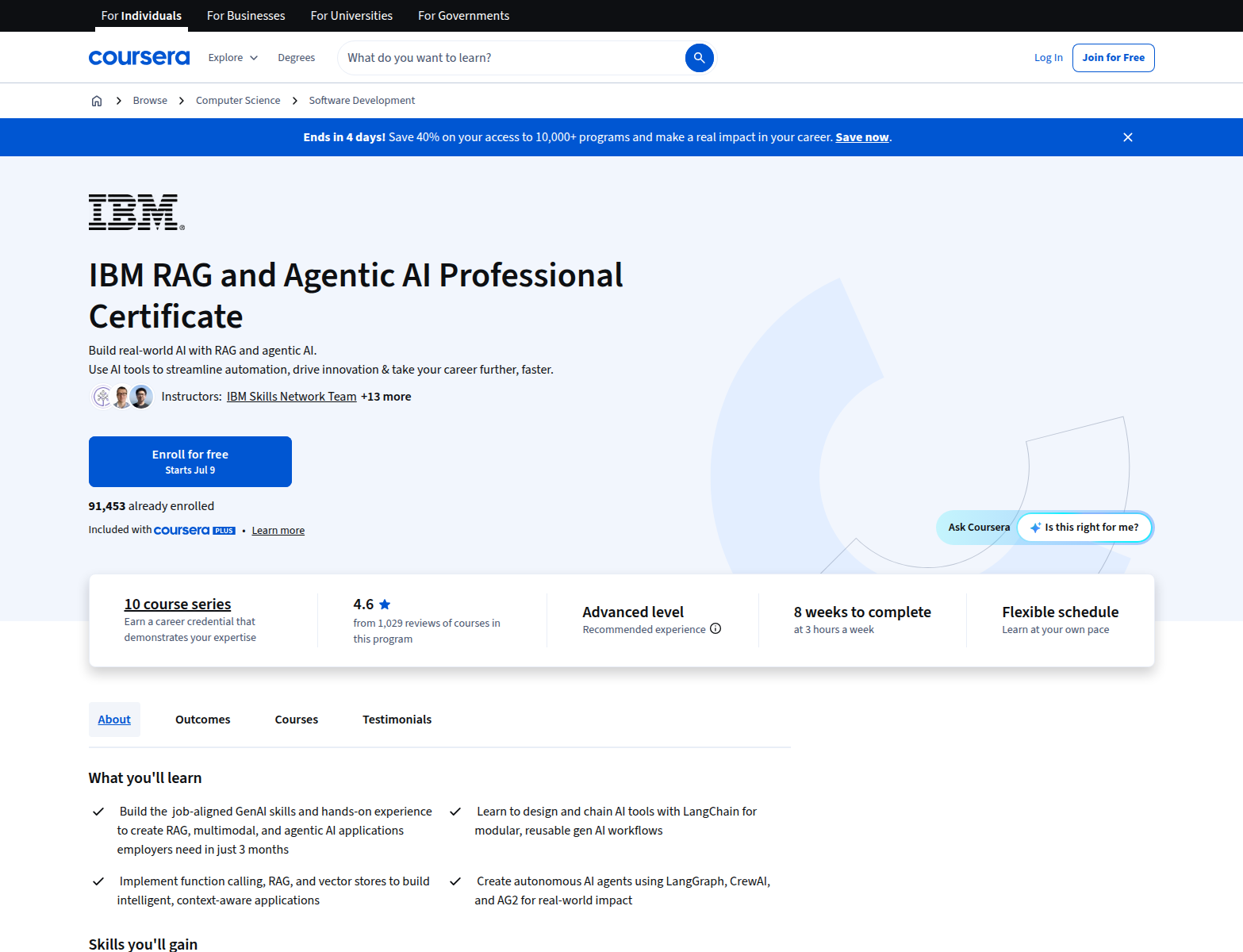
| Time estimate | Coursera lists 8 weeks at 3 hours a week |
| Total course content | About 101 hours across 10 courses |
| Practical ROI | High if you want to build or evaluate internal AI assistants, ticketing helpers, and knowledge workflows |
| Biggest risk | It is still a learning certificate, not a vendor exam badge with the same HR signal as Microsoft, AWS, or Google Cloud exams |
| My recommendation | Strong buy if you want hands-on AI engineering, especially RAG + agentic workflows |
Official page: https://www.coursera.org/professional-certificates/ibm-rag-and-agentic-ai
Why this certificate stands out for IT pros
For this article I compared the IBM certificate against the most relevant AI paths for IT professionals:
- Microsoft: Microsoft’s AI-102 and Applied Skills paths are better if you want Azure-specific credibility or lab-style credentialing. Microsoft AI & ML Engineering on Coursera is also strong, but it is more general-purpose than this IBM program.
- AWS: AWS Certified AI Practitioner is a lower-friction exam with strong brand recognition, but it is much less hands-on than a build-heavy certificate.
- Google Cloud: Google Cloud Generative AI Leader is the easiest way to get a real AI credential fast, but it is more of a strategy/literacy signal than a technical build path.
- Coursera alternatives: IBM AI Developer and Google AI are better on-ramp programs if you are still learning the basics. This IBM certificate is the more advanced sibling.
That is why IBM RAG and Agentic AI matters: it sits in a useful middle lane between “AI literacy” and “I can actually build and connect enterprise AI workflows.”
What IBM and Coursera are actually offering
Coursera’s listing is unusually concrete. IBM is not selling you a vague “AI awareness” badge. The program description says you will learn how to build RAG applications, multimodal AI applications, and autonomous multi-agent systems.
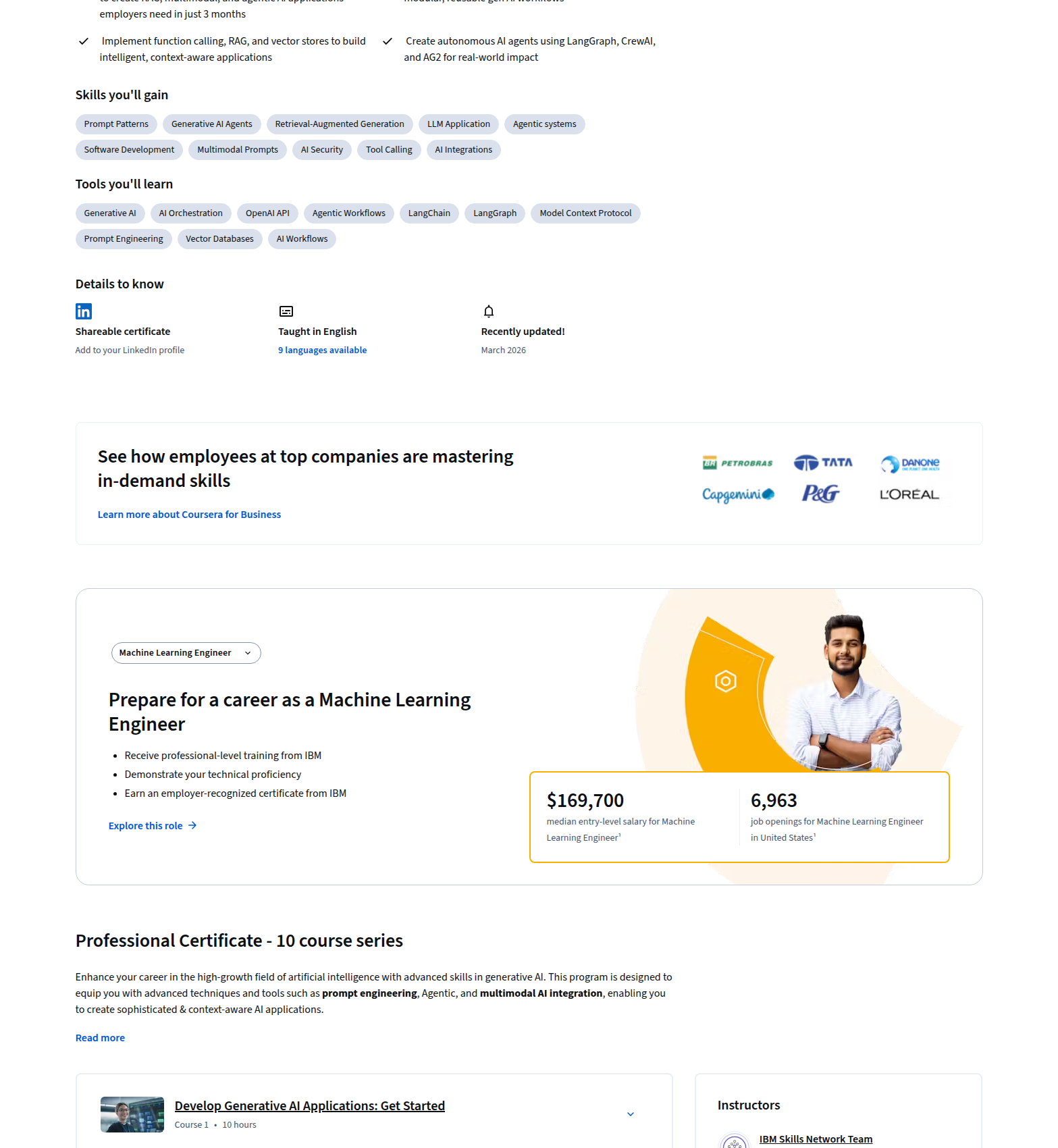
The page also calls out the main tooling stack:
- LangChain
- LangGraph
- CrewAI
- AG2
- BeeAI
- Model Context Protocol (MCP)
- OpenAI API
- vector databases
That is exactly the kind of stack IT teams are starting to see inside modern AI copilots, automation tools, and internal knowledge assistants.
The highest-value skills listed on the page are:
- Prompt Patterns
- Generative AI Agents
- Retrieval-Augmented Generation
- LLM Application
- Agentic systems
- Software Development
- Multimodal Prompts
- AI Security
- Tool Calling
- AI Integrations
For a desktop engineer, those map to practical tasks like:
- building a support assistant that answers from internal docs
- chaining AI calls with ticketing or scripting tools
- connecting model output to real enterprise data
- adding guardrails so AI does not hallucinate on critical workflows
The 10-course series is the real reason to care
The certificate is a 10-course series, and that matters because it does not pretend you can jump straight into autonomous agents without understanding the building blocks.
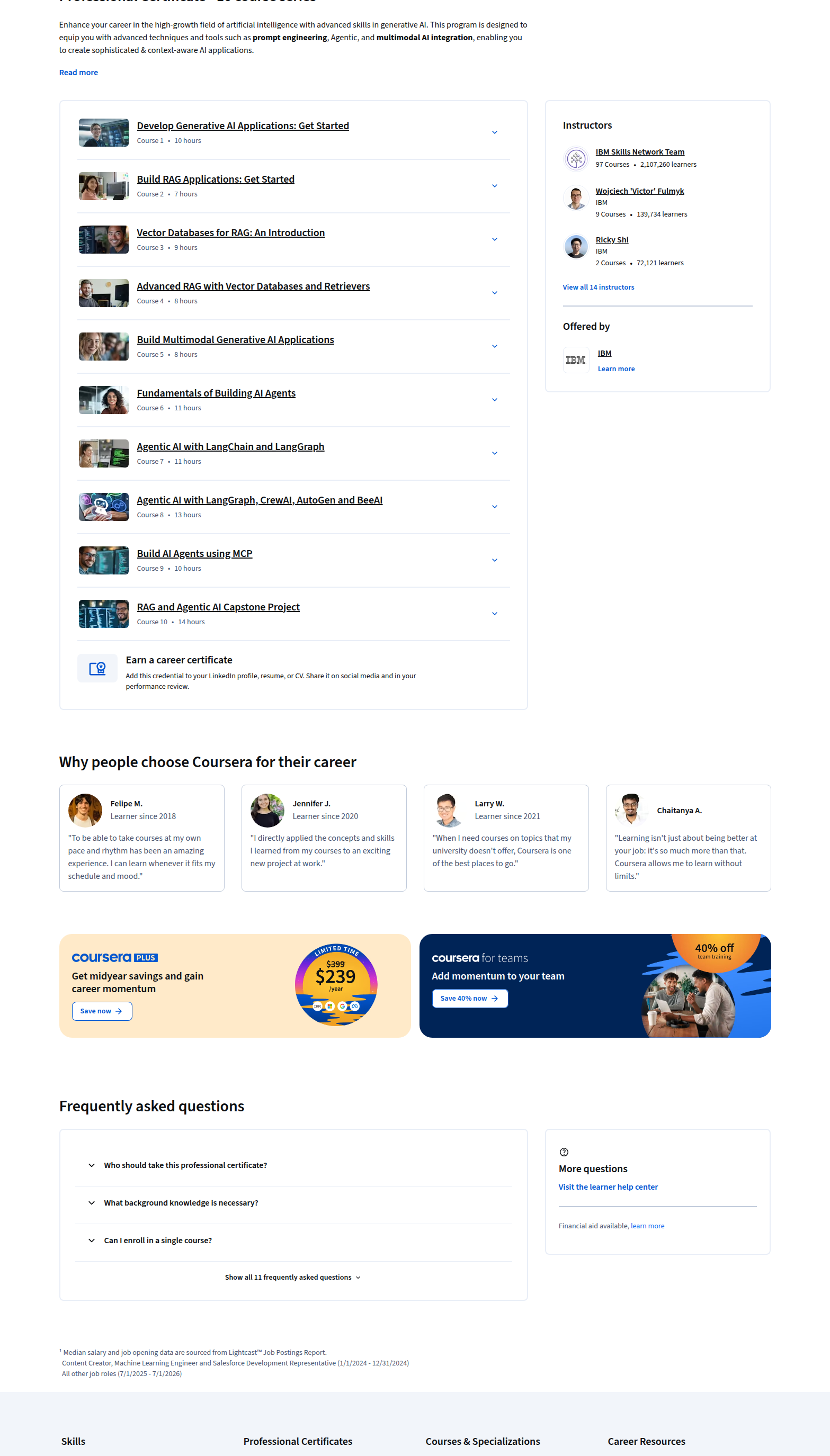
The course sequence is:
- Develop Generative AI Applications: Get Started — 10 hours
- Build RAG Applications: Get Started — 7 hours
- Vector Databases for RAG: An Introduction — 9 hours
- Advanced RAG with Vector Databases and Retrievers — 8 hours
- Build Multimodal Generative AI Applications — 8 hours
- Fundamentals of Building AI Agents — 11 hours
- Agentic AI with LangChain and LangGraph — 11 hours
- Agentic AI with LangGraph, CrewAI, AutoGen and BeeAI — 13 hours
- Build AI Agents using MCP — 10 hours
- RAG and Agentic AI Capstone Project — 14 hours
That progression is smart. It starts with basic application building, moves into RAG and vector retrieval, then expands into agents and MCP.
For IT pros, that sequence is useful because it mirrors how real enterprise AI projects evolve:
- first, make the model answer from the right data
- then, connect it to tools
- then, add workflow logic and agent orchestration
- finally, package the result into something an internal team can actually use
What the certificate teaches that matters in real IT work
1) RAG before agents
A lot of AI hype jumps straight to agents. This program spends real time on RAG first, which is the right order for enterprise IT.
RAG is what you use when you want an AI tool to answer from:
- SharePoint or document libraries
- internal KBs
- troubleshooting notes
- service desk articles
- change-management records
If you work in support, RAG is often the difference between a useful assistant and a confident but wrong chatbot.
2) Vector databases and retrieval logic
Desktop engineers and sysadmins do not need to become database architects, but they do need to know enough about retrieval to judge whether an internal AI tool is trustworthy.
This certificate teaches the practical concepts behind:
- chunking
- embeddings
- similarity search
- retrievers
- vector stores
That is valuable if you are evaluating a vendor AI tool or building one internally.
3) Agents, tool calling, and MCP
The most interesting part of the certificate is the agent stack.
The course list includes LangChain, LangGraph, CrewAI, AutoGen, BeeAI, and MCP. That combination is highly relevant in 2026 because the industry is clearly moving from “chat” to “tool-using assistants.”
That means the certificate is not just about prompt writing. It is about:
- orchestrating steps
- calling external tools
- passing context safely
- using APIs to complete tasks
- controlling what an AI agent can do
For IT teams, that is where the real ROI lives.
4) Multimodal AI and operational workflows
The certificate also covers multimodal AI, which matters if you deal with screenshots, logs, images, or mixed-format support data.
That is especially relevant for endpoint support because a lot of useful troubleshooting context is not plain text.
Practical ROI for desktop engineers and sysadmins
This is where the certificate earns its keep.
Good use cases
If you work in IT operations, this certificate can help you build or support tools that:
- answer common service-desk questions from internal documentation
- summarize incident notes and change records
- triage support requests by pulling from knowledge sources
- connect AI assistants to PowerShell, scripts, or APIs through controlled tools
- add AI capabilities without handing the model direct access to everything
Why it beats a generic AI literacy cert
A basic AI course teaches you terminology.
This certificate teaches you the architecture behind the kind of AI tools businesses are actually trying to deploy.
That makes it more useful if your job is moving toward:
- endpoint automation
- internal support tooling
- knowledge management
- low-code/no-code AI workflows
- AI governance and safe tool usage
The main limitation
It is still a learning certificate.
That means it is strongest as a skills signal and a portfolio-builder, not as a direct substitute for a vendor exam like AI-102, AI Practitioner, or Google Cloud Generative AI Leader.
How it compares with Microsoft, AWS, Google Cloud, and other Coursera options
Versus Microsoft AI & ML Engineering on Coursera
Microsoft AI & ML Engineering is better if you want an Azure-aligned path with stronger Microsoft branding.
IBM RAG and Agentic AI is better if you specifically want:
- more agent orchestration
- MCP exposure
- broader framework coverage
- a heavier focus on RAG and retrieval
If you live in the Microsoft ecosystem all day, Microsoft’s course probably feels more natural. If you want the most modern agent stack, IBM has the edge.
Versus AWS Generative AI and AI Agents with Amazon Bedrock
AWS’s Coursera certificate is shorter and more AWS-specific.
IBM’s program is better if you want:
- deeper coverage of the agent/tooling landscape
- more hands-on framework exposure
- a longer build path with stronger capstone momentum
AWS wins on cloud-brand relevance for AWS shops. IBM wins on breadth of the agentic AI stack.
Versus Google Cloud Generative AI Leader
Google Cloud Generative AI Leader is the better “get a credential fast” option.
IBM RAG and Agentic AI is the better “learn how to build” option.
So if you need a quick AI signal for your resume, Google Cloud is easier to justify. If you want actual technical skill growth, IBM is more valuable.
Versus Google AI Professional Certificate
Google AI is the easier on-ramp for beginners.
IBM RAG and Agentic AI is what you take when you already know you want to work with:
- RAG
- agents
- vector databases
- tool calling
- MCP
In other words: Google AI is a starter path; IBM RAG and Agentic AI is a builder path.
Versus IBM AI Developer
IBM AI Developer is the better first Coursera choice if you are still building your Python, app, and prompt foundation.
IBM RAG and Agentic AI is the upgrade path once you want to move into:
- modular workflow design
- retrieval systems
- agent orchestration
- integration-heavy AI applications
If you are already comfortable with Python or IT automation, this advanced certificate is the more interesting one.
Who should take it
Take this certificate if you are:
- a desktop engineer who wants to understand AI assistants beyond basic prompting
- a sysadmin who wants to build internal RAG tools for support teams
- an IT pro who wants hands-on exposure to LangChain, LangGraph, and MCP
- someone who wants a stronger portfolio piece than a generic AI literacy course
- already comfortable with Python or application logic and ready for something more advanced
Who should skip it
Skip it if you want:
- the fastest possible AI credential
- a simple exam badge with minimal coursework
- a purely business-level AI overview
- a beginner-friendly introduction to AI with less technical depth
If that is you, Google Cloud Generative AI Leader, AWS Certified AI Practitioner, or Google AI are better first stops.
Bottom line
The IBM RAG and Agentic AI Professional Certificate is one of the best Coursera AI options for IT pros who want more than theory.
It is not the easiest AI credential. It is not the cheapest AI credential. It is not the fastest AI credential.
But if your goal is to understand the stack behind modern AI assistants — especially RAG, agents, tool calling, and MCP — this is one of the most relevant certificates you can put on your learning roadmap.
For desktop engineers and sysadmins, that makes it a very credible technical upskilling choice and a stronger long-term bet than yet another shallow AI badge.