AWS Generative AI and AI Agents with Amazon Bedrock Professional Certificate: Worth It for SysAdmins?
Most AI certificates fall into one of two camps.
Some are too abstract to help a desktop engineer or sysadmin make a better career move. Others are so deep into model training and data science that they stop being relevant the moment your day job is still mostly Windows, identity, ticketing, automation, and cloud operations.
AWS Generative AI and AI Agents with Amazon Bedrock Professional Certificate sits in a much more interesting middle lane.
It is a Coursera Professional Certificate built by AWS, and the Coursera listing says it is designed for software developers and DevOps engineers. That already makes it more practical than a generic AI literacy badge. More importantly, the program focuses on Amazon Bedrock, Amazon Q Developer, LangChain, generative AI agents, knowledge bases, prompt engineering, fine-tuning, evaluation jobs, prompt caching, and routing — all things that map cleanly to real enterprise implementation work.
If you are a sysadmin or desktop engineer moving toward cloud automation, platform engineering, or internal AI tooling, this is one of the more credible AWS-aligned learning credentials you can pick up.
Quick verdict
| Category | Verdict |
|---|---|
| Best for | AWS-leaning IT pros, DevOps-minded sysadmins, and desktop engineers moving toward cloud AI implementation |
| Worst for | People who want a cheap beginner badge with almost no technical depth |
| Format | Coursera Professional Certificate, 3-course series |
| Level | Intermediate |
| Time estimate | 8 weeks at 3 hours per week |
| Rating snapshot | 4.6 from 99 reviews |
| Practical ROI | High if your environment already uses AWS or you want to build real GenAI workflows |
| Biggest limitation | Less useful for Microsoft-first endpoint shops than a Microsoft credential |
What AWS and Coursera are actually offering
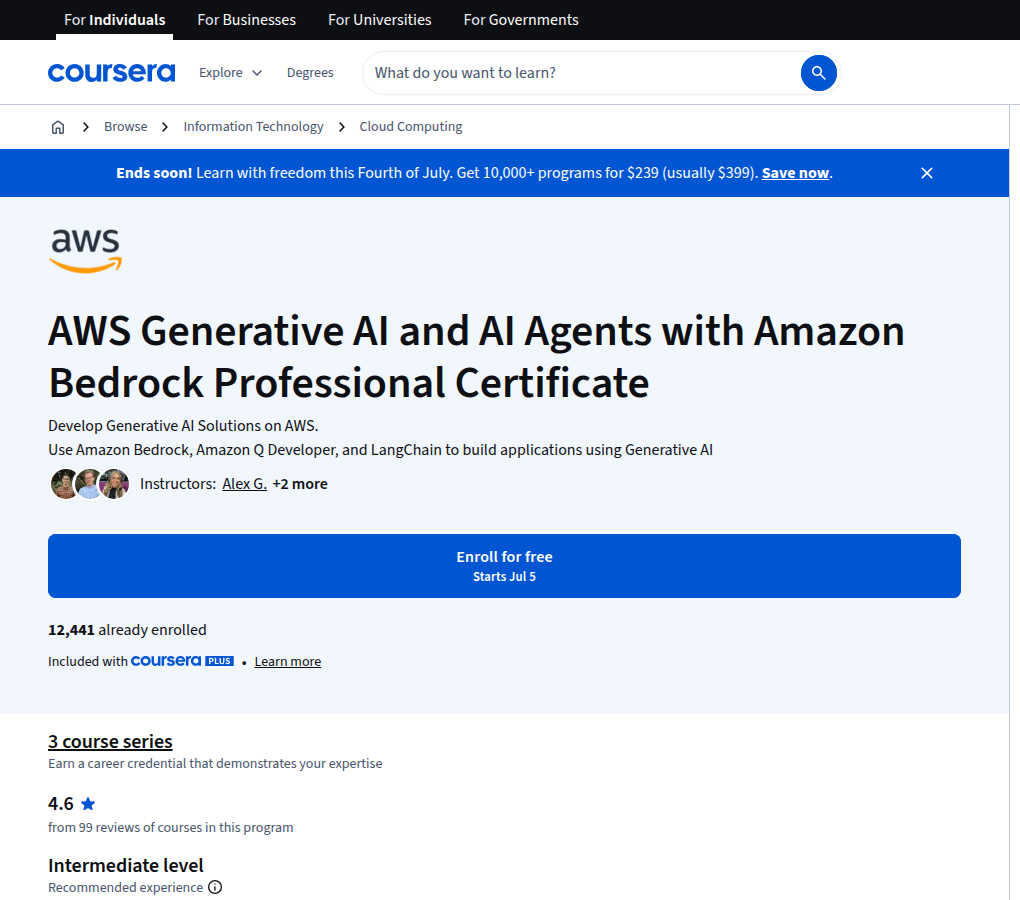
The Coursera page is unusually concrete.
It shows:
- 3 course series
- 8 weeks to complete at 3 hours a week
- Intermediate level
- 4.6 rating from 99 reviews
- a shareable certificate
- 12,441 already enrolled
That matters because it tells you this is not just a fluffy AI overview. It is a real training path with a clear completion structure and enough social proof to suggest people are actually finishing it.
The page also says the program is about:
- Develop Generative AI Solutions on AWS
- using Amazon Bedrock, Amazon Q Developer, and LangChain to build applications using generative AI
What you learn in the program
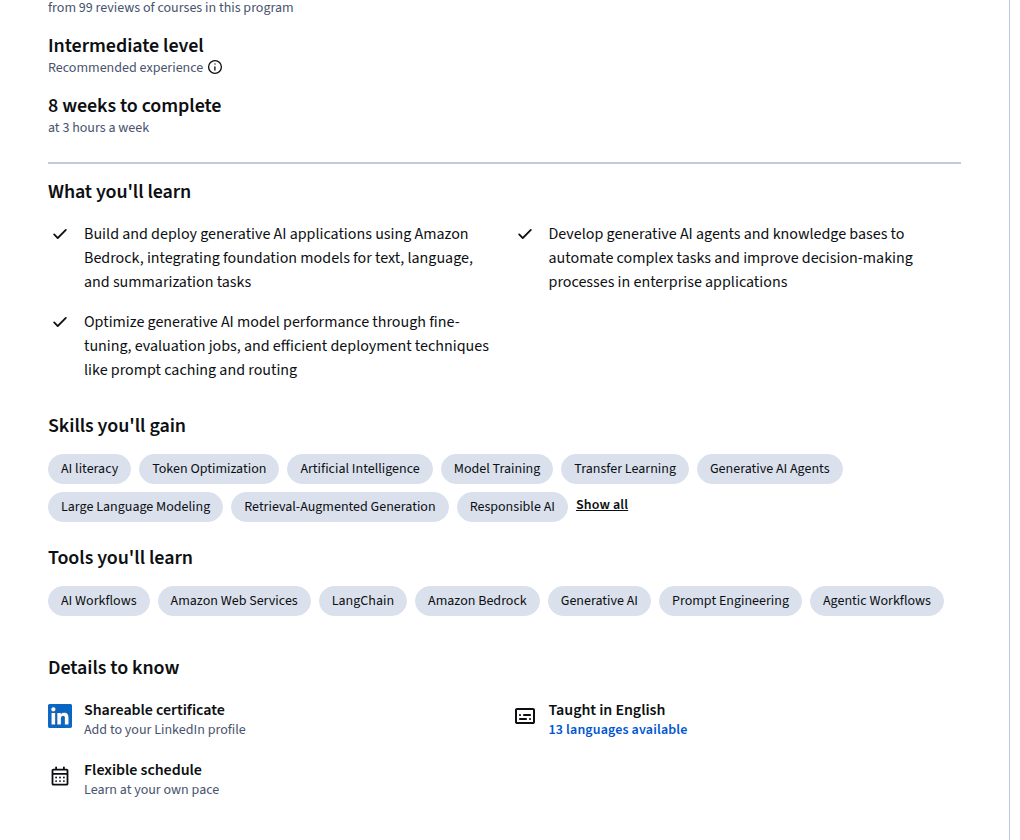
Coursera lists three big learning outcomes:
- Build and deploy generative AI applications using Amazon Bedrock, integrating foundation models for text, language, and summarization tasks
- Develop generative AI agents and knowledge bases to automate complex tasks and improve decision-making in enterprise applications
- Optimize generative AI model performance through fine-tuning, evaluation jobs, and efficient deployment techniques like prompt caching and routing
That is a strong practical mix.
For IT pros, those skills map to the kinds of work that are already showing up in helpdesk automation, internal knowledge assistants, service management, and platform engineering:
- support bots that pull from approved knowledge bases
- internal assistants for runbooks and incident response
- AI workflows that summarize tickets or meeting notes
- agentic systems that call approved tools instead of dumping raw chat output into production
- internal copilots that need governance, retrieval, and routing logic
The skill section on Coursera reinforces that practical angle. It includes:
- AI literacy
- token optimization
- artificial intelligence
- model training
- transfer learning
- generative AI agents
- large language modeling
- retrieval-augmented generation
- responsible AI
And the tools list is exactly where the utility starts to show:
- AI Workflows
- Amazon Web Services
- LangChain
- Amazon Bedrock
- Generative AI
- Prompt Engineering
- Agentic Workflows
For a sysadmin, that is much more useful than a vague “AI foundations” course because it connects AI to actual deployment and workflow decisions.
What the course series looks like
The certificate is a 3-course series:
- Getting Started with AWS Generative AI for Developers — 9 hours
- Generative AI Applications with Amazon Bedrock — 9 hours
- Amazon Bedrock Customization, Optimization & Automation — 5 hours

That sequence is important.
It starts with foundational AWS GenAI concepts, moves into actual application building, and ends with customization and operational optimization. In other words, the credential is trying to walk you from understanding to building to tuning.
That progression is exactly what you want if your goal is career ROI rather than just collecting vocabulary.
Why sysadmins and desktop engineers should care
If your current job is still mostly endpoint management, support escalation, identity troubleshooting, and scripting, you may wonder why a Bedrock certificate matters at all.
The answer is simple: AI is becoming part of the tooling layer that IT already owns.
Sysadmins and desktop engineers are increasingly asked to:
- evaluate AI features before enabling them
- support internal assistants and knowledge tools
- understand data exposure and governance concerns
- help automate repetitive support tasks
- build lightweight workflows around approved APIs
- explain how prompts, retrieval, and guardrails affect enterprise risk
This certificate is valuable because it helps you participate in those conversations with more than just buzzwords.
It gives you enough real AWS context to understand how generative AI apps and agents are built, where knowledge bases fit, why responsible AI matters, and how deployment decisions affect performance and cost.
That is a meaningful upgrade from being the person who only says, “We should probably be careful with AI.”
Where it fits in the AWS AI ladder
If you already live in AWS, this certificate is more practical than a generic intro course.
Compared with AWS Certified AI Practitioner, this Coursera certificate is:
- more hands-on
- more implementation-focused
- more directly tied to building agentic workflows and knowledge-based apps
Compared with AWS Certified Machine Learning Engineer – Associate, it is:
- less exam-heavy
- less production-ML-engineering specific
- easier to approach if you want application-layer AI rather than full ML operations depth
So the right question is not “Is this the most advanced AWS AI credential?”
It is “Do I want practical AWS GenAI implementation skills that I can use in internal automation or platform work?”
For many IT pros, the answer is yes.
How it compares with Microsoft, Google Cloud, and other Coursera options
Versus Microsoft Applied Skills
If you are in a Microsoft-first environment, Microsoft Applied Skills credentials can be even more relevant.
They are especially strong for:
- Microsoft 365 Copilot governance
- Purview, Intune, and Entra-adjacent workflows
- endpoint and compliance-driven teams
If your day job is mostly Microsoft endpoint and tenant management, a Microsoft Applied Skills badge may have stronger immediate ROI.
But if your environment is AWS-heavy, this Bedrock certificate is the better fit because it speaks the language of AWS-native GenAI delivery.
Versus Google Cloud Generative AI Leader
Google Cloud Generative AI Leader is a lighter, more strategic cert.
It is good if you want AI literacy, cross-functional credibility, and a low-friction vendor credential.
This AWS certificate goes deeper on implementation.
That means Google Cloud Generative AI Leader is the better “start here” option, while AWS Bedrock is the better “I want to build actual AI workflows” option.
Versus Coursera programs like IBM AI Developer or Microsoft GenAI Engineering
Coursera has some strong AI programs, but they do different jobs.
- IBM AI Developer Professional Certificate is great if you want Python, APIs, Flask, and application development context.
- Microsoft Generative AI Engineering is better if you want Azure AI Foundry and Microsoft-aligned build skills.
- Google AI Professional Certificate is broader and more beginner-friendly.
This AWS program is the best Coursera choice if your real career direction is AWS cloud implementation, agentic workflows, and Bedrock-based enterprise AI.
Who should take it
Take this certificate if you are one of these people:
- a sysadmin moving toward cloud automation or platform engineering
- a desktop engineer supporting internal AI tools or AI-assisted workflows
- a DevOps engineer who wants more GenAI credibility
- an AWS-heavy IT pro who needs Bedrock-specific hands-on experience
- a support engineer who wants to understand how AI assistants are actually assembled
Who should skip it
Skip it or delay it if:
- your environment is mostly Microsoft and you need Copilot / Purview / Intune value first
- you want a pure beginner AI badge with minimal effort
- you need a deep ML engineering certification instead of application-layer skills
- you are not likely to touch AWS services in your next role
My practical ROI verdict
For desktop engineers and sysadmins, this is not the first AI credential I would buy blindly.
But if your career path includes AWS, automation, internal tooling, or cloud platform work, it is a very solid choice.
The reason is simple: it teaches you how to think about real AI delivery on AWS, not just how to talk about AI in abstract terms.
That makes it more useful than generic AI learning certificates and more career-relevant than a lot of vendor-neutral courses.
Bottom line: if you want an AWS-branded, hands-on, cloud-implementation-focused AI certificate, this one is worth serious consideration.
Final recommendation
Choose AWS Generative AI and AI Agents with Amazon Bedrock Professional Certificate if you want:
- practical Bedrock experience
- agentic workflow exposure
- RAG and knowledge base concepts
- a Coursera credential with AWS branding
- a learning path that is realistic for working IT professionals
Choose something else if you need:
- Microsoft-first endpoint alignment
- a pure exam credential
- a beginner badge with almost no effort
- deeper ML engineering depth than application building
For AWS-minded sysadmins and desktop engineers, this is one of the most relevant Coursera AI certificates currently worth watching.