
Databricks Certified Machine Learning Professional: Worth It for IT Pros?
If you are an IT professional who is already drifting toward data platforms, MLOps, or AI workload support, the Databricks Certified Machine Learning Professional is one of the most credible signals you can add to your resume.
It is not a beginner-friendly badge. It is a real production exam that expects hands-on machine learning experience, familiarity with Databricks tools, and comfort with deployment, monitoring, and model lifecycle management.
That makes it a strong fit for cloud engineers, data engineers, platform engineers, and technical support people who are moving closer to AI operations.
Quick verdict
| Category | Verdict |
|---|---|
| Provider | Databricks |
| Level | Professional |
| Exam style | Proctored, multiple choice |
| Time | 120 minutes |
| Cost | $200 |
| Experience needed | 1+ years of hands-on ML work recommended |
| Best for | Data/AI engineers and platform teams supporting production ML |
| ROI | High if your target roles touch Databricks, MLOps, or enterprise AI platforms |
| Weak fit | Pure desktop support or endpoint-only careers |
Official page: https://www.databricks.com/learn/certification/machine-learning-professional
Why this certification matters
Databricks sits in the middle of a lot of modern AI stacks:
- feature engineering
- model training
- experiment tracking
- governed data access
- deployment pipelines
- monitoring and retraining
That means this credential is more than a “learn AI buzzwords” badge. It is a signal that you understand the mechanics of getting models into production and keeping them healthy.
For IT pros, that matters because AI support work is increasingly operational:
- keeping data pipelines reliable
- helping teams deploy models safely
- managing access and governance
- troubleshooting failed jobs and serving issues
- coordinating platform updates and cost controls
What the exam actually tests
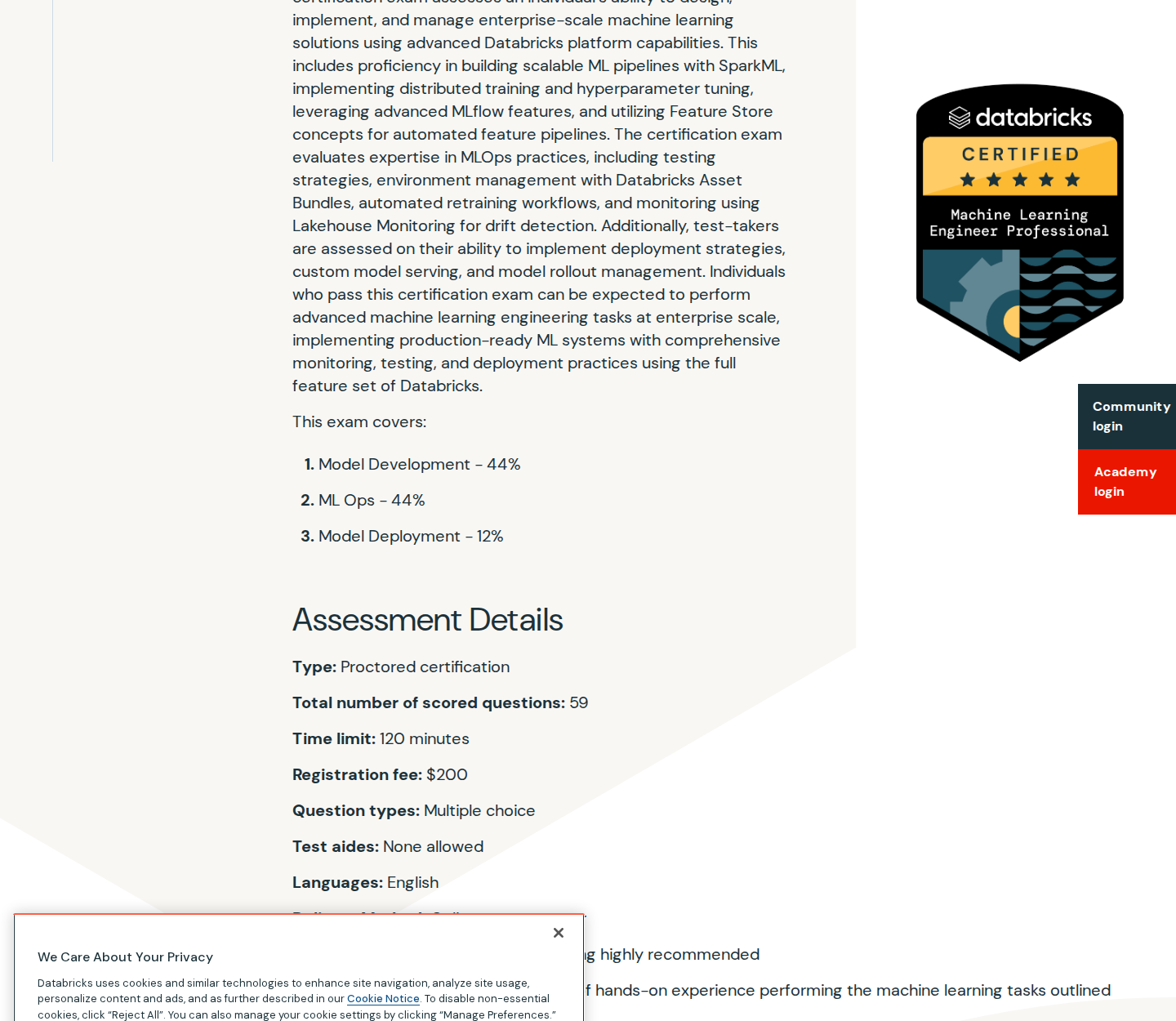
The Databricks exam description says it assesses the ability to design, implement, and manage enterprise-scale machine learning solutions using advanced Databricks capabilities.
The main themes are:
- scalable ML pipelines with SparkML
- distributed training and hyperparameter tuning
- MLflow workflows
- Feature Store concepts
- testing and environment management
- automated retraining
- Lakehouse Monitoring for drift detection
- deployment strategies and model rollout management
That is useful because it shows the exam is not centered on theory alone. It is centered on the kind of operational work that production AI systems actually need.
Exam details at a glance
The assessment details are straightforward and serious:
- 59 questions
- 120 minutes
- $200
- Multiple choice
- English
- Online or test center delivery
- No prerequisites listed, but Databricks recommends related training and real experience
- Recertification every 2 years
That last point matters. A two-year recertification cycle is a strong reminder that this is a living platform credential, not a one-time resume ornament.
Who should take it
This certification makes sense if you are:
- a data engineer moving deeper into ML
- a cloud engineer supporting analytics or AI platforms
- a platform engineer responsible for Databricks environments
- a senior sysadmin or IT ops person transitioning into AI infrastructure
- a technical professional who wants a harder credential than entry-level AI badges
It is especially compelling if your employer already uses Databricks or is planning to.
Who should skip it for now
This is probably not the right first AI certification if you are:
- still focused mainly on endpoint management
- new to machine learning concepts
- looking for a quick and cheap AI credential
- trying to get broad AI fluency without platform specialization
If that sounds like you, something like AI-900, AWS Certified AI Practitioner, or a lighter foundational path will usually produce faster ROI.
ROI for IT professionals
The ROI case is strongest when the cert matches your actual job market.
Good ROI scenarios
- your company already runs Databricks
- you support AI or analytics workloads in a cloud environment
- your team is building internal ML pipelines
- you want to pivot from admin work into platform or data engineering
- you need a credential that looks credible to technical hiring managers
Weak ROI scenarios
- your work is mostly Windows, MDM, or help desk support
- your employer has no Databricks footprint
- you want broad AI literacy rather than platform depth
- you need something quickly and cheaply
The big advantage here is that the cert maps to real production work. The downside is that the signal is narrower than a foundational AI badge.
Preparation strategy
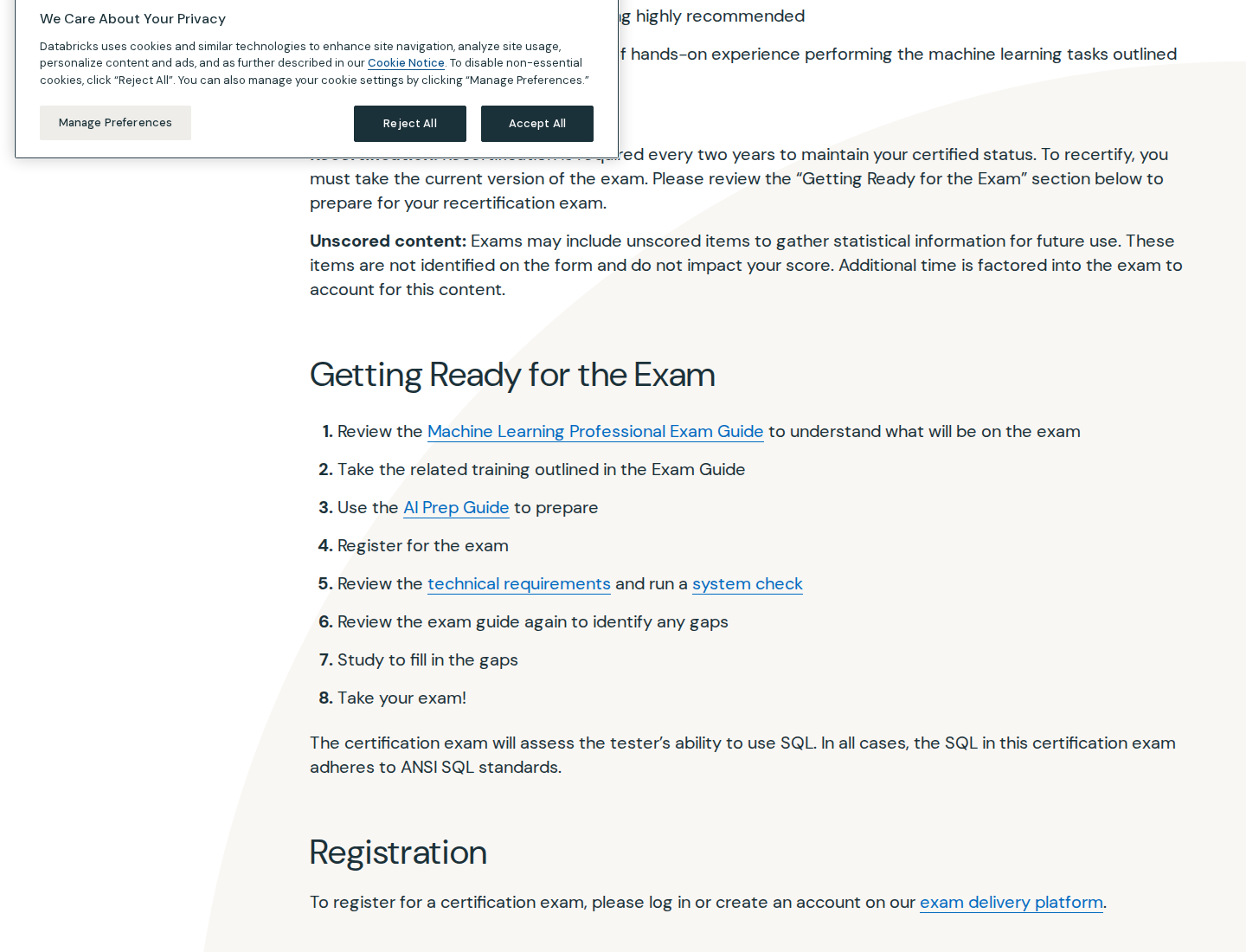
Databricks points candidates to the exam guide, an AI prep guide, technical requirements, and a system check.
That suggests the right prep plan is:
- Read the exam guide first
- Compare the tested areas to your actual experience
- Review MLflow, Feature Store, serving, and monitoring concepts
- Practice platform workflows in Databricks if you have access
- Focus on deployment and operational monitoring, not just model training
My recommendation
Worth it? Yes — but only for the right IT pro.
This is a high-signal certification for people who are moving into serious AI infrastructure, MLOps, or data platform work. If that is your path, the cost and effort are justified.
If your career is still mostly desktop support or Microsoft endpoint operations, this is probably not your first move. But if you want a credential that proves you can operate in the production AI layer, Databricks Certified Machine Learning Professional is a strong one.
Bottom line
Choose this certification if you want to show that you can work on the operational side of machine learning systems, not just talk about AI in theory.
Skip it if you need a faster, cheaper, more general AI credential.
For the right engineer, it is absolutely a resume-worthy signal.