
Databricks Certified Generative AI Engineer Associate: Worth It for IT Pros?
The Databricks Certified Generative AI Engineer Associate is a technical certification for designing and implementing LLM-enabled solutions on Databricks. It is a particularly relevant option for IT professionals who are moving beyond chatbot experimentation into data, retrieval, governance, deployment, and operational ownership.
Quick verdict
| Category | Verdict |
|---|---|
| Provider | Databricks |
| Credential | Databricks Certified Generative AI Engineer Associate |
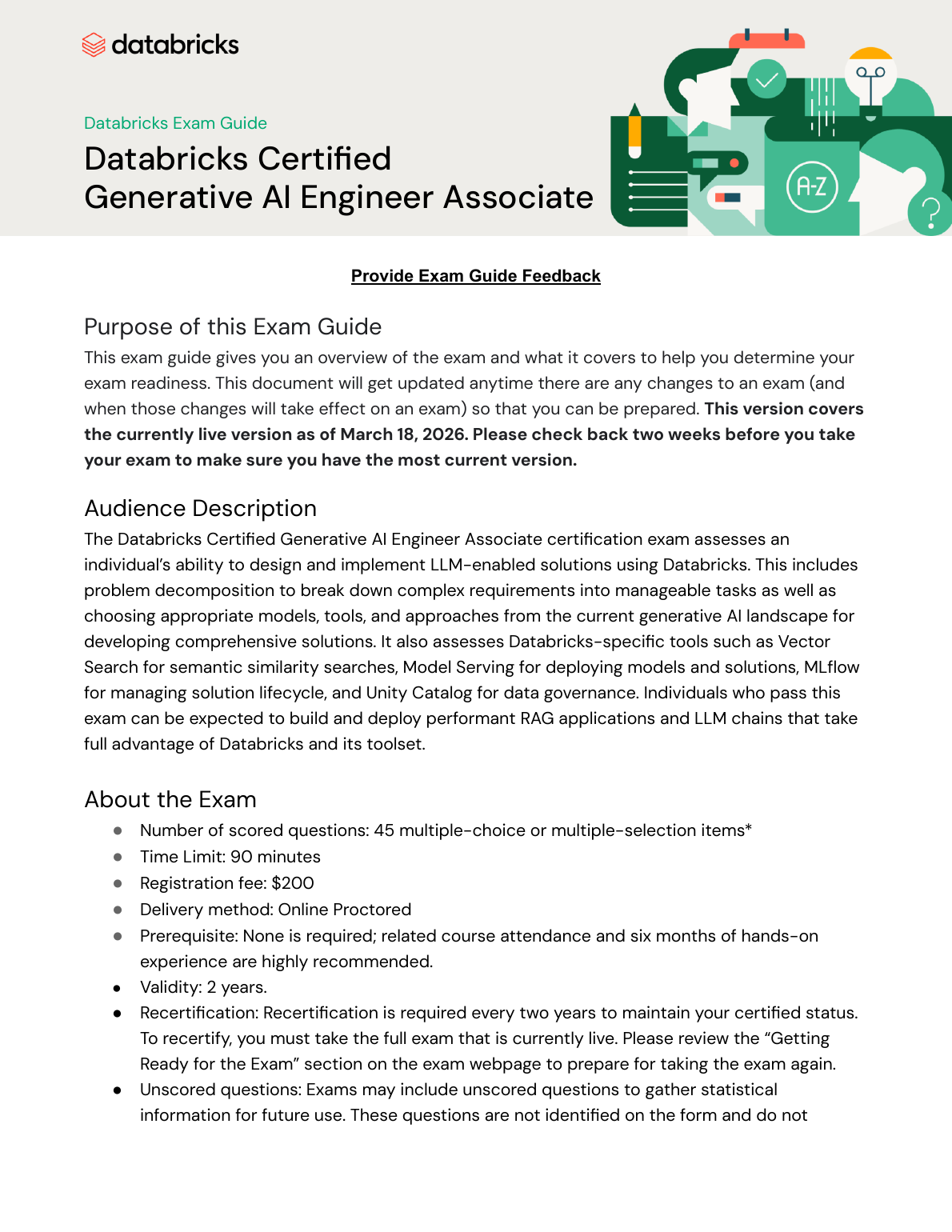
| Assessment | 45 scored multiple-choice questions |
| Time | 90 minutes |
| Price | $200 USD |
| Delivery | Proctored online or test center |
| Validity | Two years; recertification requires the current exam |
| Level | Associate, but practical experience is strongly recommended |
| Best fit | Cloud, data-platform, MLOps, automation, and AI operations professionals |
| ROI | Strong in Databricks-heavy organizations; limited if your work never touches lakehouse data or model delivery |
Databricks says candidates should have at least six months of hands-on experience performing the tasks in the exam guide. There are no formal prerequisites, but that recommendation is important: this is not merely a prompt-engineering vocabulary test.
What it actually validates
The credential tests whether you can turn a generative-AI requirement into a working Databricks solution. The official description emphasizes problem decomposition, model and tool selection, and Databricks services including AI Search for semantic search, Model Serving, MLflow, and Unity Catalog.
In practical terms, the certification is about building and operating systems such as:
- retrieval-augmented generation applications
- LLM chains and tool-enabled workflows
- semantic search over governed enterprise data
- deployed model and application endpoints
- evaluated, monitored, and auditable AI features
That scope makes it more useful to an IT professional than a generic AI fundamentals badge when the target job includes platform implementation or production support.

Exam domains and the preparation signal
The March 2026 exam guide divides the blueprint into six areas:
| Domain | Weight |
|---|---|
| Design applications | 14% |
| Data preparation | 14% |
| Application development | 30% |
| Assemble and deploy applications | 22% |
| Governance | 8% |
| Evaluation and monitoring | 12% |
The weighting tells you where to spend study time. Application development and deployment together represent more than half of the exam. Governance and evaluation are smaller sections, but they are exactly the areas that separate a production-minded implementation from a demo.
Expect to study the full lifecycle: selecting an approach, preparing data, implementing retrieval or chains, deploying the result, applying Unity Catalog controls, and monitoring quality and behavior. A person who only knows how to call an LLM endpoint will have significant gaps.
Why an IT professional might pursue it
1. It connects infrastructure work to AI delivery
Many sysadmins and cloud engineers already understand identity, networking, secrets, access controls, logging, and incident response. Databricks adds a data-and-model application layer to that foundation. The certification gives that transition a concrete target.
2. It rewards operational thinking
RAG quality, endpoint availability, model versioning, permissions, and cost controls are operational problems. The exam’s inclusion of MLflow, Model Serving, governance, evaluation, and monitoring maps well to platform and production-support responsibilities.
3. It is portfolio-friendly
A credible portfolio project can be small: ingest a controlled document set, create a governed search or RAG workflow, deploy it, record evaluation results, and document failure modes. That demonstrates more than a completion certificate because it shows the exact lifecycle the credential covers.
Where it is not a good fit
Skip or postpone this certification if your role is limited to end-user AI productivity, Microsoft 365 administration, or general help-desk support. It is also a poor first choice if you have no Python, SQL, data-platform, or API experience and are not prepared to build those skills first.
It is not a replacement for a cloud-provider AI certification when your employer standardizes on Azure or AWS. Nor does it make you a machine-learning researcher. Its value is strongest in organizations that use Databricks as the platform for governed data and AI applications.
A practical study plan
- Learn the platform vocabulary. Review AI Search, Model Serving, MLflow, Unity Catalog, vector search, and serving endpoints.
- Build one small RAG application. Use a controlled dataset and document ingestion, chunking, retrieval, prompting, and citations.
- Add governance. Apply access control and explain which data can and cannot be used by the application.
- Deploy and evaluate it. Track latency, retrieval quality, answer quality, and failure cases rather than relying on a few successful prompts.
- Use the official exam guide. Work through every blueprint domain and practice scenario-based decisions, not just definitions.
Final recommendation
The Databricks Certified Generative AI Engineer Associate is worth it for an IT professional when the next role involves RAG applications, AI platform operations, data governance, or production model delivery on Databricks. The $200 exam fee and two-year renewal cycle are reasonable if you can pair the credential with a working project.
For a general desktop engineer who wants a first exposure to AI, it is too specialized. Start with fundamentals and hands-on Python/API work. For a cloud or operations engineer already supporting data platforms, however, this is a focused way to demonstrate that you understand the difference between an AI demo and a governed, deployable AI application.
Official sources: Databricks certification page · March 2026 exam guide