Databricks Certified Machine Learning Associate: Worth It for IT Pros?
Production AI is not only about training a model. Someone must prepare features, run experiments, track versions, deploy models, and monitor what happens after release. Databricks Certified Machine Learning Associate targets that practical layer: using Databricks to perform basic machine-learning tasks.
This article evaluates one credential—not a roundup—for IT professionals moving toward MLOps, data-platform support, or AI infrastructure.
Quick verdict
| Category | Verdict |
|---|---|
| Provider | Databricks |
| Credential | Databricks Certified Machine Learning Associate |
| Best for | Cloud/platform engineers, data engineers, MLOps beginners, and IT pros supporting ML workloads |
| Assessment | Proctored certification exam; 48 scored questions; 90 minutes |
| Question type | Multiple choice |
| Fee listed by provider | $200 |
| Languages listed | English, Japanese, Brazilian Portuguese, and Korean |
| AI relevance | High for operating ML workflows; limited for advanced model research |
| My take | Worth it when your role touches the Databricks ML platform and model lifecycle |
Bottom line: this is a credible bridge from general IT operations into machine-learning platform work. It is not the right first choice for someone who needs broad AI literacy, deep statistics, or advanced model-development expertise.
What Databricks says the credential measures
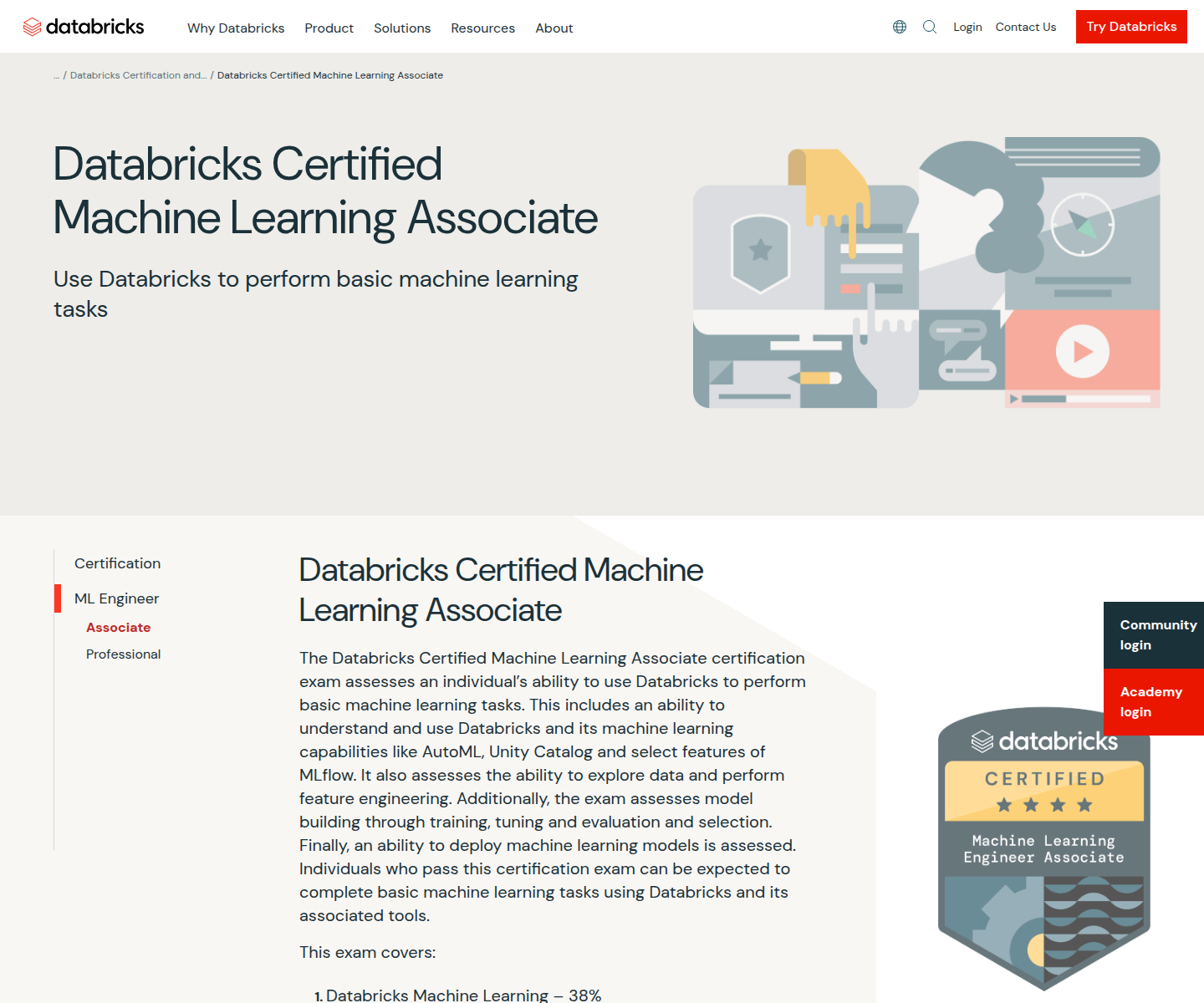
Databricks describes the certification as assessing the ability to use its platform for basic machine-learning tasks. The official page names capabilities including AutoML, Unity Catalog, feature selection, MLflow, feature engineering, model training, tuning, evaluation, selection, and deployment.
That scope is useful because it follows a model through a lifecycle rather than stopping at a notebook. An IT professional can connect familiar operational concerns—identity, access, repeatability, monitoring, and deployment hygiene—to ML-specific workflows.
Why it matters for IT professionals
1. It makes MLOps concrete
Many infrastructure professionals understand CI/CD, cloud resources, secrets, logging, and change control but have not applied those ideas to models. The exam scope gives that transition a practical shape: track experiments, manage features, register model versions, and deploy a selected model.
2. Governance is part of the platform
Unity Catalog is not just a data catalog in an AI environment. Permissions, lineage, and controlled access affect which data can become a feature and who can deploy or consume a model. This makes the credential more relevant to enterprise IT than a purely theoretical ML course.
3. The lifecycle creates operational work
A model can be accurate in a test notebook and still fail in production because of drift, bad features, dependency changes, latency, or weak rollback procedures. The certification is a useful signal for roles that help data scientists turn experiments into repeatable services.
4. It complements—not replaces—cloud operations knowledge
Databricks ML work still depends on identity, networking, storage, compute, secrets, observability, and cost controls. Candidates coming from systems or cloud operations should treat those skills as an advantage, while closing gaps in Python, SQL, statistics, and ML concepts.
Exam facts and what they imply
Databricks lists a proctored exam with 48 scored questions and a 90-minute time limit. The provider lists multiple-choice questions, no test aides, a $200 registration fee, and four supported languages.
That format rewards scenario recognition and platform fluency more than writing a large amount of code during the exam. The preparation risk is assuming that familiarity with the Databricks UI is enough. Candidates still need to understand why a workflow uses a particular feature, how artifacts move through a lifecycle, and where governance or deployment controls belong.
A practical preparation plan
Phase 1: Build the platform map
Learn the relationship between workspaces, catalogs, schemas, tables, notebooks, jobs, clusters, and permissions. Be able to explain where data lives, who can access it, and how a repeatable job is executed.
Phase 2: Practice the ML lifecycle
Work through a small project that covers feature preparation, an AutoML or notebook experiment, MLflow tracking, model selection, registration, and deployment. The goal is not a sophisticated model; it is a traceable workflow.
Phase 3: Add production controls
Practice role-based access, secret handling, job scheduling, logging, cost awareness, and rollback thinking. Ask operational questions: What happens when a feature changes? How do you identify the deployed version? How would you restrict sensitive training data?
Phase 4: Use the official exam scope as a checklist
Revisit every capability named on Databricks’ certification page. If you can define a feature, explain its place in the lifecycle, and recognize the operational tradeoff, you are better prepared than someone who only memorizes menu labels.
Who should take it?
This certification is a strong fit for:
- IT or cloud engineers supporting Databricks workspaces and ML workloads.
- Data engineers who want to understand what happens after curated data reaches a model pipeline.
- Junior MLOps engineers building platform fundamentals.
- Systems professionals moving into AI infrastructure, model deployment, or platform governance.
It is a weaker fit for:
- Help-desk professionals seeking a general introduction to AI.
- Researchers pursuing advanced deep-learning or statistical modeling roles.
- Engineers whose employers do not use Databricks and who need a cloud-neutral credential first.
Final recommendation
Databricks Certified Machine Learning Associate is worth considering when the target job includes the Databricks ML lifecycle. Its value comes from connecting machine-learning work to platform operations: governed data, tracked experiments, reproducible features, model versioning, and deployment.
For a generalist IT professional, pair it with hands-on Python or SQL and a small end-to-end project. For a cloud or data-platform professional, it can be a focused way to demonstrate that you understand what production ML requires beyond a successful notebook.