
Google Cloud Professional Machine Learning Engineer: Worth It for IT Pros?
The Google Cloud Professional Machine Learning Engineer certification is a serious production-AI credential—not a beginner badge and not a generic introduction to chatbots.
It is designed for people who build, deploy, monitor, and improve machine-learning systems on Google Cloud. For IT professionals, that makes it relevant when your career is moving from endpoint or infrastructure support toward cloud platforms, data pipelines, MLOps, and AI workload operations.
Quick verdict
| Category | Verdict |
|---|---|
| Provider | Google Cloud |
| Level | Professional |
| Exam | 50–60 multiple-choice and multiple-select questions |
| Duration | Two hours |
| Registration fee | $200, plus tax where applicable |
| Delivery | Online proctored or testing center |
| Prerequisites | None formally required |
| Recommended experience | 3+ years in industry, including 1+ year designing and managing Google Cloud solutions |
| Best fit | Cloud, platform, data, and MLOps professionals |
| ROI | High when Google Cloud or production AI is part of your target role |
| Weak fit | Endpoint-only roles with no cloud or data responsibility |
Official certification page: https://cloud.google.com/learn/certification/machine-learning-engineer
What the certification actually validates
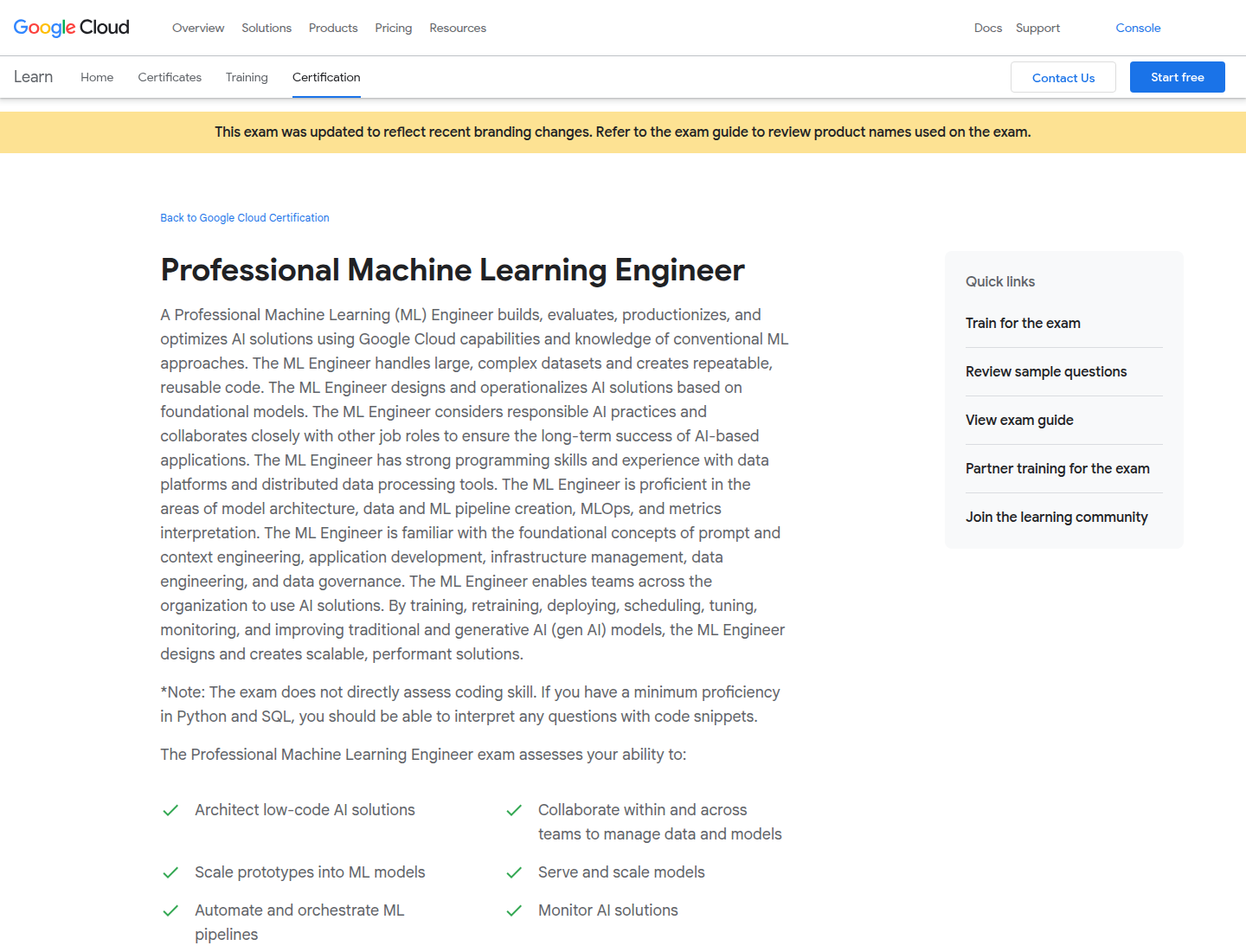
Google describes the role as building, evaluating, productionizing, and optimizing AI solutions. The exam scope goes well beyond selecting a model in a notebook. It tests whether you can reason about the complete operating lifecycle:
- architect low-code AI solutions
- collaborate across teams to manage data and models
- scale prototypes into machine-learning models
- serve and scale models
- automate and orchestrate ML pipelines
- monitor AI solutions
The current page also highlights foundational-model work, prompt and context engineering, application development, infrastructure management, data engineering, data governance, and responsible AI. That combination is valuable for IT pros because production AI fails as often from platform, identity, data, and monitoring problems as from model-selection mistakes.
Why it can have strong ROI for IT professionals
1. It connects AI to operations
A portfolio project can show that you can train a model. This certification signals a broader understanding of how teams run AI systems repeatedly: deployment, scheduling, tuning, monitoring, retraining, and improvement.
That is a useful bridge for cloud engineers, systems engineers, platform administrators, data engineers, and technical support specialists who are becoming responsible for AI-backed services.
2. It rewards platform thinking
The exam is Google Cloud native and now reflects recent product and branding changes, including the transition from Vertex AI terminology toward the Gemini Enterprise Agent Platform and updates to Google Cloud’s data and analytics stack. Candidates should study the current exam guide rather than relying on older Vertex AI-only material.
3. It is credible without requiring a formal prerequisite
There is no formal prerequisite. That does not make it entry-level: Google recommends three or more years of industry experience, including at least one year designing and managing Google Cloud solutions. Treat that recommendation as an honest difficulty signal.
Exam details and practical constraints
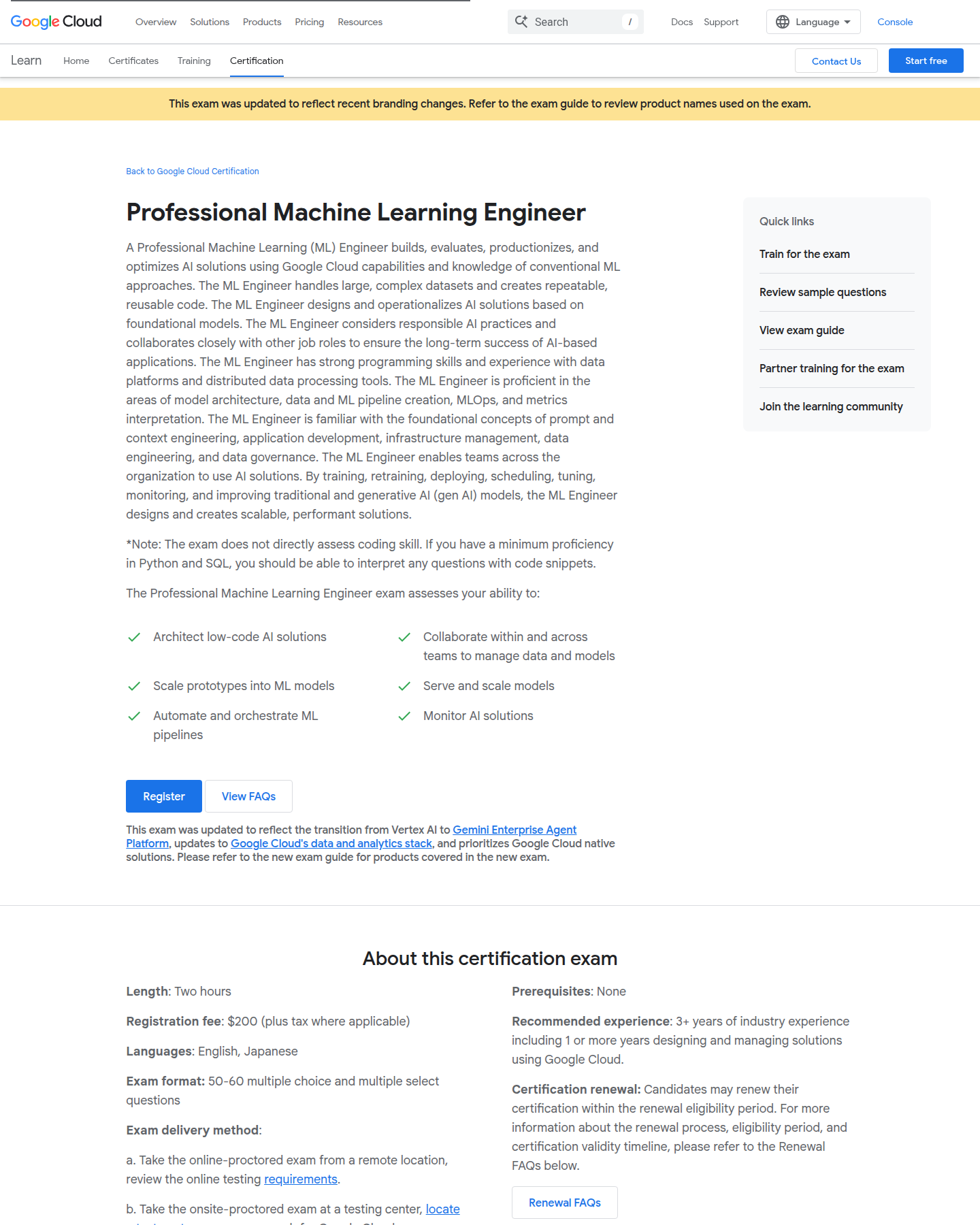
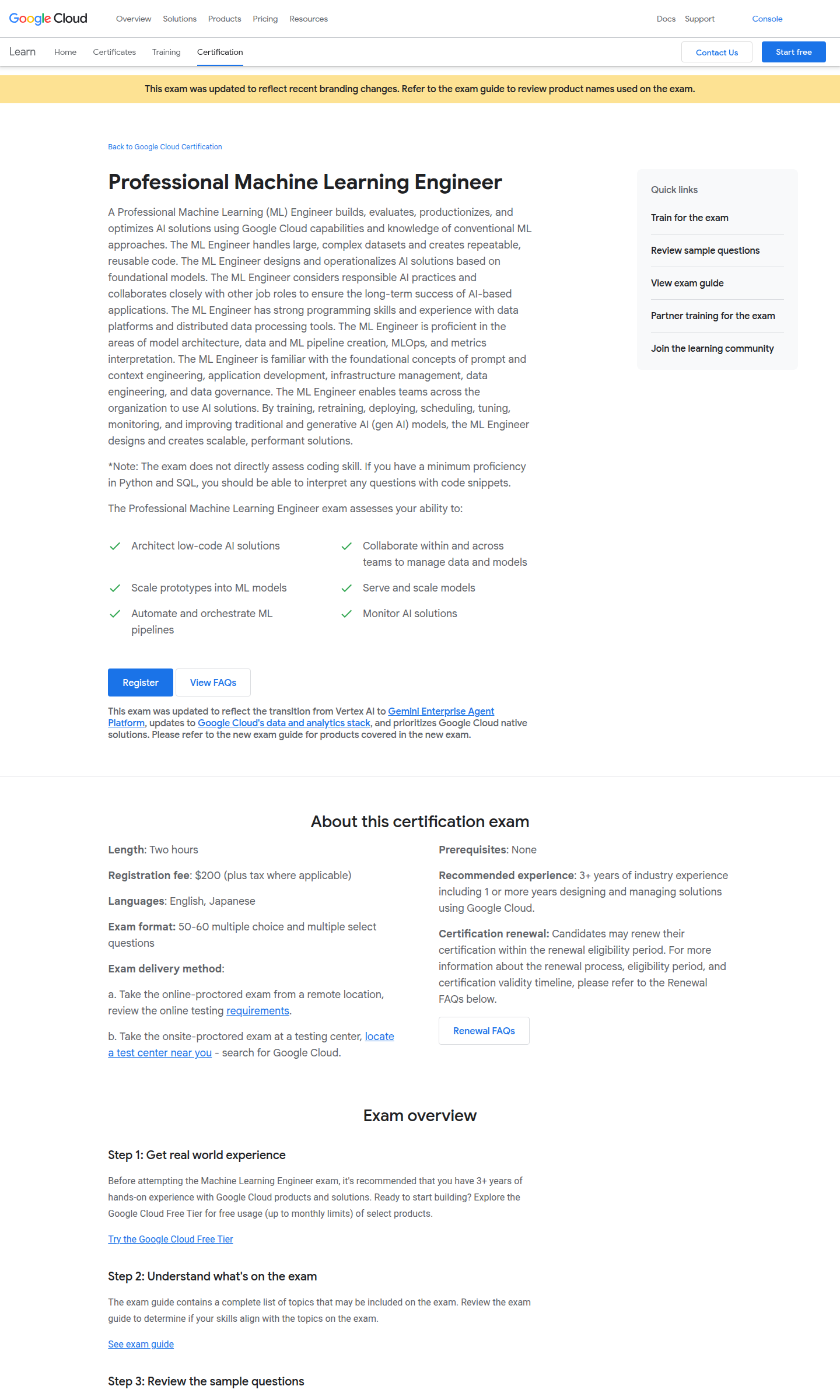
The exam is two hours, costs $200 plus applicable tax, and is available in English and Japanese. You can take it online with remote proctoring or at a testing center. The question count is 50–60 multiple-choice and multiple-select questions.
The exam does not directly assess coding skill. However, Google says candidates should have enough Python and SQL proficiency to interpret code snippets. In practice, you need to understand what code and pipeline configurations are doing even if you are not asked to write a full application during the exam.
What to study
Use the official exam guide as the source of truth, then build a study plan around the work the credential measures:
- Data and model management: permissions, data quality, feature handling, model selection, and reproducibility.
- Model development: traditional ML and generative AI patterns, evaluation, tuning, and responsible-AI tradeoffs.
- Serving and scaling: online and batch prediction, latency, throughput, versioning, and rollout decisions.
- Pipelines and automation: repeatable workflows, orchestration, scheduling, testing, and retraining.
- Monitoring: drift, performance, operational health, alerting, and the feedback loop from production back into development.
- Google Cloud architecture: the native services and data stack that support those workflows.
Do not prepare by memorizing a list of product names. Practice explaining why one architecture is safer, cheaper, more maintainable, or easier to monitor than another.
A realistic preparation plan
Phase 1: Validate the career fit
Before paying for the exam, check job postings you actually want. Look for Google Cloud, Vertex AI or the current platform naming, BigQuery, data pipelines, model deployment, MLOps, monitoring, and governance. If none of those appear in your target market, the credential may be impressive but poorly aligned with your next move.
Phase 2: Build one end-to-end lab
Create a small project that moves from data to deployed prediction and monitoring. Document the architecture, access controls, cost assumptions, evaluation method, rollback plan, and what you would alert on in production.
For an IT professional, the operational documentation is as important as the model. It demonstrates the skills hiring teams need when AI becomes another service that must be reliable and governed.
Phase 3: Use the official resources
Google recommends real-world experience, the exam guide, sample questions, and the Professional Machine Learning Engineer learning path. Use sample questions to expose weak areas, not to memorize answers. Supplement the path with hands-on labs and current Google Cloud documentation.
Who should take it?
This certification is a strong choice for:
- cloud engineers moving into AI platform work
- data engineers supporting ML and analytics workloads
- platform engineers building reusable AI infrastructure
- MLOps or ML engineers operating production systems
- senior IT professionals whose organizations are standardizing on Google Cloud
- technical support engineers who now troubleshoot AI services, pipelines, and data access
Who should wait?
Wait if you are a desktop or help-desk professional who has not yet worked with cloud data, Python or SQL, or production service operations. The certification will be expensive study material if your immediate role has no path to AI platforms.
For a Microsoft-first endpoint career, a Microsoft-aligned AI credential or an applied, lab-based cloud skill may produce faster day-to-day value. For a general AI introduction, a foundational credential is a more sensible first step.
Is it worth $200?
Yes—if the target role involves Google Cloud production AI. The fee is reasonable for a professional exam, but the real investment is the experience and preparation time. The certification earns its ROI when it supports a role change, an internal platform assignment, or credibility with teams that already run Google Cloud workloads.
No—not as a speculative badge for an endpoint-only career. Without a Google Cloud lab, relevant work examples, or a realistic target role, the credential is unlikely to change your opportunities by itself.
Final recommendation
The Google Cloud Professional Machine Learning Engineer is one of the better AI certifications for experienced IT professionals who want to move into the operational side of machine learning. It covers architecture, pipelines, serving, monitoring, governance, and both traditional and generative AI—not just model theory.
Choose it when your next career step is clearly Google Cloud and production AI. Build one end-to-end lab before booking the exam, study the current exam guide because the platform language is changing, and treat the certification as evidence of platform competence rather than a replacement for hands-on experience.