
NVIDIA-Certified Associate: Generative AI LLMs (NCA-GENL) — Worth It for IT Pros?
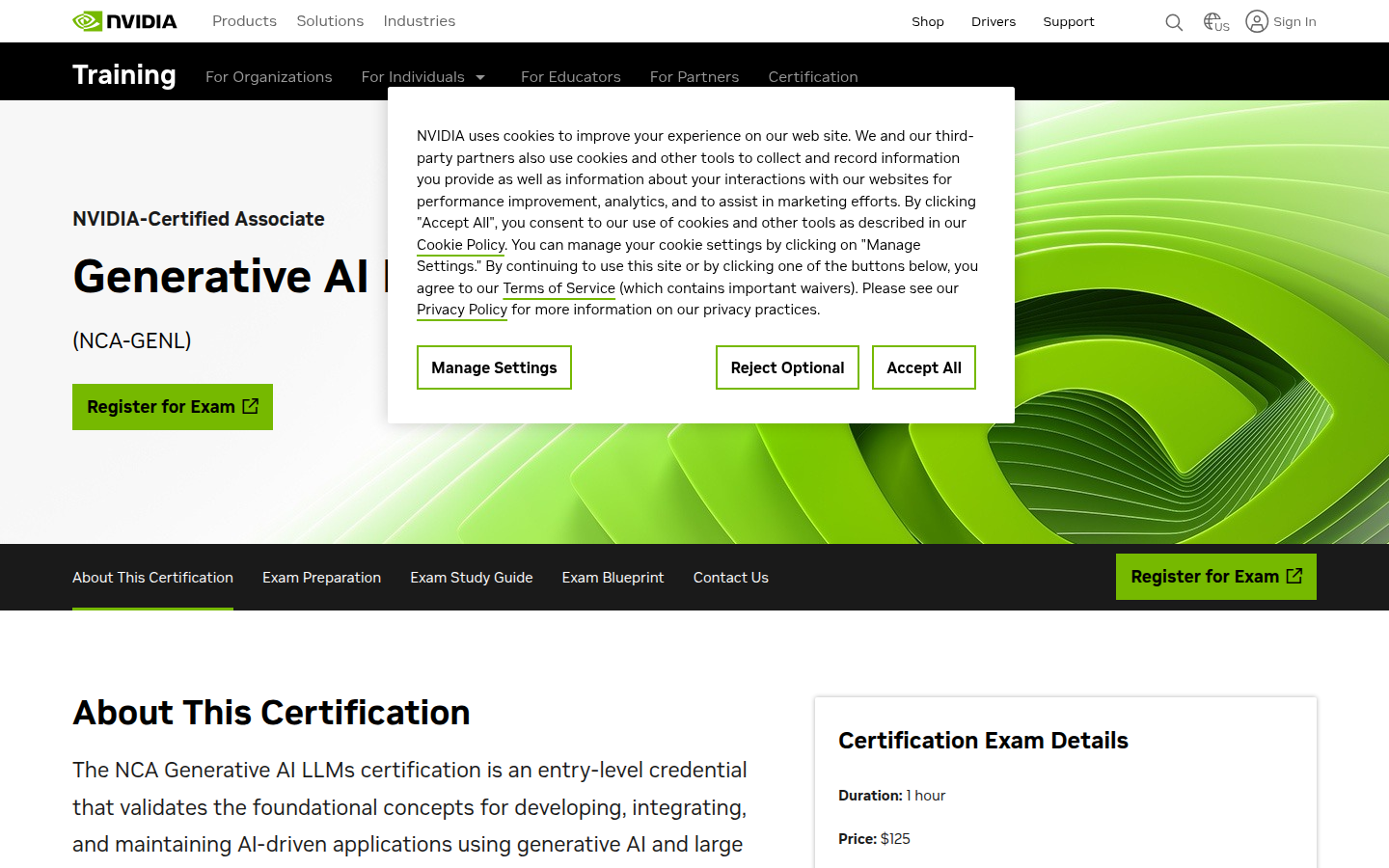
The NVIDIA-Certified Associate (NCA) Generative AI LLMs certification is an entry-level credential for people who need to understand how generative-AI and large-language-model applications are developed, integrated, and maintained with NVIDIA solutions.
It is not a general “AI awareness” badge. NVIDIA’s blueprint includes software development, experimentation, Python libraries for LLMs, LLM integration and deployment, data work, and trustworthy AI. That makes it worth considering for IT professionals who are moving toward AI platform support, cloud architecture, AI DevOps, or application operations.
Quick verdict
| Category | Verdict |
|---|---|
| Provider | NVIDIA |
| Credential | NVIDIA-Certified Associate: Generative AI LLMs (NCA-GENL) |
| Level | Associate / entry level |
| Exam | 50–60 multiple-choice questions |
| Duration | 60 minutes |
| Price | $125 |
| Delivery | Online, remotely proctored |
| Prerequisite | Basic understanding of generative AI and LLMs |
| Validity | Two years from issuance; retake the exam to recertify |
| Best fit | AI DevOps, cloud, solutions architecture, software, and data professionals |
| ROI | Good as a foundational signal; limited as a standalone senior credential |
Official source: NVIDIA Generative AI with LLMs Certification
What the exam validates
NVIDIA describes NCA-GENL as validating foundational concepts for developing, integrating, and maintaining AI-driven applications using generative AI and LLMs. The published topic list includes:
- fundamentals of machine learning and neural networks
- prompt engineering and alignment
- data analysis and visualization
- experimentation and experiment design
- data preprocessing and feature engineering
- software development
- Python libraries for LLMs
- LLM integration and deployment
That scope matters for IT pros because production AI is not only a model question. Someone has to understand the application boundary, data path, deployment method, monitoring expectations, and the risks of an unreliable or ungoverned output.
Exam logistics and cost

The exam is one hour, uses 50–60 multiple-choice questions, is delivered online with remote proctoring, and costs $125. NVIDIA lists English as the exam language and says the credential is valid for two years from issuance. Passing earns a digital badge and an optional certificate showing the certification level and topic.
The price is reasonable compared with many professional cloud exams, but the total preparation cost can be higher. NVIDIA maps the blueprint to optional training, including self-paced courses such as Getting Started With Deep Learning (8 hours, $90), Accelerating End-to-End Data Science Workflows (8 hours, $90), Introduction to Transformer-Based Natural Language Processing (6 hours, $30), Building LLM Applications with Prompt Engineering (8 hours, $90), and Rapid Application Development With Large Language Models (8 hours, $90). Those are preparation options, not additional exam requirements.
How the blueprint should shape your study plan

The blueprint assigns the largest share to core machine-learning and AI knowledge (30%), followed by software development (24%), experimentation (22%), data analysis and visualization (14%), and trustworthy AI (10%).
A sensible plan follows those weights:
- Learn the foundations: neural networks, LLM terminology, tokenization, embeddings, inference, and the difference between training, fine-tuning, and retrieval-augmented generation.
- Practice application behavior: prompt construction, Python LLM libraries, API boundaries, input/output handling, and failure modes.
- Understand experiments: evaluation design, reproducibility, data preprocessing, feature engineering, and how to compare changes rather than relying on anecdotes.
- Add operational context: deployment, integration, latency, cost, logging, access control, and rollback thinking.
- Treat trust as an engineering concern: alignment, data exposure, hallucination risk, and human review paths.
Do not study only NVIDIA product names. The page’s domains are conceptual and practical enough that you should be able to explain why a design is testable, deployable, and safe—not merely identify a branded tool.
Is it useful for desktop engineers and sysadmins?
It can be, but the value depends on the direction of your role.
Strong fit
NCA-GENL is a useful foundation if you are:
- supporting internal AI applications or copilots
- moving from endpoint operations into AI platform operations
- building automation that calls LLM APIs
- becoming responsible for AI workload access, deployment, or troubleshooting
- targeting AI DevOps, cloud solution architecture, or technical support for AI products
It gives you a structured vocabulary for conversations with developers and data teams. That can be more valuable than a broad “AI for everyone” course when your job includes operating real systems.
Weak fit
The credential is a weaker investment if your role is strictly endpoint administration and your target jobs do not mention cloud, data, software, AI applications, or automation. It also should not be treated as proof that you can productionize an LLM independently. The exam is foundational and multiple-choice; it does not replace a portfolio project or experience operating a live service.
A practical lab to pair with the certification
Build a small internal help-desk assistant using a controlled document set. The goal is not to create a flashy chatbot. Document:
- which documents the application can retrieve
- how prompts and citations are assembled
- what happens when retrieval finds no answer
- how secrets and user data are protected
- how responses are evaluated
- what logs and alerts an operator needs
- how you would roll back a bad prompt or model change
That exercise connects the exam’s prompt engineering, experimentation, LLM integration, deployment, and trustworthy-AI domains to the work IT teams actually perform.
Final recommendation
Take NCA-GENL if you want an affordable, vendor-backed foundation in LLM application concepts and you can connect it to an AI operations or automation project. At $125, it is a reasonable signal for an IT professional entering the AI layer.
Do not buy it expecting the credential alone to qualify you for senior machine-learning engineering roles. Its strongest use is as a bridge: pair it with cloud fundamentals, Python/API practice, identity and security knowledge, and one documented end-to-end AI lab. For desktop engineers and sysadmins, that combination makes the certification materially more useful than the badge by itself.