
AWS Certified Generative AI Developer - Professional: Worth It for IT Pros?
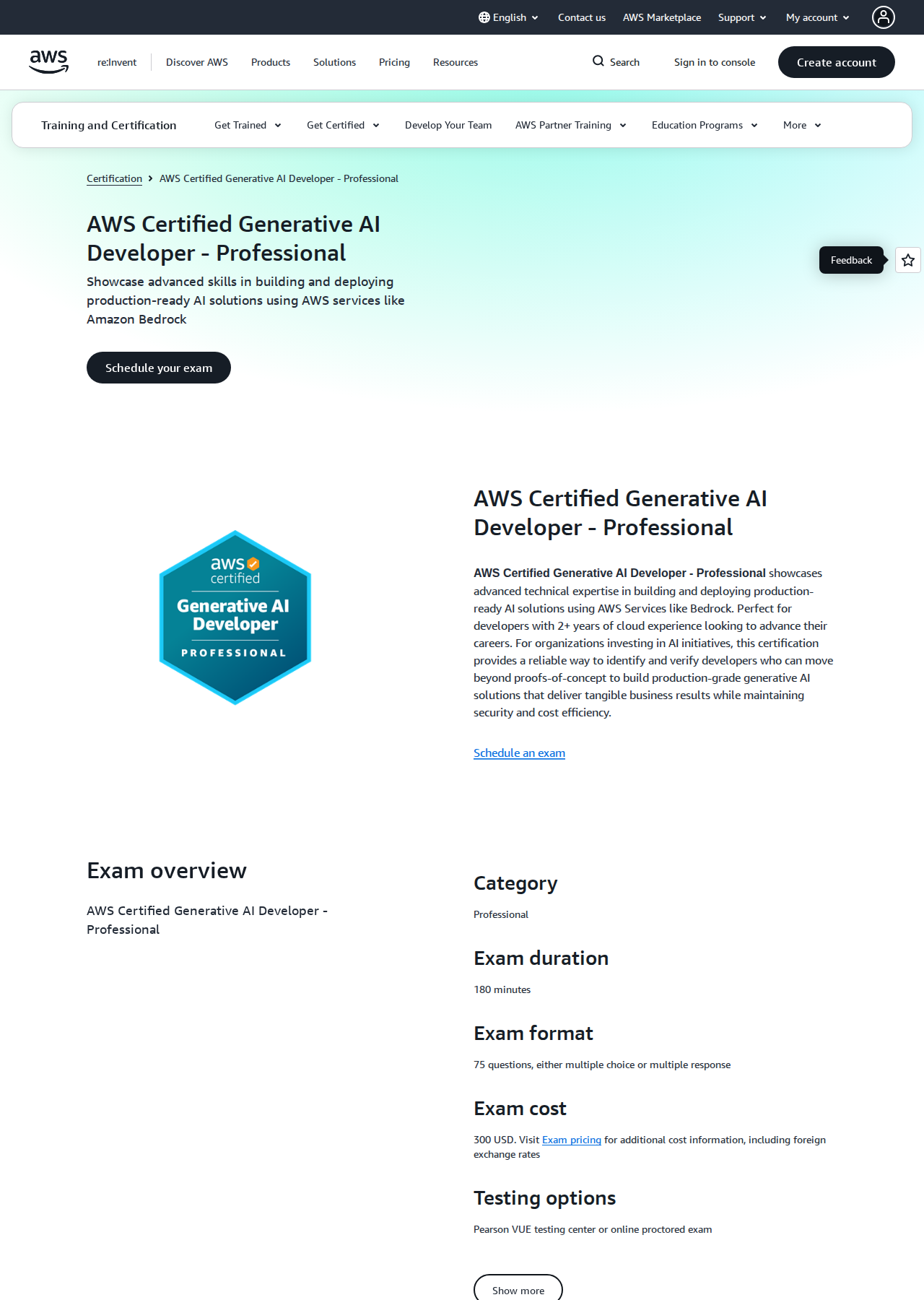
The AWS Certified Generative AI Developer - Professional is aimed at engineers who can move generative-AI work beyond a demo and into a secure, observable, cost-aware production service. AWS positions it around building and deploying solutions with services such as Amazon Bedrock.
That makes it a very different proposition from an AI fundamentals badge. For an IT professional, the value is not simply proving that you can call a model. The value is demonstrating that you understand the surrounding application, identity, data, reliability, and governance decisions that make an AI workload supportable.
Quick verdict
| Category | Practical answer |
|---|---|
| Provider | AWS |
| Level | Professional |
| Core focus | Production-ready generative-AI applications |
| Featured platform | Amazon Bedrock and related AWS services |
| AWS-stated audience | Developers with 2+ years of cloud experience |
| Exam price | Confirm the current amount on the AWS exam pricing page before booking |
| Best fit | Cloud developers, platform engineers, DevOps engineers, and AI application owners |
| ROI | High when AWS is your target cloud and you can show hands-on application work |
| Weak fit | Endpoint-only roles with no cloud, API, or application ownership |
Official page: https://aws.amazon.com/certification/certified-generative-ai-developer-professional/
What AWS is actually validating
AWS describes this credential as advanced technical expertise in building and deploying production-ready AI solutions. The important phrase is production-ready. A useful preparation plan should therefore cover the full path from an application request to a controlled service:
- selecting and integrating foundation models through Bedrock
- designing prompts, context, retrieval, and tool-use patterns
- building APIs and application workflows around model responses
- controlling access with IAM and service-specific security boundaries
- protecting prompts, documents, personal data, and model outputs
- evaluating quality, latency, safety, and failure modes
- monitoring usage and cost so the application remains operable
- improving a prototype without turning every experiment into production risk
This is why the credential can matter to infrastructure and operations professionals. AI applications inherit familiar IT problems—identity sprawl, secrets, logging gaps, network paths, change control, incident response, and unpredictable spend—while adding model-specific failure modes.
The practical IT-professional ROI
1. It converts AI interest into an architecture signal
Many candidates can describe a chatbot. Fewer can explain how the chatbot authenticates, retrieves approved enterprise content, handles a provider timeout, redacts sensitive data, records an audit trail, and falls back when a model is unavailable.
A professional-level certification is useful when it supports that broader story. Pair the badge with a small but complete reference implementation and you have evidence that you can operate the boundary between cloud infrastructure and AI application behavior.
2. It is aligned with where AWS customers are spending
Amazon Bedrock gives organizations a managed route to foundation-model access, but managed does not mean automatic. Teams still need developers who understand application integration, governance, observability, and cost controls. The credential is most valuable for people targeting cloud engineering, DevOps, platform engineering, solutions architecture, or internal AI enablement roles in AWS-heavy organizations.
3. It rewards security and cost judgment—not just model enthusiasm
A production AI design should answer who can invoke a model, which data may enter a prompt, how outputs are evaluated, what gets logged, how requests are throttled, and how spend is attributed. Those are familiar operational questions, which gives experienced IT pros a useful advantage over candidates who know only the model vocabulary.
The experience bar is real
AWS says the credential is suited to developers with 2+ years of cloud experience. That is not a formal prerequisite, but it is a meaningful difficulty signal. If you have not worked with IAM, APIs, deployment pipelines, logging, and basic cloud architecture, begin with hands-on AWS fundamentals before treating this as your next exam.
For desktop engineers and sysadmins, the bridge is practical rather than academic:
- Build a small internal knowledge assistant with approved documents.
- Put an authenticated API in front of it.
- Add retrieval, access filtering, prompt-injection defenses, and structured logging.
- Test bad inputs, unavailable dependencies, latency, and budget limits.
- Document the runbook, rollback plan, and data-retention decisions.
The project does not need to be large. It needs to show that you think like the person who will support it at 2 a.m.
How to prepare without memorizing product lists
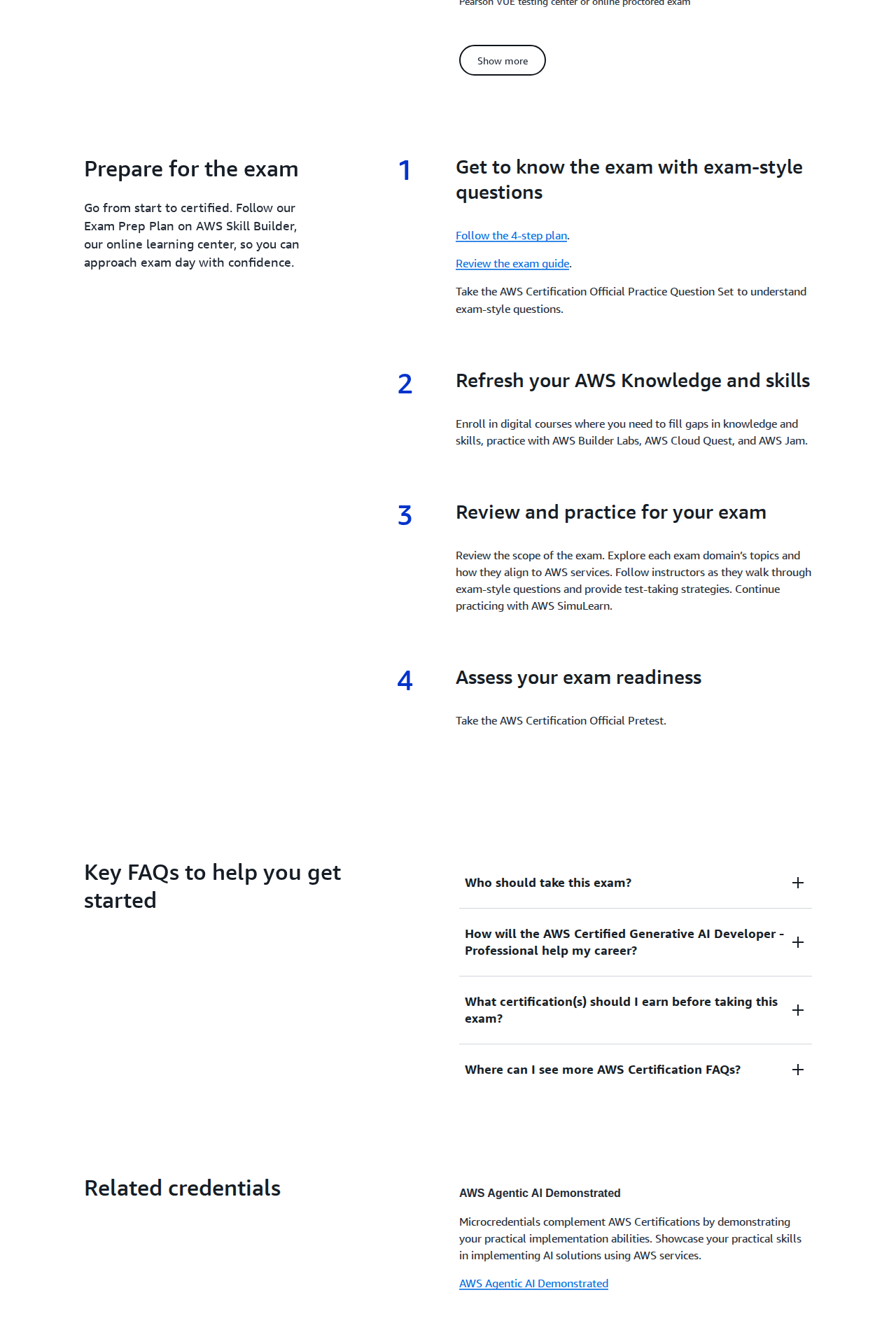
AWS’s preparation flow emphasizes four useful stages: become familiar with exam-style questions, refresh AWS knowledge, review and practice, then assess readiness. Translate that into a work-oriented plan.
Stage 1: Map the exam to an application lifecycle
Organize notes around identity, data, model interaction, application integration, evaluation, observability, reliability, and cost. For every service or pattern, write down the problem it solves and the tradeoff it introduces.
Stage 2: Build one end-to-end Bedrock lab
Use a narrow scenario such as an IT-support knowledge assistant. Include authentication, a document ingestion path, retrieval, a model call, structured output, logging, and a basic evaluation set. Treat prompt and retrieved-document data as untrusted input.
Stage 3: Practice operational decisions
Do not stop after a successful response. Test timeouts, malformed output, rate limits, missing permissions, prompt injection, unsupported requests, and rising token usage. Explain how you would alert, investigate, and recover.
Stage 4: Use official exam material as the source of truth
AWS can change service names, exam scope, and preparation resources. Read the current exam guide and official practice material immediately before scheduling. The page currently recommends AWS digital courses, Builder Labs, Cloud Quest, AWS Jam, SimuLearn, and official practice assessments as preparation options.
Who should take it?
This is a strong choice for:
- AWS developers building generative-AI features
- cloud and DevOps engineers moving into AI platform delivery
- platform engineers responsible for internal AI enablement
- solutions architects who need implementation depth
- IT professionals who already operate AWS and want a credible AI specialization
It is a weaker choice if your immediate goal is basic AI literacy, general project management, or endpoint administration without cloud application responsibilities. In those cases, a fundamentals credential or a focused applied lab may produce faster returns.
Final recommendation
Take AWS Certified Generative AI Developer - Professional if you already have AWS foundations and can commit to building one secure, observable AI application. It has strong practical ROI because it maps to the hard part of enterprise AI: making the application reliable, governable, and supportable after the demo.
Do not buy it as a substitute for experience. Use the certification to structure that experience, then show the architecture, tests, runbook, and cost decisions alongside the badge.
Sources
- AWS certification page: https://aws.amazon.com/certification/certified-generative-ai-developer-professional/
- AWS certification exam pricing: https://aws.amazon.com/certification/exams/
- Amazon Bedrock documentation: https://docs.aws.amazon.com/bedrock/