NVIDIA-Certified Associate: AI Infrastructure and Operations (NCA-AIIO): Worth It for IT Pros?
The NVIDIA-Certified Associate: AI Infrastructure and Operations (NCA-AIIO) is an entry-level credential for people who need to understand how AI computing is built, scaled, and operated. It is not a GPU programming certification and it does not prove that you can train a model. Its value is more practical: it gives infrastructure and operations professionals a structured way to learn the vocabulary and design trade-offs behind accelerated computing.
Quick verdict
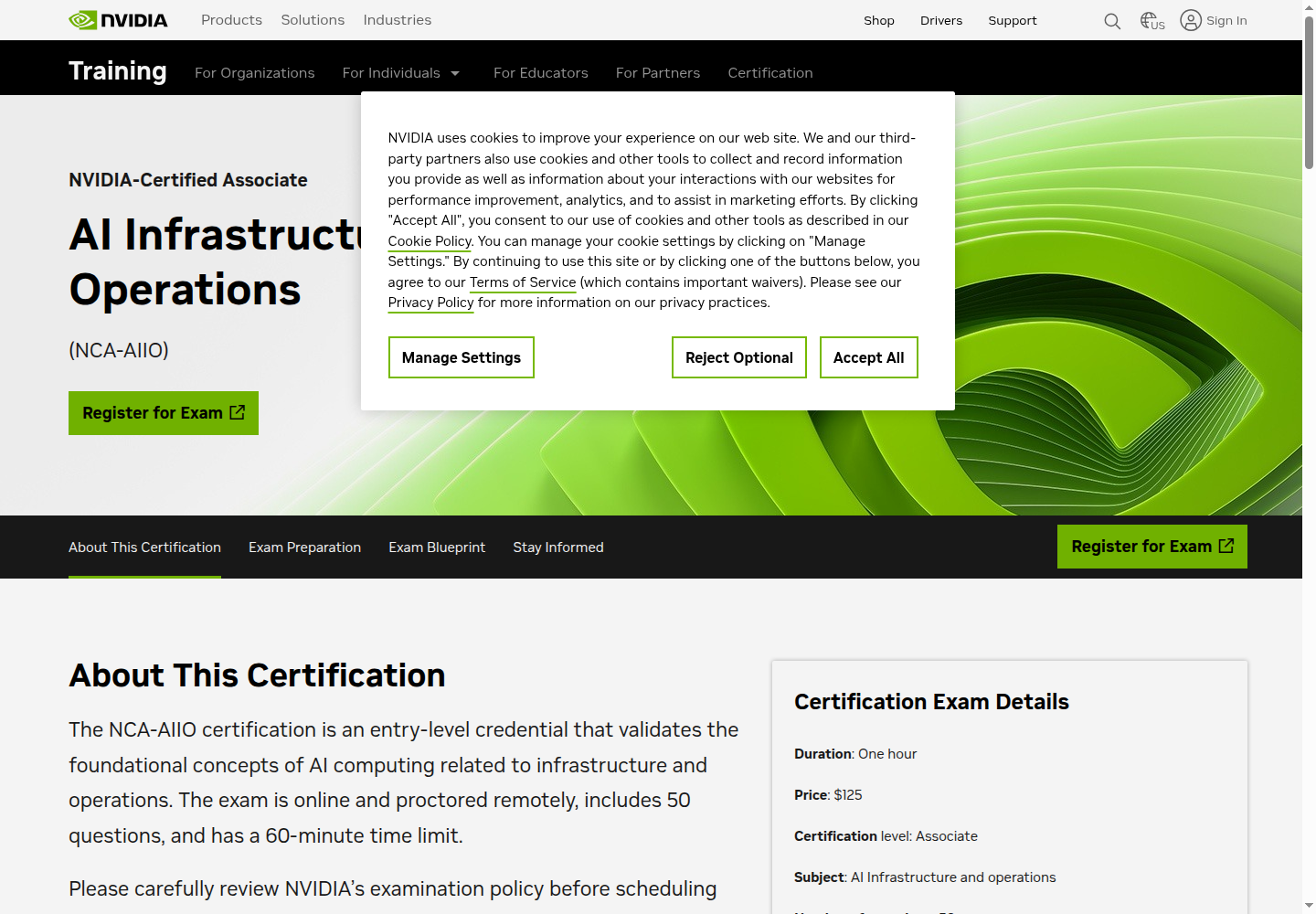
| Category | Verdict |
|---|---|
| Best for | System administrators, data-center technicians, cloud engineers, and infrastructure support teams |
| Provider | NVIDIA |
| Certification | NVIDIA-Certified Associate: AI Infrastructure and Operations |
| Exam | NCA-AIIO |
| Level | Associate / entry level |
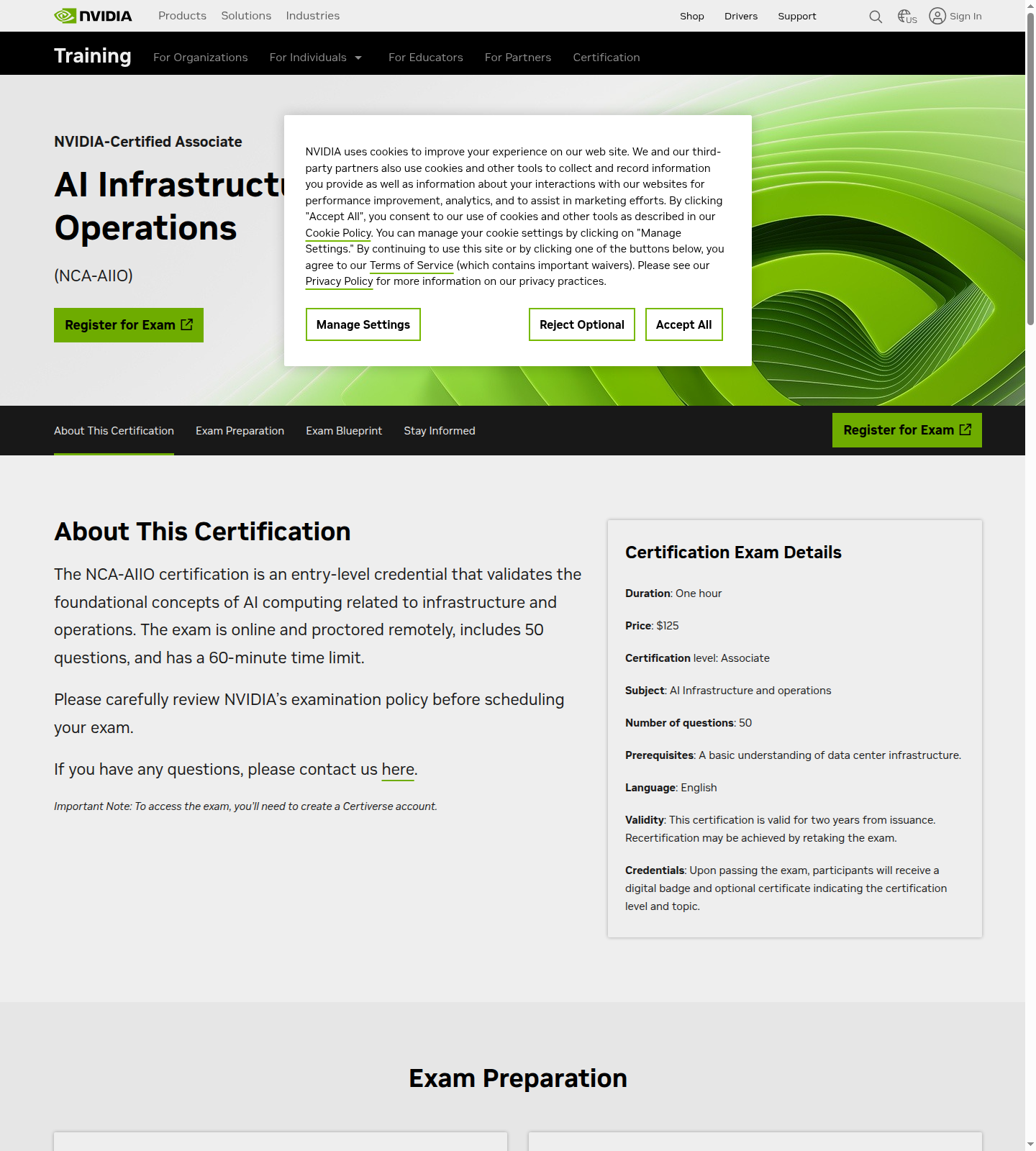
| Exam format | 50 questions, online proctored |
| Exam time | 60 minutes |
| Prerequisite | Basic understanding of data-center infrastructure |
| Validity | Two years from issuance |
| ROI | Strong for people supporting GPU platforms; limited for general desktop support with no AI infrastructure exposure |
What it validates
NVIDIA divides the exam into three useful areas:
- Essential AI Knowledge — 38%: AI, machine learning, and deep-learning concepts; accelerated-computing use cases; CPU and GPU architecture; NVIDIA’s software stack; and the AI development and deployment lifecycle.
- AI Infrastructure — 40%: Hardware selection, GPU scaling, power and cooling, on-premises versus cloud infrastructure, accelerated clusters, data-center networking, and DPUs.
- AI Operations — 22%: Data-center management, monitoring, cluster orchestration, job scheduling, GPU monitoring, and virtualization of accelerated infrastructure.
The weighting is revealing. Infrastructure is the largest domain, so this is a better fit for an infrastructure practitioner than for someone looking for a broad “AI awareness” badge. You should be able to reason about why a workload needs GPUs, what a cluster requires, and which operational signals indicate trouble.
Why it can pay off for IT professionals
AI projects increasingly create work for teams that do not build models. Someone must provision capacity, manage identities and containers, monitor GPU utilization, plan network paths, account for power and cooling, and decide whether a workload belongs on-premises or in the cloud.
NCA-AIIO can support that transition in four ways:
- It connects existing infrastructure skills to AI workloads. Linux, networking, virtualization, hardware support, and monitoring all remain relevant; the credential adds the accelerated-computing context.
- It improves design-review fluency. You can participate more usefully when developers or MLOps engineers discuss inference capacity, GPU memory, cluster scheduling, or DPU offload.
- It gives a portfolio project a defensible structure. A small lab that documents GPU monitoring, container deployment, and capacity assumptions maps better to the exam domains than a vague AI tutorial.
- It is vendor-specific in a useful way. NVIDIA technologies are common in enterprise AI infrastructure. The badge does not replace vendor-neutral systems knowledge, but it can signal familiarity with the ecosystem many employers actually operate.
What the exam does not prove
Do not treat this certification as proof that you can administer a production AI factory independently. The official scope is foundational. It does not substitute for hands-on experience with Kubernetes, Slurm, NVIDIA NGC, NVIDIA AI Enterprise, storage design, incident response, or a specific cloud provider.
It also is not a software-development credential. If your target role is building RAG applications, agent workflows, or model-serving APIs, you will need coding and application-level projects alongside this exam.
A practical preparation plan
Start with the official AI Infrastructure and Operations Fundamentals learning path. Study in the same order as the domain weighting:
- Learn the difference between AI, machine learning, and deep learning, then connect each to real infrastructure demand.
- Build a simple comparison of CPU and GPU workloads, including memory, throughput, latency, and cost considerations.
- Draw an AI cluster architecture showing compute, storage, networking, management, cooling, and power dependencies.
- Practice explaining on-premises versus cloud trade-offs for training and inference.
- Review monitoring and scheduling concepts. Be able to identify what GPU utilization, memory pressure, queue time, and job failure signals tell an operator.
The best companion project is a short infrastructure runbook: choose a hypothetical inference workload, estimate its compute needs, document the network and facility assumptions, define monitoring signals, and write the first five troubleshooting checks. That produces evidence an employer can evaluate even though the exam itself is multiple choice.
Who should take it
This is a sensible choice if you are:
- a system administrator moving toward GPU or AI platform support
- a data-center or hardware technician supporting accelerated servers
- a cloud engineer comparing GPU capacity across deployment models
- a network or infrastructure engineer preparing for AI-cluster work
- an operations professional who needs a foundation before pursuing deeper NVIDIA credentials
It is a weaker choice if you work exclusively in endpoint support, have no access to data-center or cloud infrastructure, or need a certification that proves application development. In those cases, the opportunity cost may be better spent on a cloud, Linux, networking, or programming credential that matches your daily work.
Final recommendation
NCA-AIIO is worth it for infrastructure-focused IT professionals who want a credible entry point into AI operations. The exam is short, but the subject is not superficial: power, cooling, networking, GPU architecture, cluster scheduling, and monitoring are real operational concerns.
The credential has limited standalone value. Pair it with a lab, a documented architecture, or an AI-platform support project. That combination turns a foundational badge into a clearer career signal and helps you show that you understand AI as an operating environment—not just as a model or chatbot.