Microsoft Certified: Azure Administrator Associate (AZ-104): Worth It for AI-Focused IT Pros?
AI services do not operate in a vacuum. Someone still has to configure identity, networking, compute, storage, policy, monitoring, and recovery around them. Microsoft Certified: Azure Administrator Associate is Microsoft’s intermediate administrator credential for those operational responsibilities, assessed through exam AZ-104.
It is not an AI certification and it does not prove that you can train a model or build a retrieval-augmented generation application. Its relevance is more practical: it validates the Azure platform skills that keep AI-enabled workloads secure, available, governable, and supportable.
Quick verdict
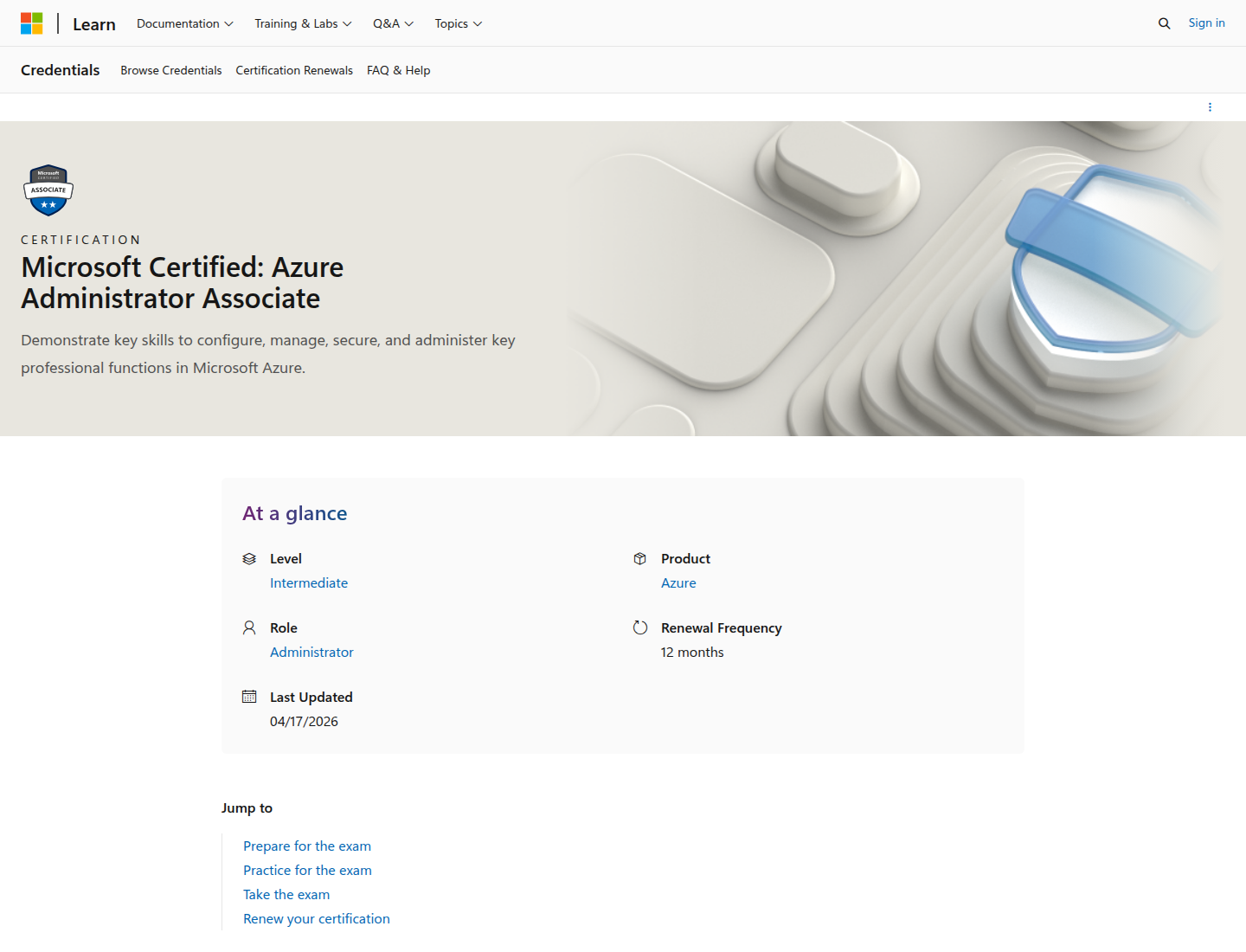
| Category | Verdict |
|---|---|
| Best for | Azure administrators, sysadmins, cloud support engineers, and platform technicians moving into AI infrastructure |
| Provider | Microsoft |
| Certification | Microsoft Certified: Azure Administrator Associate |
| Exam | AZ-104: Microsoft Azure Administrator |
| Level | Intermediate |
| Exam time | 100 minutes, proctored |
| Renewal | 12 months |
| Prerequisites | Microsoft lists no formal prerequisite; practical Azure administration experience is expected |
| AI relevance | Indirect but foundational: identity, governance, compute, storage, networking, and monitoring |
| ROI | Strong for Azure operations roles; insufficient alone for an AI engineering role |
What Microsoft says AZ-104 validates
Microsoft describes the credential as demonstrating the ability to configure, manage, secure, and administer key Azure functions. The certification page identifies the target candidate as someone who implements, manages, and monitors an Azure environment, including:
- virtual networks
- storage
- compute
- identity
- security
- governance
Microsoft also expects familiarity with operating systems, networking, servers, virtualization, PowerShell, Azure CLI, the Azure portal, Azure Resource Manager templates or Bicep, and Microsoft Entra ID. That combination makes the credential a natural bridge for an experienced desktop or infrastructure professional who is adding cloud and AI support duties.
The five exam areas
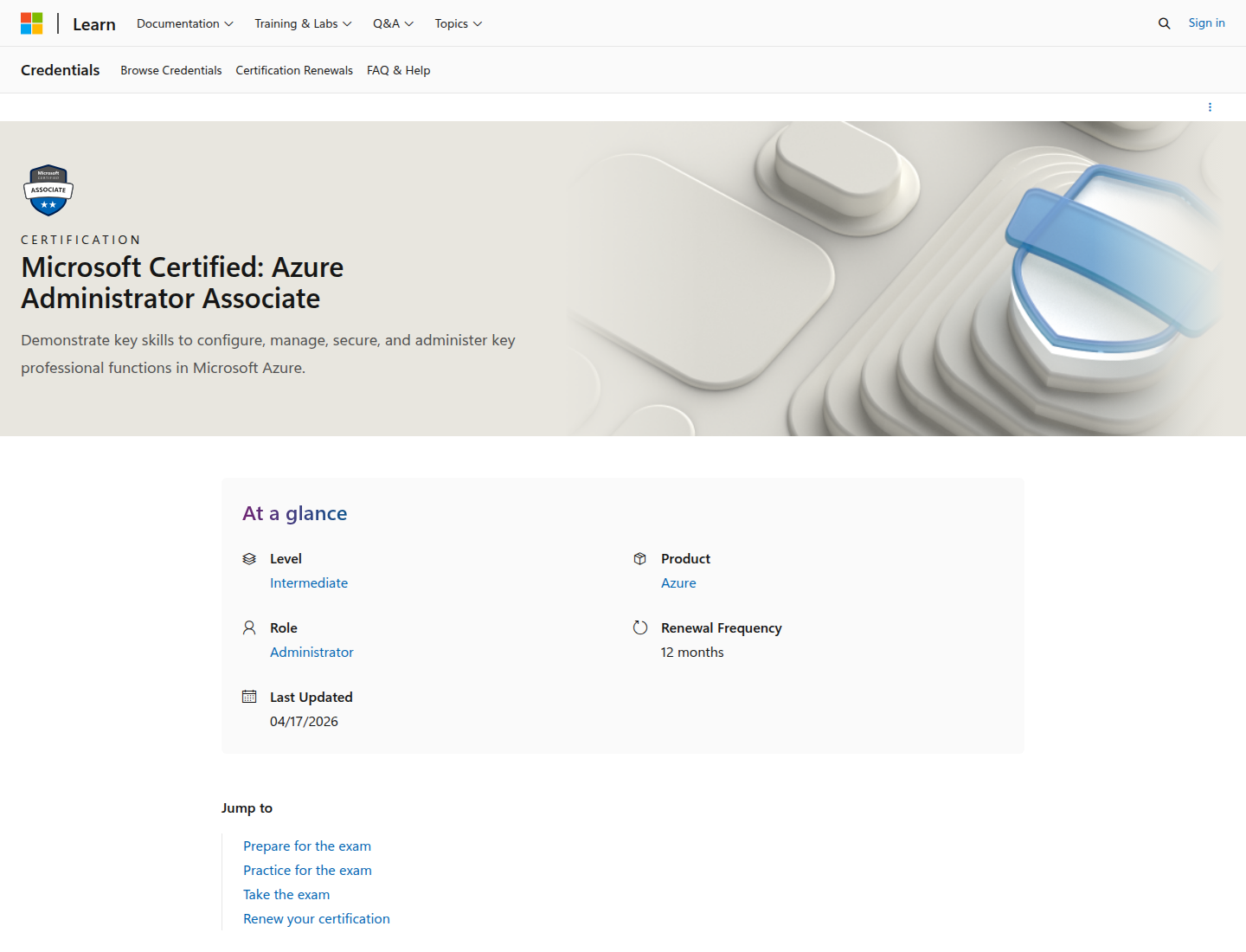
Microsoft currently lists five assessed areas for AZ-104:
- Manage Azure identities and governance — Microsoft Entra ID, role-based access control, subscriptions, policy, and governance.
- Implement and manage storage — configuring and protecting Azure storage services and access.
- Deploy and manage Azure compute resources — virtual machines, containers, and related compute administration.
- Implement and manage virtual networking — connectivity, network security, and traffic control.
- Monitor and maintain Azure resources — operational visibility, alerts, backup, and continuity practices.
These are not merely background topics for AI. They determine whether an AI application can reach its data, whether a service account has excessive permissions, whether private endpoints are configured correctly, and whether an expensive workload can be monitored and controlled.
Why it matters for AI-focused IT work
An AI project may involve Azure AI Foundry, Azure OpenAI, Azure AI Search, or a third-party model hosted on Azure. The administrator credential does not certify expertise in those products, but it covers the platform controls surrounding them.
Identity and least privilege
AI applications commonly use managed identities, service principals, storage accounts, search indexes, and deployment pipelines. Understanding Entra ID and Azure RBAC helps an administrator grant the application only the access it needs instead of distributing broad keys or owner permissions.
Network and data boundaries
Enterprise AI workloads often need private connectivity, segmentation, firewall rules, and controlled access to storage or search services. AZ-104 preparation gives an IT professional the Azure networking vocabulary and operational foundation to troubleshoot those boundaries.
Cost and resource governance
Model inference, vector indexing, logging, and GPU-backed compute can produce unexpected spend. Azure Policy, tags, subscriptions, budgets, and monitoring are administrator concerns. They are also part of making an AI pilot safe enough to operate beyond a demo.
Recovery and supportability
A production AI service still needs backups, alerts, diagnostic logs, and a response process. The administrator credential is useful when the job is to keep the surrounding platform healthy rather than to choose a model or tune a prompt.
Microsoft’s official preparation path
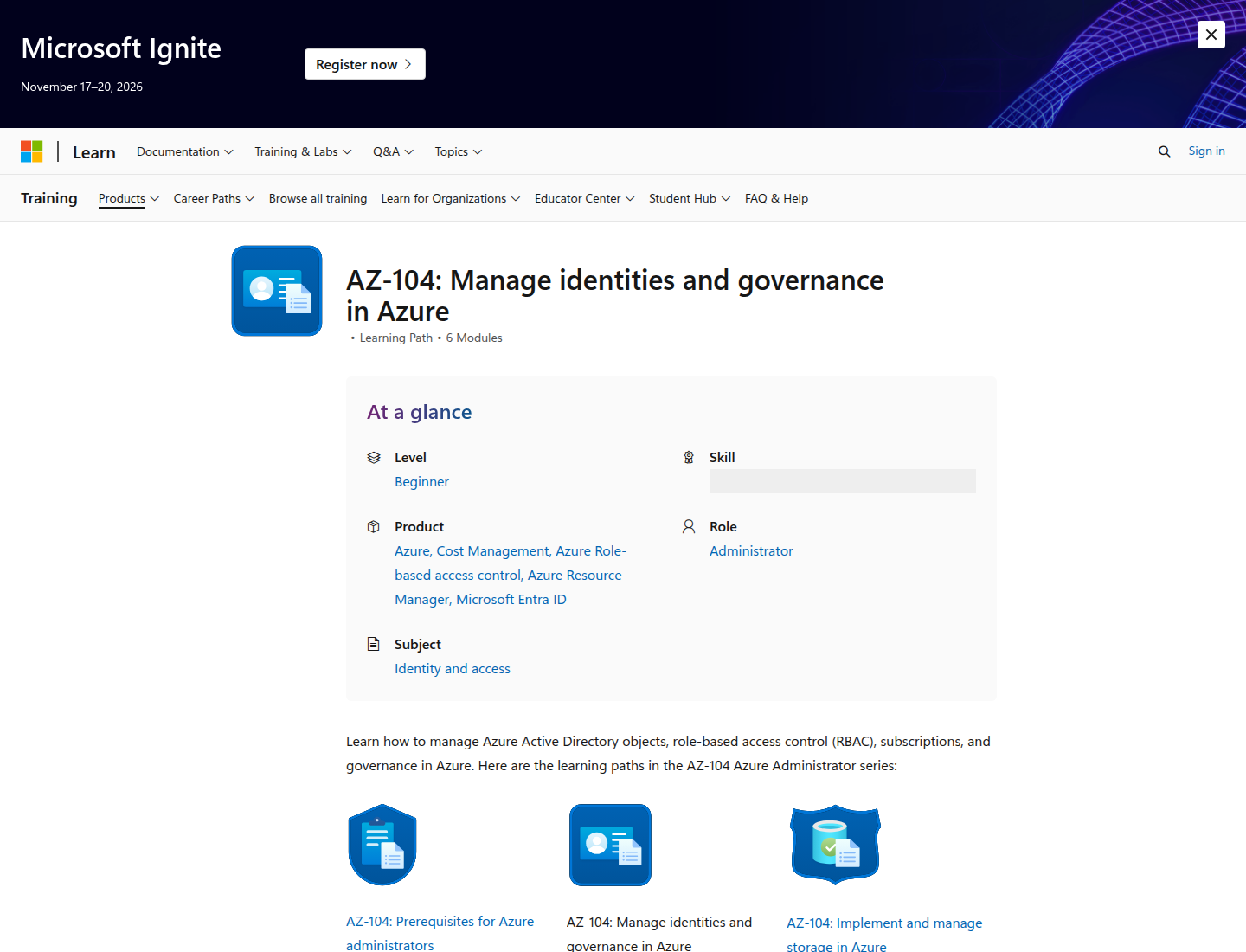
Microsoft’s AZ-104 learning catalog includes separate paths for prerequisites, identities and governance, storage, compute, networking, and monitoring and backup. The identities-and-governance path currently contains six modules and covers Entra ID, identities, Azure architecture, Azure Policy initiatives, Azure RBAC, and self-service password reset.
A sensible preparation sequence is:
- build or refresh Azure fundamentals;
- complete the AZ-104 administrator learning paths;
- administer a small Azure environment rather than only reading documentation;
- practice with Azure CLI, PowerShell, Bicep, RBAC, policy, storage, networking, and monitoring;
- use Microsoft’s practice assessment and exam sandbox before scheduling the proctored exam.
The hands-on step matters. A candidate who can explain Azure services but has never diagnosed a permission, route, storage, or alerting problem will find the scenario-based questions harder than the product list suggests.
What AZ-104 does not prove
This credential should not be marketed as an AI engineering certification. It does not establish that a candidate can:
- design prompts or evaluate model quality;
- build a RAG system or agent;
- train, fine-tune, or deploy a machine-learning model;
- implement responsible-AI evaluation;
- design an end-to-end AI application architecture;
- operate GPU clusters at specialist depth.
For those goals, AZ-104 is a platform foundation. An AI-focused candidate would normally pair it with a more direct credential or project involving Azure AI, data engineering, security, or application development.
Career fit and ROI
AZ-104 is a good choice when the job description includes Azure administration, cloud operations, identity, networking, resource governance, or support for application teams. It is especially defensible for a Windows or Microsoft 365 administrator whose organization is moving workloads and AI services into Azure.
The ROI is weaker if the target role is exclusively machine learning engineering, data science, prompt engineering, or AI application development. In those cases, the certification may still remove a platform-skills gap, but it should not be the only credential on the plan.
Bottom line
Microsoft Certified: Azure Administrator Associate is worth it for AI-focused IT pros who will operate the Azure platform around AI workloads. It provides a concrete, recognizable baseline in identity, governance, compute, storage, networking, and monitoring.
It is not a shortcut into AI engineering. Treat it as the operations layer: earn it when you need to make Azure-based AI systems secure and supportable, then add a specialized AI, data, security, or development credential that matches the role you actually want.