Microsoft Certified: Azure Cosmos DB Developer Specialty: Worth It for AI-Focused IT Pros?
AI applications are only as useful as the data layer behind them. A chatbot, retrieval-augmented generation system, or agent still needs a database that can store application state, retrieve information quickly, scale predictably, and enforce security boundaries. Microsoft Certified: Azure Cosmos DB Developer Specialty (exam DP-420) focuses on that implementation layer.
This is one certification—not a roundup. It is a practical option for IT professionals who want to move from general cloud operations into cloud-native application data, AI backends, or Azure platform support.
Quick verdict
| Category | Verdict |
|---|---|
| Provider | Microsoft |
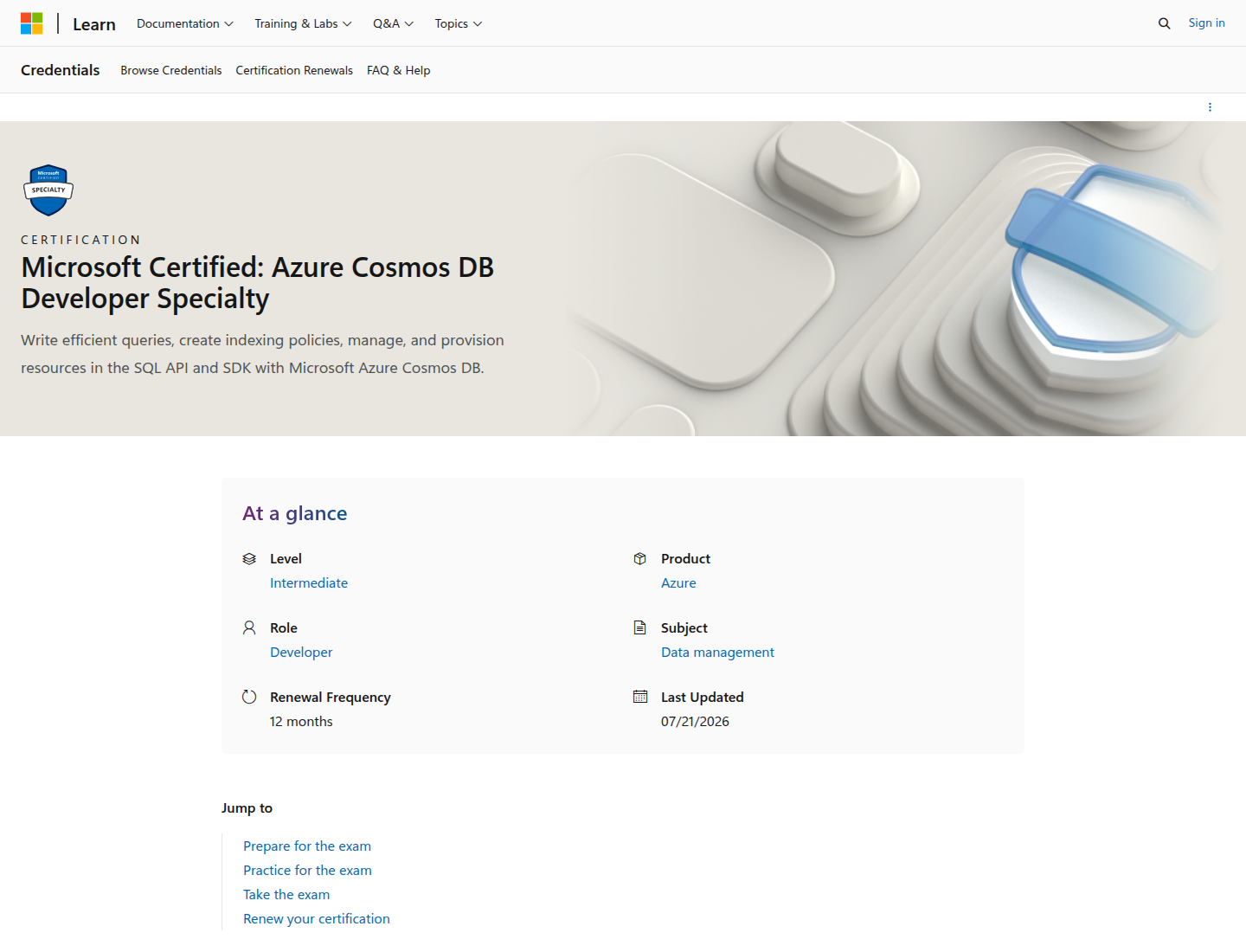
| Credential | Microsoft Certified: Azure Cosmos DB Developer Specialty |
| Exam | DP-420: Designing and Implementing Cloud-Native Applications Using Microsoft Azure Cosmos DB |
| Level | Intermediate |
| Best fit | Azure developers, platform engineers, data engineers, and IT pros supporting AI applications |
| AI relevance | Indirect but practical: application data, retrieval, scale, resilience, and security |
| Main limitation | It is not an AI model-development or prompt-engineering certification |
| My take | Worth it when your organization runs Azure-native data or AI applications and you can build hands-on |
Official pages: certification overview and DP-420 study guide.
What DP-420 actually validates
Microsoft describes the role as designing, implementing, and monitoring cloud-native applications that store and manage data. The candidate is expected to design data models and data distribution, load data into Azure Cosmos DB, optimize and maintain the solution, and integrate it with other Azure services.
The practical baseline is specific. Microsoft expects experience developing Azure applications and working with Cosmos DB database technologies, including the SQL API, JavaScript server-side objects, indexing, JSON, and SDK-based application development. The page also calls out reading C# or Java code, using PowerShell, and provisioning and managing Azure resources.
That makes DP-420 more technical than a general cloud-fundamentals credential. It tests whether you can make a cloud-native data service usable and supportable—not merely explain what Cosmos DB is.
Current exam scope
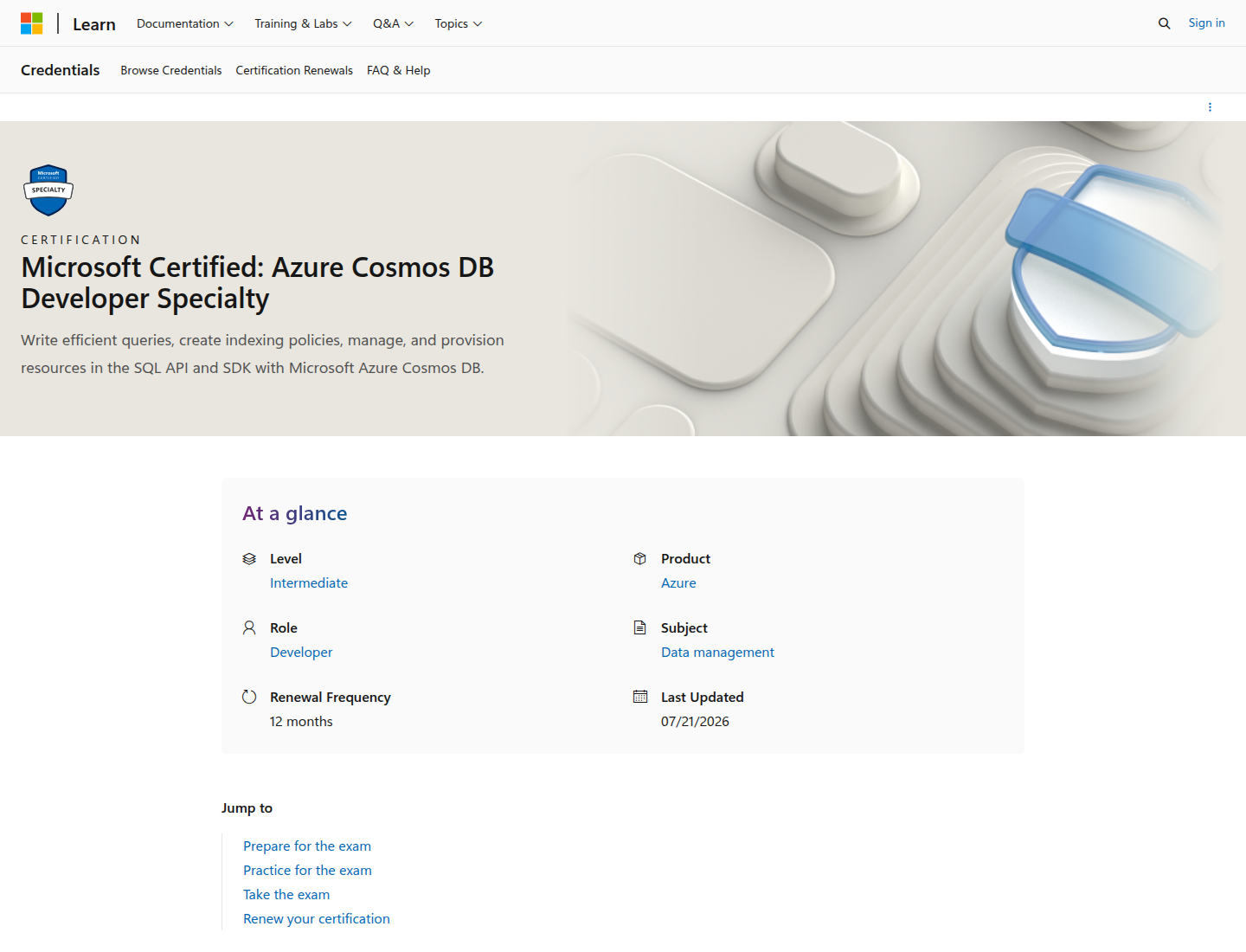
Microsoft’s current study guide, listed as updated July 21, 2026, organizes the assessment around five domains:
- Design and implement data models (35–40%): partitioning, data modeling, consistency, and choosing an appropriate API and data layout.
- Design and implement data distribution (15–20%): distribution, replication, availability, and routing data to meet application requirements.
- Integrate an Azure Cosmos DB solution (15–20%): SDKs, change feed, Azure Functions, Azure services, and application integration.
- Optimize an Azure Cosmos DB solution (5–10%): query performance, indexing, throughput, and cost-aware design.
- Maintain an Azure Cosmos DB solution (25–30%): monitoring, backup and restore, security, resilience, and operational maintenance.
The certification page states that the exam is 100 minutes, is proctored, and may include interactive components. Microsoft lists a passing score of 700 or greater in the study guide. The certification is a Microsoft specialty credential and renews every 12 months through a free online assessment on Microsoft Learn.
Why this matters for AI-supporting IT teams
DP-420 does not teach transformer architecture, model training, or prompt design. Its AI value is operational:
- AI applications need fast retrieval. Partitioning, indexing, query design, and distribution affect the latency users feel when an agent retrieves context or application state.
- AI systems are stateful services. Conversation history, user preferences, workflow state, and feedback need reliable storage and lifecycle management.
- Scale and cost are engineering problems. A successful AI proof of concept can become expensive or unstable when throughput, partition keys, and indexing are poorly chosen.
- Security is part of the data path. Identity, access control, network boundaries, backup, and resilience matter when AI features touch business records.
- IT becomes a stronger platform partner. Understanding the database behind an AI service lets an endpoint or systems engineer troubleshoot the whole service instead of treating the model endpoint as a black box.
The best fit is someone already supporting Azure, APIs, application platforms, or data services who wants a concrete bridge into AI infrastructure.
The hands-on assessment challenge
The hard part is not memorizing Azure product names. It is making trade-offs under real workload constraints. Preparation should include hands-on practice with:
- partition-key and data-model decisions
- SQL queries and indexing policies
- SDK access from a small application
- consistency, replication, and regional distribution
- change feed and event-driven integration
- throughput, latency, and cost monitoring
- identity, security, backup, and recovery behavior
For an IT administrator, the unfamiliar area will usually be application code and data modeling. For a developer, the unfamiliar area may be operational ownership: monitoring, resilience, permissions, and recovery. The credential is valuable only if you close that gap with a working lab.
A preparation plan for IT professionals
1. Start with one small application
Build a simple API that stores users, conversations, or device inventory in Cosmos DB for NoSQL. Add a query that retrieves records by the partition key and measure what happens when the query does not use it.
2. Make the design decisions explicit
Document why you chose the partition key, consistency level, indexing policy, and throughput model. DP-420 rewards engineering judgment, and a written decision log exposes weak assumptions quickly.
3. Add an Azure integration
Use the SDK with an Azure Function or another small service, then test change-feed behavior. This turns the certification from a database-reading exercise into cloud-native application practice.
4. Practice failure and maintenance paths
Test monitoring alerts, throttling, permissions, backup options, and recovery procedures. AI services are production services; support teams need to know what happens when latency rises or a dependency is unavailable.
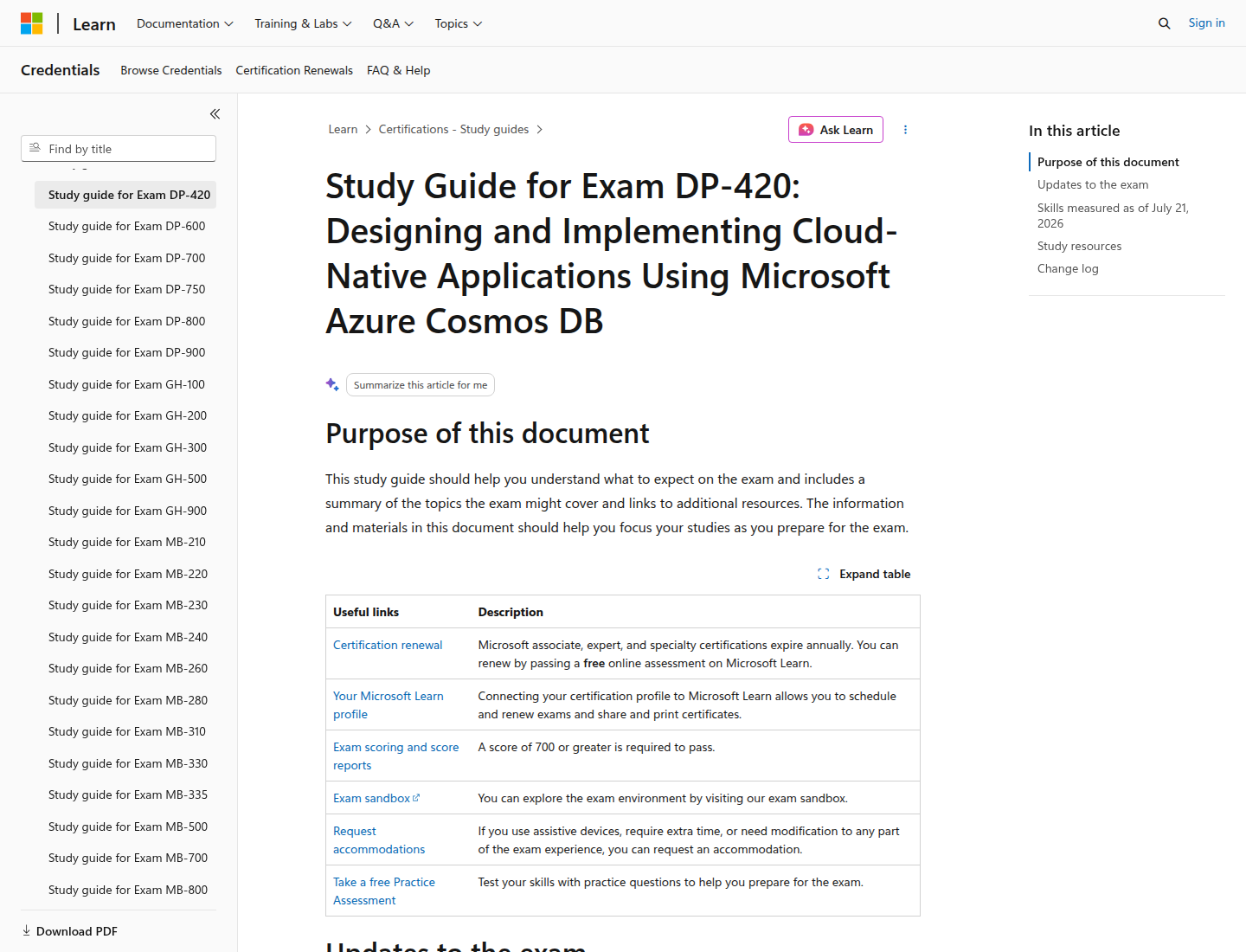
5. Use Microsoft’s study guide and practice assessment
Start with the largest domains—data models and maintenance—then use the official practice assessment to identify gaps. Practice questions should guide study, not replace building and testing.
DP-420 versus a direct AI certification
If your goal is to build or deploy models, an Azure AI, machine-learning, or generative-AI credential is a more direct signal. If your goal is to support the application and data platform those systems depend on, DP-420 can be more useful than another broad AI overview.
Choose DP-420 when you want to:
- support Azure-native AI applications or agent backends
- move from endpoint or systems operations into platform engineering
- own data reliability, performance, and recovery for cloud applications
- become the bridge between infrastructure, developers, and data teams
Skip it for now if your daily work has no Azure or application-data component and you are still learning basic cloud concepts. In that case, fundamentals plus a small Azure lab will produce a better return first.
Final recommendation
Microsoft Certified: Azure Cosmos DB Developer Specialty is worth it for AI-focused IT pros when the target role includes Azure application data, platform operations, or cloud-native service reliability. It is not an AI certification in the narrow sense, but it validates a layer that AI products cannot avoid: storing, retrieving, securing, and operating data at application scale.
Treat DP-420 as a build-and-operate credential. Pair the exam with a small working service, a documented partitioning decision, monitored queries, and a tested recovery path. That combination will signal more practical readiness than the badge alone.