
Google Cloud Associate Cloud Engineer: Worth It for AI-Focused IT Pros?
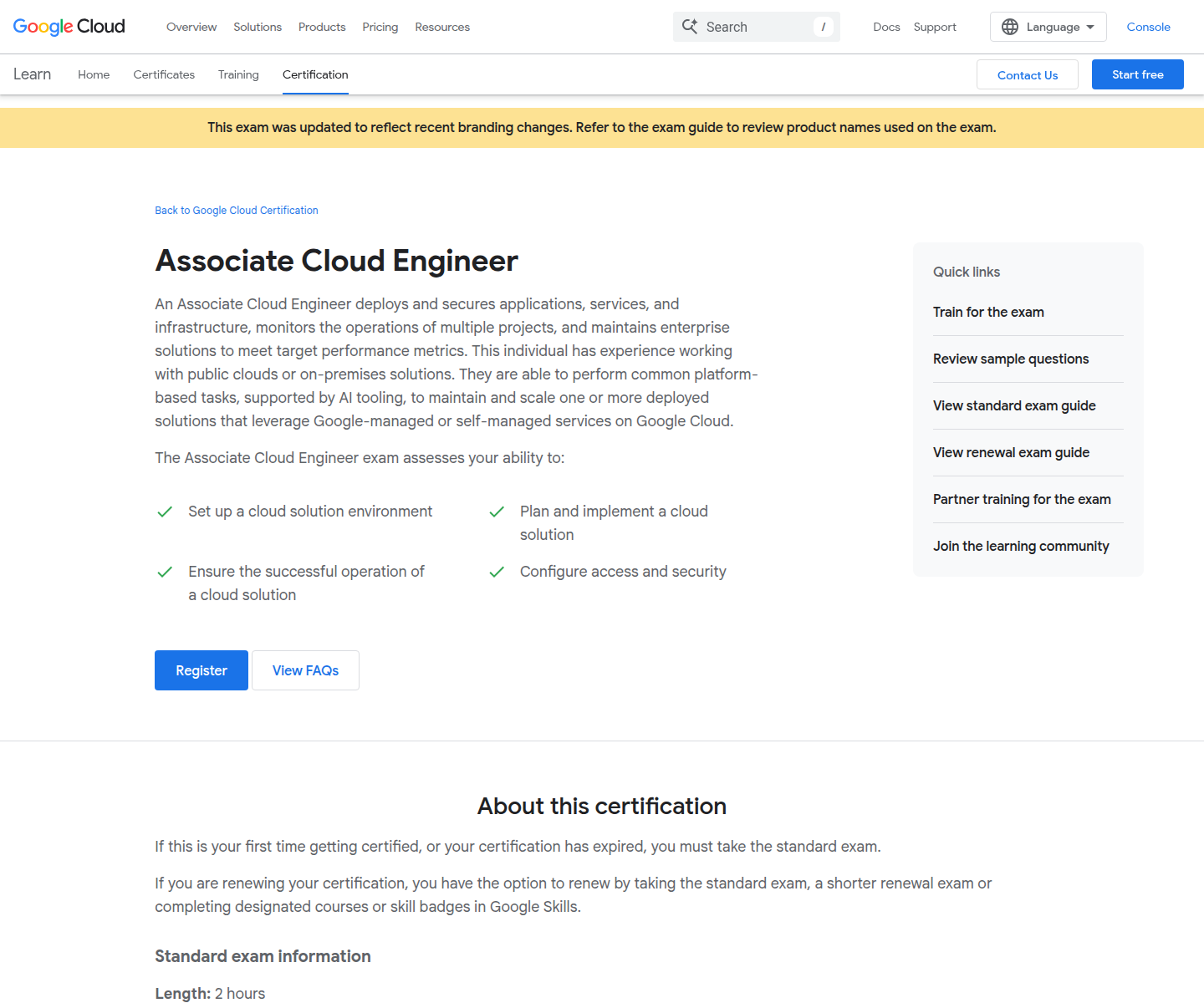
Google Cloud’s Associate Cloud Engineer (ACE) is not an AI-model certification. It validates the operational layer that AI workloads still depend on: deploying applications, configuring access, managing compute and storage, monitoring services, and maintaining cloud environments. For an IT professional moving from endpoint or systems administration into AI infrastructure, that makes ACE a credible foundation rather than a shortcut into machine learning.
Quick verdict
| Category | Verdict |
|---|---|
| Provider | Google Cloud |
| Credential | Associate Cloud Engineer |
| Best for | Sysadmins, cloud support engineers, platform technicians, and infrastructure administrators |
| Exam length | Two hours |
| Format | 50–60 multiple-choice and multiple-select questions |
| Registration fee | $125 plus applicable tax |
| Languages | English, Japanese, Spanish, and Portuguese |
| Prerequisites | None |
| Recommended experience | Six or more months of hands-on Google Cloud experience |
| Validity | Three years |
| AI relevance | Indirect but useful for operating AI platforms and services |
Bottom line: ACE is worth considering when you need a first Google Cloud credential and your target work includes the infrastructure around AI. It is not the right choice if you need proof of model development, prompt engineering, data science, or generative-AI application design.
What the certification actually proves
Google’s official certification page positions ACE around deploying and implementing applications, monitoring operations, and managing cloud solutions. That translates into practical responsibilities such as:
- provisioning and configuring compute resources;
- managing storage and data access;
- configuring identity and permissions;
- monitoring availability and service health;
- deploying workloads through repeatable operational procedures; and
- supporting secure, resilient cloud environments.
Those skills matter in AI environments because model endpoints, vector-search services, data pipelines, notebooks, batch jobs, and internal AI applications all require reliable cloud administration. The credential does not prove that you can train a model, but it can show that you understand the platform where the model runs.
Where ACE helps an AI-focused IT career
1. It creates a bridge from systems administration to cloud operations
Many desktop and systems engineers already understand change control, access management, incident response, and service reliability. ACE gives those habits a Google Cloud vocabulary: projects, IAM, compute, storage, networking, monitoring, and deployment.
2. It improves conversations with AI engineering teams
An infrastructure engineer does not need to be the person writing Python model code to be valuable on an AI platform team. Understanding how services are deployed, secured, monitored, and cost-controlled makes handoffs between infrastructure, security, and application teams more precise.
3. It supports practical AI-adjacent projects
ACE preparation can support work such as hosting an internal AI API, configuring a managed database for an application, setting permissions for a data-science project, or monitoring a cloud workload that calls a model service. Those are operational outcomes, not vague AI literacy claims.

What ACE does not cover deeply
Do not buy this exam expecting it to validate:
- machine-learning algorithms or model evaluation;
- generative-AI prompting or fine-tuning;
- responsible-AI policy design;
- advanced data engineering; or
- production MLOps at a professional level.
For those goals, ACE should be treated as a prerequisite or platform foundation. A later specialization can then demonstrate data, machine-learning, security, networking, or application-development depth.
Exam and preparation strategy
Google lists no prerequisites and recommends at least six months of hands-on experience. That recommendation is important: reading service descriptions alone is a weak preparation method. Build a small project and practice the operational loop:
- create a project with a controlled budget;
- deploy a simple service;
- configure least-privilege access;
- store and retrieve data securely;
- add monitoring and logging; and
- remove resources and review the bill.
Use Google’s Cloud Engineer Learning Path and the official exam guide as the source of truth for objectives. The standard exam is two hours, uses 50–60 multiple-choice and multiple-select questions, and can be taken online with remote proctoring or at a testing center. The credential is valid for three years.
Is it worth it for a sysadmin?
Yes, if you are moving toward cloud operations, platform engineering, AI infrastructure support, or Google Cloud administration and can get hands-on practice before sitting the exam.
Probably not yet, if your immediate goal is AI application development, model engineering, or an introductory understanding of generative AI. In those cases, a more specialized learning path will produce stronger evidence of the skill you actually want to sell.
ACE is best viewed as an infrastructure credential with AI-adjacent value. That is a narrower claim than calling it an AI certification, but it is also the more honest one.