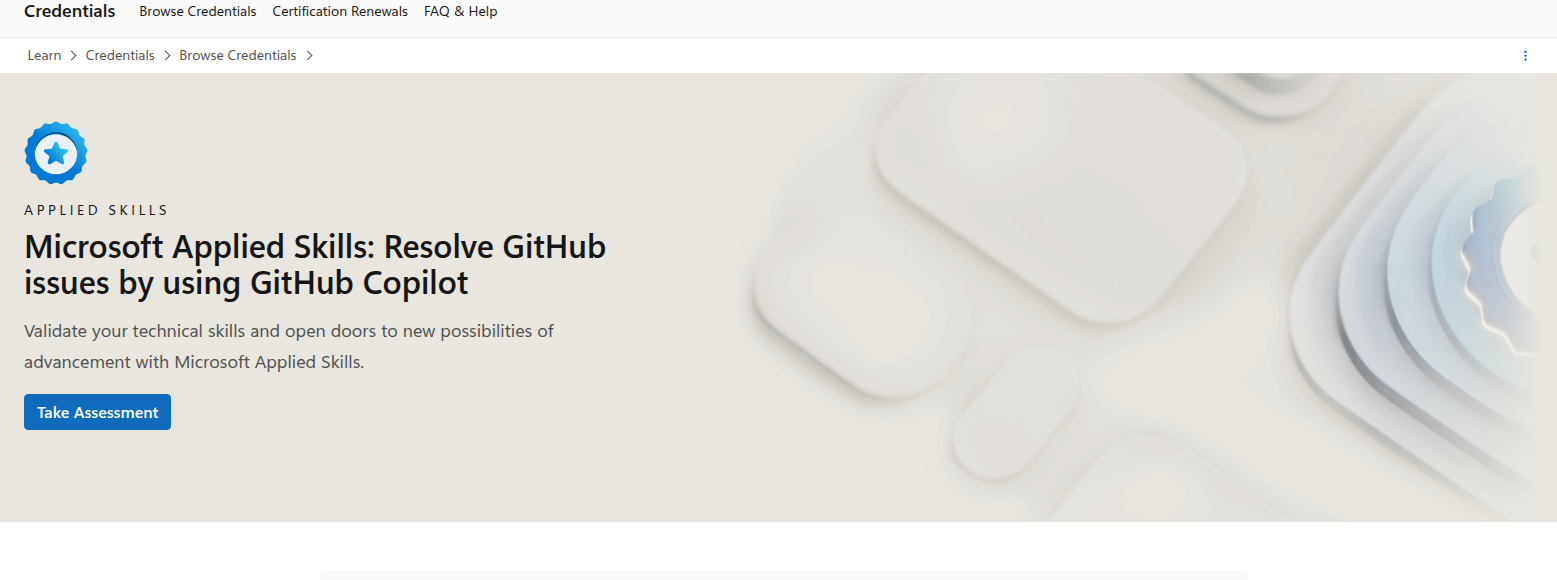
Microsoft Applied Skills: Resolve GitHub issues by using GitHub Copilot — Worth It for DevOps-Minded SysAdmins?
If you are a desktop engineer or sysadmin who now spends time in GitHub, VS Code, scripts, and internal engineering workflows, this Microsoft Applied Skills badge is one of the more practical AI credentials I found.
It is not a broad AI literacy cert. It is not an ML theory course. It is a hands-on interactive lab that checks whether you can use GitHub Copilot to investigate, resolve, and close GitHub issues.
That makes it unusually relevant for IT pros who are moving beyond endpoint-only work and into the messy reality of operational automation, repo-backed tooling, and devops collaboration.
Quick verdict
| Category | Verdict |
|---|---|
| Best for | DevOps-minded sysadmins, desktop engineers, and support engineers who already use GitHub and VS Code |
| Provider | Microsoft Learn |
| Credential type | Applied Skills badge |
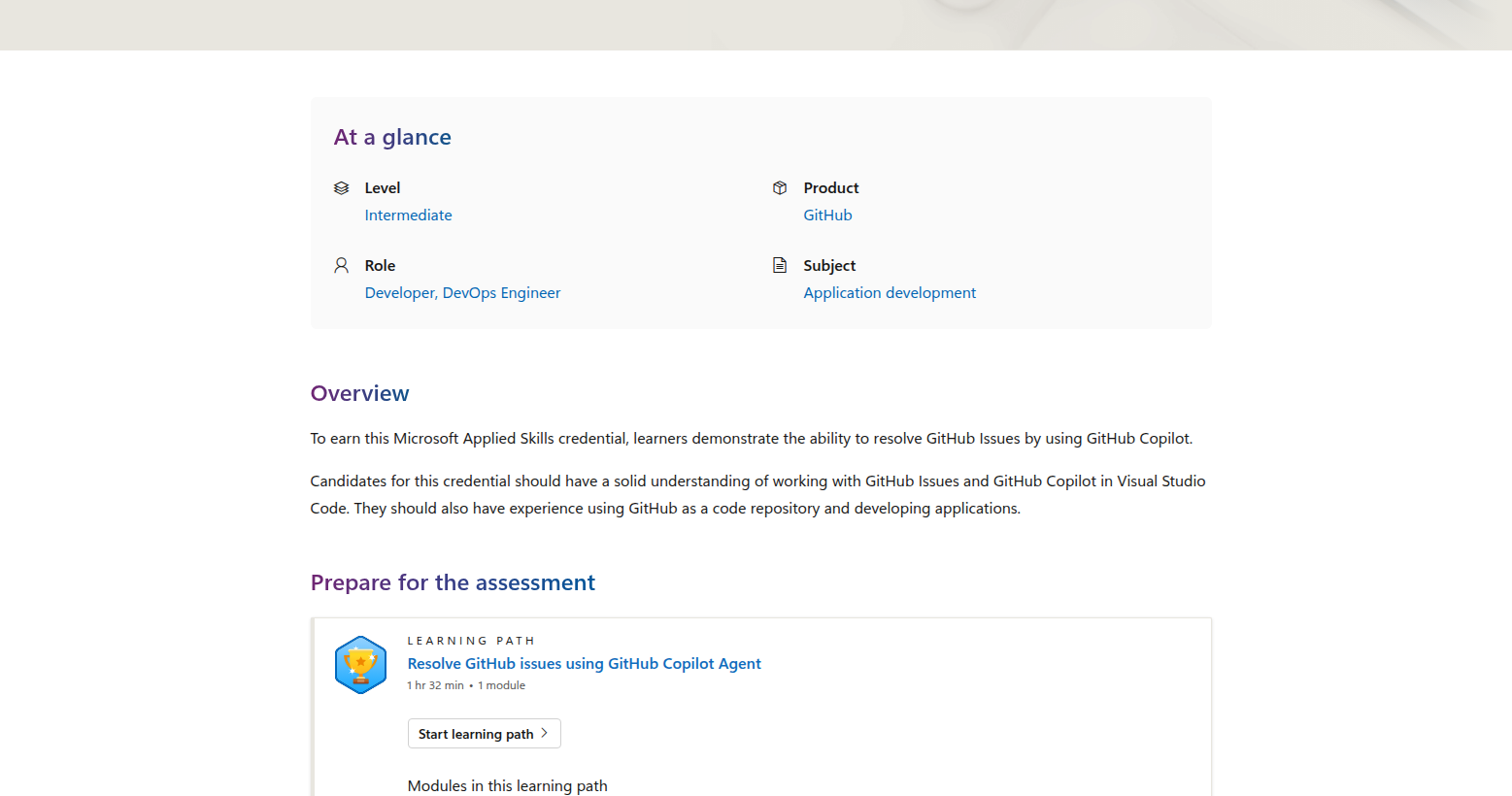
| Level | Intermediate |
| Assessment | 45-minute interactive lab |
| Prep path | 1 hr 32 min learning path, 1 module |
| Practical ROI | High if your work touches GitHub issues, scripts, internal tooling, or AI-assisted triage |
| Biggest strength | Real lab proof instead of trivia-style multiple choice |
| Biggest limitation | Too GitHub/developer-shaped for pure endpoint admins |
Bottom line: if your job already includes repo-based automation or issue triage, this badge proves something useful. If you never touch GitHub, it is probably not your best first AI credential.
What this credential actually proves
Microsoft says this credential validates that learners can resolve GitHub issues by using GitHub Copilot.
The credential page also says candidates should have a solid understanding of:
- working with GitHub Issues
- using GitHub Copilot in Visual Studio Code
- using GitHub as a code repository
- developing applications
That is a very specific signal. This badge is not trying to prove that you know AI buzzwords. It is trying to prove that you can use Copilot in an actual engineering workflow.
For sysadmins and desktop engineers, that still matters if your day-to-day includes:
- internal scripts and automation
- support tooling owned in GitHub
- engineering handoffs with developers
- issue triage and root-cause work
- documentation and workflow cleanup
- assisting with repo-backed operational tooling
The assessment is the real product
This is where the badge gets interesting.
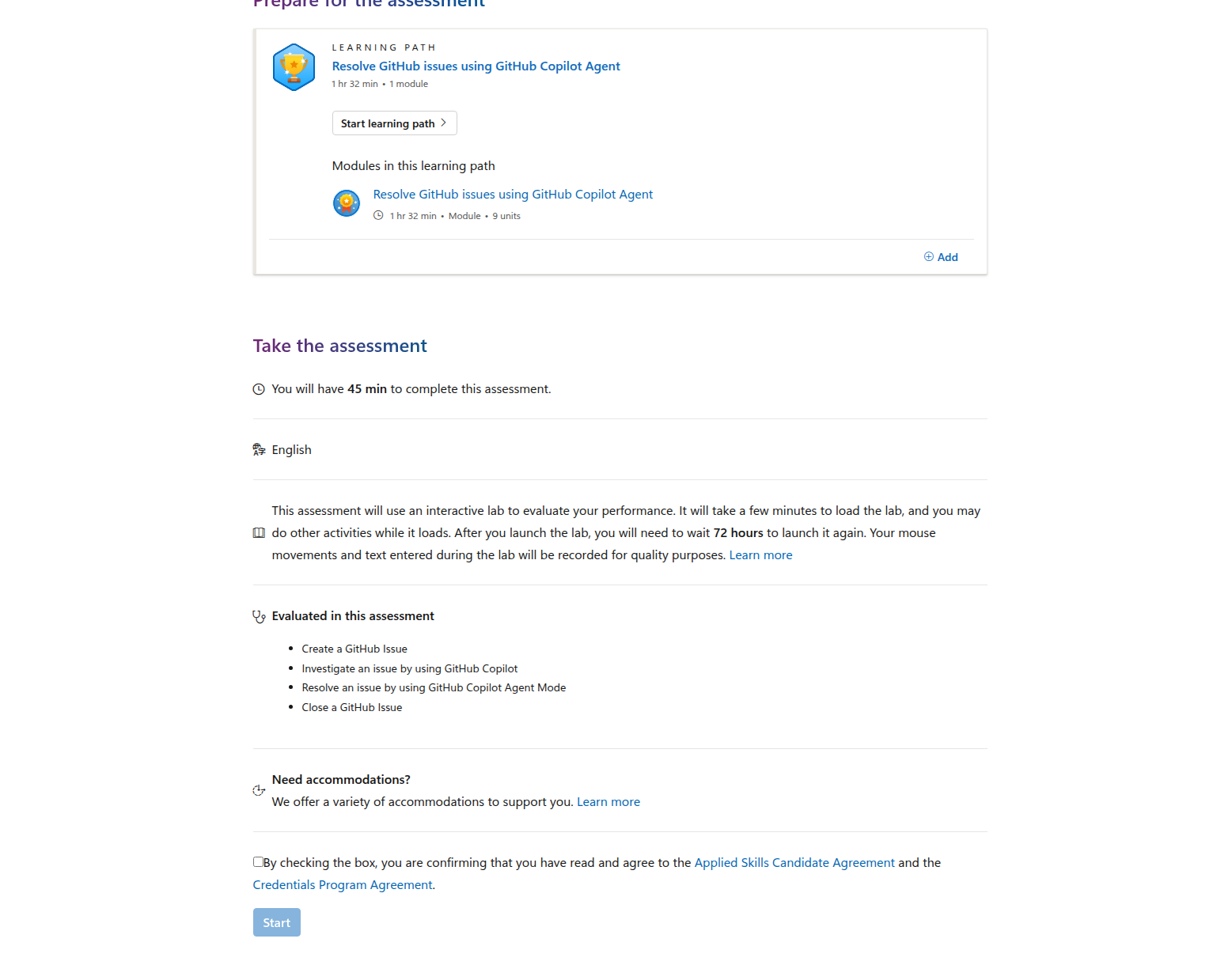
Microsoft lists the assessment as:
- 45 minutes long
- delivered as an interactive lab
- followed by a 72-hour wait before you can launch it again
- with mouse movements and text entered during the lab recorded for quality purposes
That is stronger than a typical knowledge check because it measures whether you can actually do the work.
What you prepare with
The learning path is short:
- Resolve GitHub issues using GitHub Copilot Agent
- 1 hr 32 min
- 1 module
- 9 units
That is lightweight enough to fit into a busy work week, but still specific enough to feel hands-on.
What the lab evaluates
Microsoft says the assessment evaluates whether you can:
- Create a GitHub Issue
- Investigate an issue by using GitHub Copilot
- Resolve an issue by using GitHub Copilot Agent Mode
- Close a GitHub Issue
That workflow is meaningful for IT teams because it mirrors how a lot of modern support and automation work actually gets done:
- somebody files a reproducible issue
- Copilot helps you inspect and summarize the problem
- you use agent mode to accelerate the fix
- you close the loop cleanly in GitHub
Why desktop engineers should care
A lot of AI credentials are either too academic or too generic. This one is neither.
It maps well to the actual work many desktop engineers and sysadmins are doing now:
- handling internal automation repos
- triaging break/fix issues faster
- collaborating with dev teams in GitHub
- improving scripts and small tools
- documenting fixes and investigations
- using AI to reduce the time from issue to resolution
That said, there is an important boundary.
If your role is still mostly pure endpoint policy, device enrollment, imaging, or ticket closure, this badge may be too GitHub-centric to justify first.
If your role already blends operations and engineering, it is a much better fit.
How it compares with AWS, Google Cloud, and Coursera
I looked at the major practical AI options for IT pros across Microsoft, AWS, Google Cloud, and Coursera. This badge wins in one narrow but important area: real workflow proof.
1) AWS Certified AI Practitioner
AWS Certified AI Practitioner is the cloud-side foundation play. It is a good choice if you want beginner-friendly AI fundamentals and AWS branding, but it is still a broad knowledge credential.
For desktop engineers, the ROI is strongest when you are moving into broader cloud and automation work, not when you need proof that you can handle a GitHub issue with Copilot.
2) Google Cloud Generative AI Leader
Google Cloud Generative AI Leader is one of the lowest-friction AI signals you can buy:
- $99
- 90 minutes
- no prerequisites
- 3-year validity
That makes it a strong general AI literacy badge. But it is still an adoption-and-awareness credential, not an operational lab that proves you can solve an engineering task.
3) Coursera AI Mastery for Professionals
Coursera’s AI Mastery for Professionals specialization is excellent if you want practical AI workflow skills without locking into a cloud vendor. It is a 3-course specialization, designed for beginners, with a 4.8 rating from 9,355 reviews and an estimated 4 weeks at 10 hours/week.
That is a great productivity-focused option. But again, it is not a vendor lab that proves you can resolve a live GitHub issue with Copilot Agent Mode.
Practical ranking for IT pros
If I rank these by real-world ROI for DevOps-minded sysadmins, I get:
- Microsoft Applied Skills: Resolve GitHub issues by using GitHub Copilot — best hands-on proof for GitHub-heavy work
- Coursera AI Mastery for Professionals — best vendor-neutral productivity skill builder
- Google Cloud Generative AI Leader — best low-friction AI signal
- AWS Certified AI Practitioner — best if your path is broader AWS/cloud AI fundamentals
That ranking changes if your environment changes. If you live in AWS, AWS may move up. If you need pure AI literacy, Google Cloud may move up. If you want broad AI workflow practice, Coursera may move up. But for issue-driven engineering teams, Microsoft’s badge is the most operational.
Who should skip it
Skip this badge if:
- you never work in GitHub
- you do not touch VS Code or developer tooling
- your job is still mostly endpoint-only administration
- you want broad AI fundamentals instead of a task-specific lab
- you need a beginner cert with minimal workflow assumptions
That is not a criticism of the badge. It just means the credential is optimized for a narrower audience.
Who should absolutely consider it
This badge makes the most sense if you are:
- a sysadmin moving toward devops-style collaboration
- a desktop engineer supporting internal automation tooling
- a support engineer who owns scripts or repo-based runbooks
- an IT pro who needs to show practical Copilot usage, not just AI knowledge
- someone who wants a Microsoft-branded badge with a real lab attached
In that lane, it has a solid ROI.
My recommendation
If you are trying to build a practical AI stack as an IT pro, do not start by chasing the flashiest certification. Start with the credential that matches the work you actually do.
For a GitHub-heavy support or engineering workflow, this Microsoft Applied Skills badge is a strong choice because it proves an operational skill:
you can use AI to move an issue from open to resolved.
That is more valuable than generic AI trivia for a lot of modern IT teams.
If you want, I would treat this as the right credential when your role sits at the intersection of:
- support
- automation
- GitHub
- Copilot
- devops collaboration
If your job is more general AI literacy, Coursera or Google Cloud may be better first steps. If your job is cloud-first credential signaling, AWS is still worth a look.
But if you want a Microsoft badge that proves you can do useful work with Copilot in a real workflow, this one is absolutely worth considering.