Microsoft Certified: Multi-Agent AI Solutions Expert (Beta) — Worth It for IT Pros?
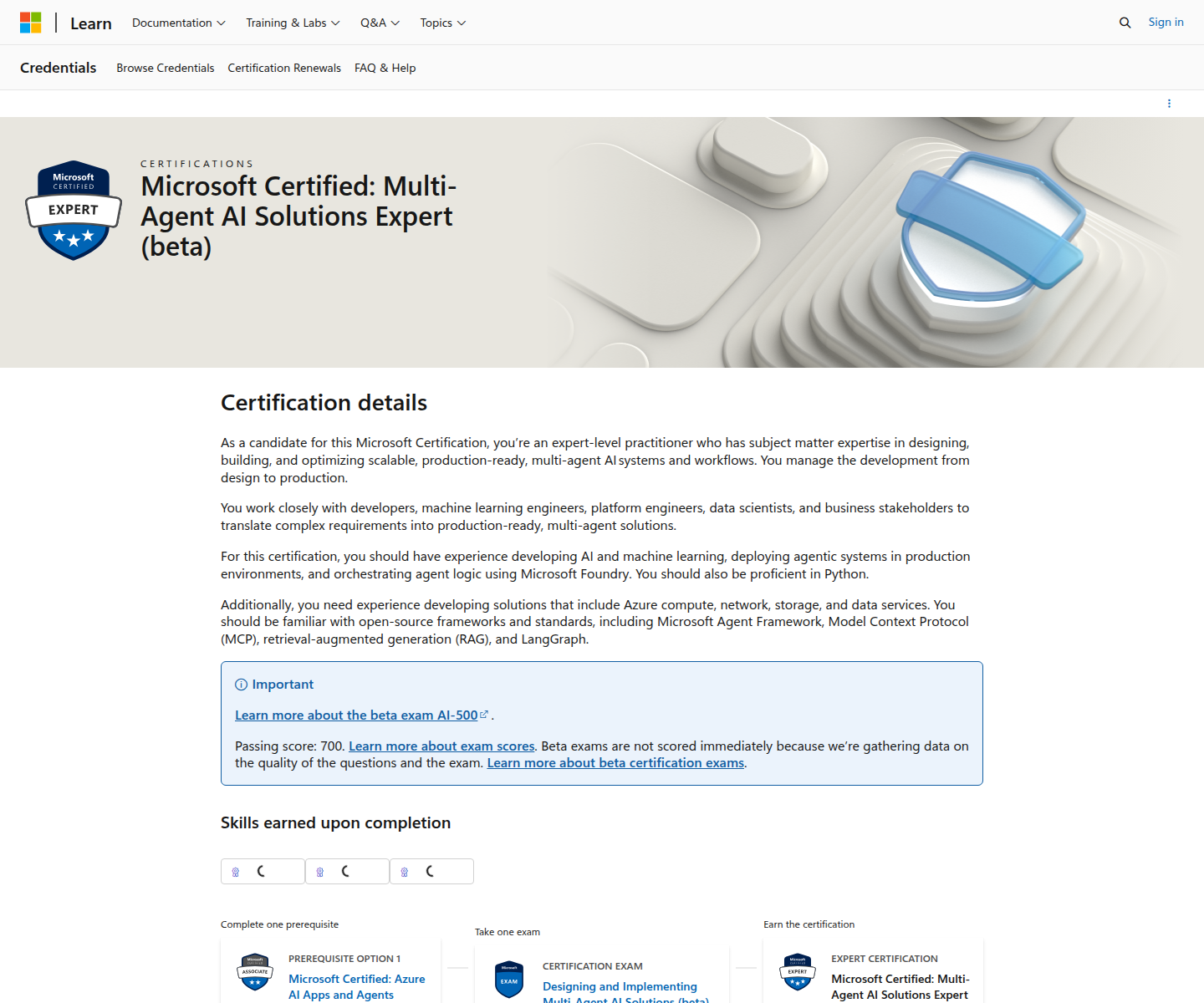
Microsoft’s Multi-Agent AI Solutions Expert is a new beta certification for practitioners who design, build, and operate production-ready multi-agent AI systems. It is not an entry-level prompt-engineering badge. The pathway is aimed at engineers and architects who can connect agent orchestration to Azure services, application code, security, monitoring, and governance.
Quick verdict
| Category | Verdict |
|---|---|
| Provider | Microsoft Learn |
| Credential | Microsoft Certified: Multi-Agent AI Solutions Expert (beta) |
| Required exam | AI-500: Designing and Implementing Multi-Agent AI Solutions (beta) |
| Prerequisite | Microsoft Certified: Azure AI Apps and Agents Developer Associate |
| Best fit | AI engineers, solution architects, platform engineers, and senior cloud administrators moving into agent platforms |
| Core stack | Microsoft Foundry, Azure services, Python, Microsoft Agent Framework, MCP, RAG, and LangGraph |
| Recommendation | Worth considering for experienced Microsoft/Azure practitioners who can demonstrate production engineering depth; premature for general desktop support roles |
What this certification actually validates
Microsoft describes the credential as expert-level. The candidate profile includes experience developing AI and machine-learning systems, deploying agentic systems in production, and orchestrating agent logic with Microsoft Foundry. Microsoft also expects Python proficiency and familiarity with Azure compute, networking, storage, and data services.
That combination is important. The credential is not simply about writing prompts or configuring a chatbot. It is about turning multiple specialized agents and tools into a dependable system that can be evaluated, secured, monitored, and deployed.
The relevant ecosystem includes:
- Microsoft Foundry
- Microsoft Agent Framework
- Model Context Protocol (MCP)
- Retrieval-augmented generation (RAG)
- LangGraph
- Azure compute, network, storage, and data services
- Python-based application development
The AI-500 exam scope
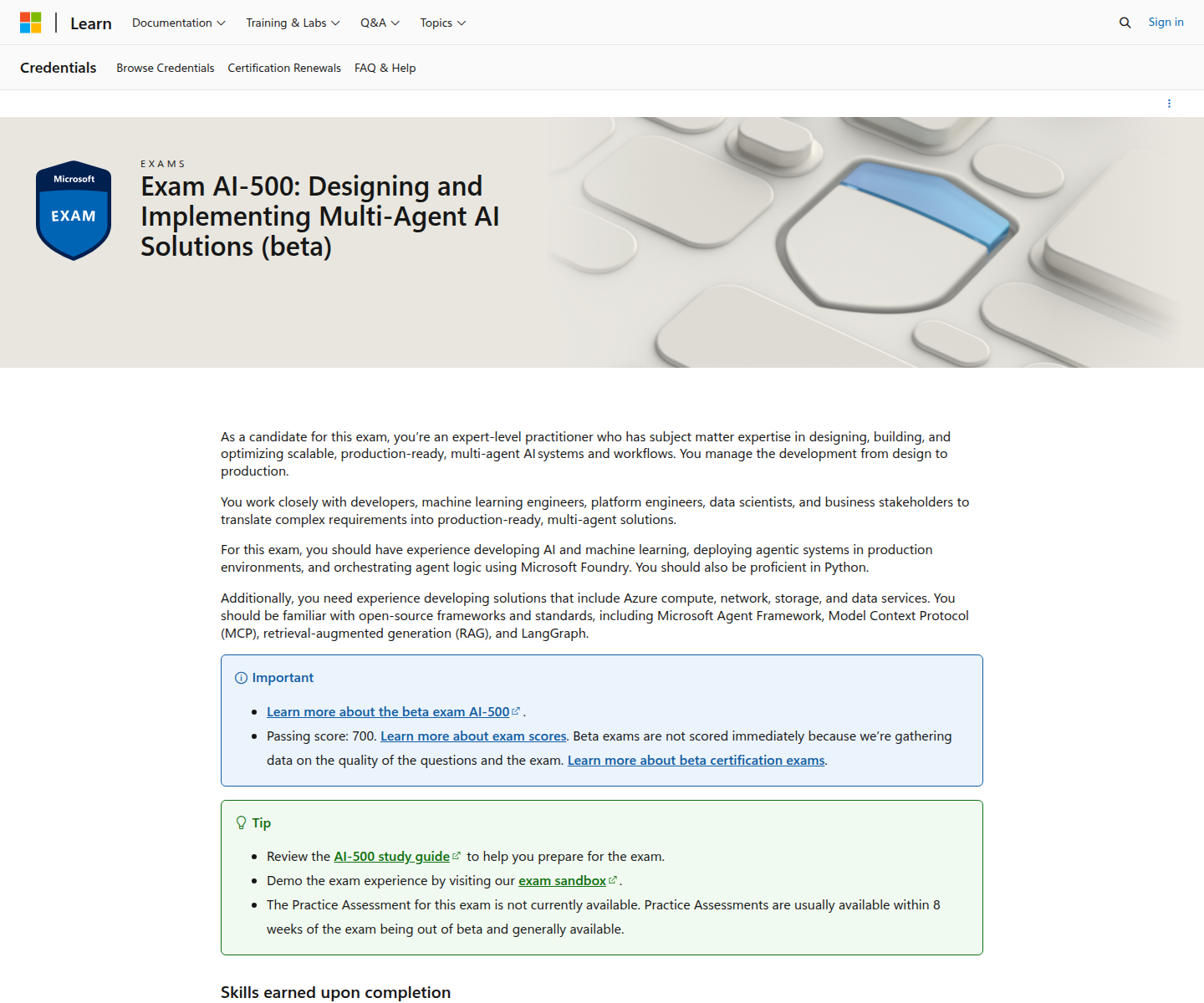
The required beta exam is AI-500: Designing and Implementing Multi-Agent AI Solutions. Microsoft lists four assessed areas:
- Architect multi-agent solutions — 15–20%
- Develop multi-agent solutions in Azure — 30–35%
- Evaluate, optimize, and monitor multi-agent solutions — 20–25%
- Secure, govern, and deploy multi-agent solutions — 20–25%
The weighting makes development the largest domain, but an IT professional should not overlook the other three. A system that works in a notebook is not automatically production-ready. Architecture decisions, telemetry, access controls, deployment pipelines, and governance are part of the job the certification is trying to signal.
Microsoft states that the beta exam has a passing score of 700. Beta exams are not scored immediately while Microsoft gathers data about question quality, so candidates should treat the beta as a longer-feedback assessment rather than expecting an instant result.
The prerequisite changes the ROI calculation
The certification requires the Azure AI Apps and Agents Developer Associate credential. That prerequisite means this is a stacked pathway rather than a single exam purchase.
For an IT professional, the route is most sensible when the prerequisite already matches your work. If you are still learning Python, Azure application development, or basic generative-AI implementation, the associate certification is the better first milestone. It gives you a foundation before the expert exam asks you to reason about multi-agent architecture, evaluation, deployment, and security together.
The prerequisite also prevents a common mistake: treating a senior AI architecture credential as a shortcut into AI engineering. It is a validation layer for people who already have substantial development and cloud experience.
Where desktop and infrastructure engineers fit
A traditional desktop engineer should not pursue this certification just because it contains the word “AI.” The direct day-to-day overlap is limited unless the role is expanding into one or more of these areas:
- internal AI platform administration
- Azure landing zones for AI workloads
- identity and access controls for agent tools
- monitoring and incident response for AI services
- RAG knowledge systems for service desks
- governance of agent permissions and data access
- automation platforms that connect agents to enterprise systems
For a Microsoft-heavy infrastructure team, the certification can become relevant when the engineer is responsible for the conditions that make agents safe to operate: network boundaries, secrets, logging, workload identity, data protection, deployment gates, and rollback plans.
For a help-desk technician or endpoint specialist with no Azure development responsibilities, the opportunity cost is high. A foundational AI credential or a practical Applied Skills lab is likely to produce a faster return.
Practical preparation plan
A credible preparation plan should produce working artifacts, not only completed videos.
1. Build a small multi-agent system
Create a controlled service-desk scenario with separate agents for triage, knowledge retrieval, and escalation. Define the tools each agent may call and make the hand-offs explicit.
2. Add evaluation before optimization
Create test cases for refusal, hallucination, incorrect routing, prompt injection, and missing permissions. Record quality, latency, and cost metrics before changing the prompts or orchestration.
3. Secure the tool boundary
Use least-privilege identities, separate read and write tools, validate tool arguments, and require human approval for destructive actions. Treat agent-to-tool calls as privileged API traffic.
4. Deploy through an observable path
Practice configuration management, structured logs, traces, health checks, alerting, and rollback. The exam domains explicitly include evaluation, monitoring, security, governance, and deployment—not just generation quality.
5. Document architecture decisions
Write down why you selected a particular orchestration pattern, memory strategy, retrieval approach, model, and approval boundary. This is useful exam preparation because it forces trade-off reasoning instead of memorization.
Main risks and limitations
It is beta. Exam content, delivery details, and scoring timelines may change as Microsoft validates the assessment.
It is senior-level. Candidates without production AI, Azure, and Python experience may spend more time filling prerequisites than earning the expert credential.
The credential is Microsoft-centered. It can be a strong signal for organizations invested in Azure and Microsoft Foundry, but it is less portable as a standalone proof of general AI engineering than a vendor-neutral portfolio showing equivalent systems work.
The prerequisite adds cost and time. The full pathway should be evaluated as two credentials and a body of practical work, not as one isolated exam.
Final recommendation
The Microsoft Certified: Multi-Agent AI Solutions Expert (beta) is worth pursuing for senior IT professionals who are moving from infrastructure or cloud operations into AI platform engineering, agent architecture, or enterprise automation. Its strongest signal is the combination of architecture, implementation, evaluation, monitoring, security, governance, and deployment.
It is not the right next step for most desktop support professionals. Start with Azure fundamentals, Python, the Azure AI Apps and Agents Developer Associate prerequisite, or a focused hands-on Applied Skills credential. Move to AI-500 only when you can explain—and preferably demonstrate—how a multi-agent system behaves in production.