Oracle Cloud Infrastructure AI Foundations Associate (2026): Worth It for IT Pros?
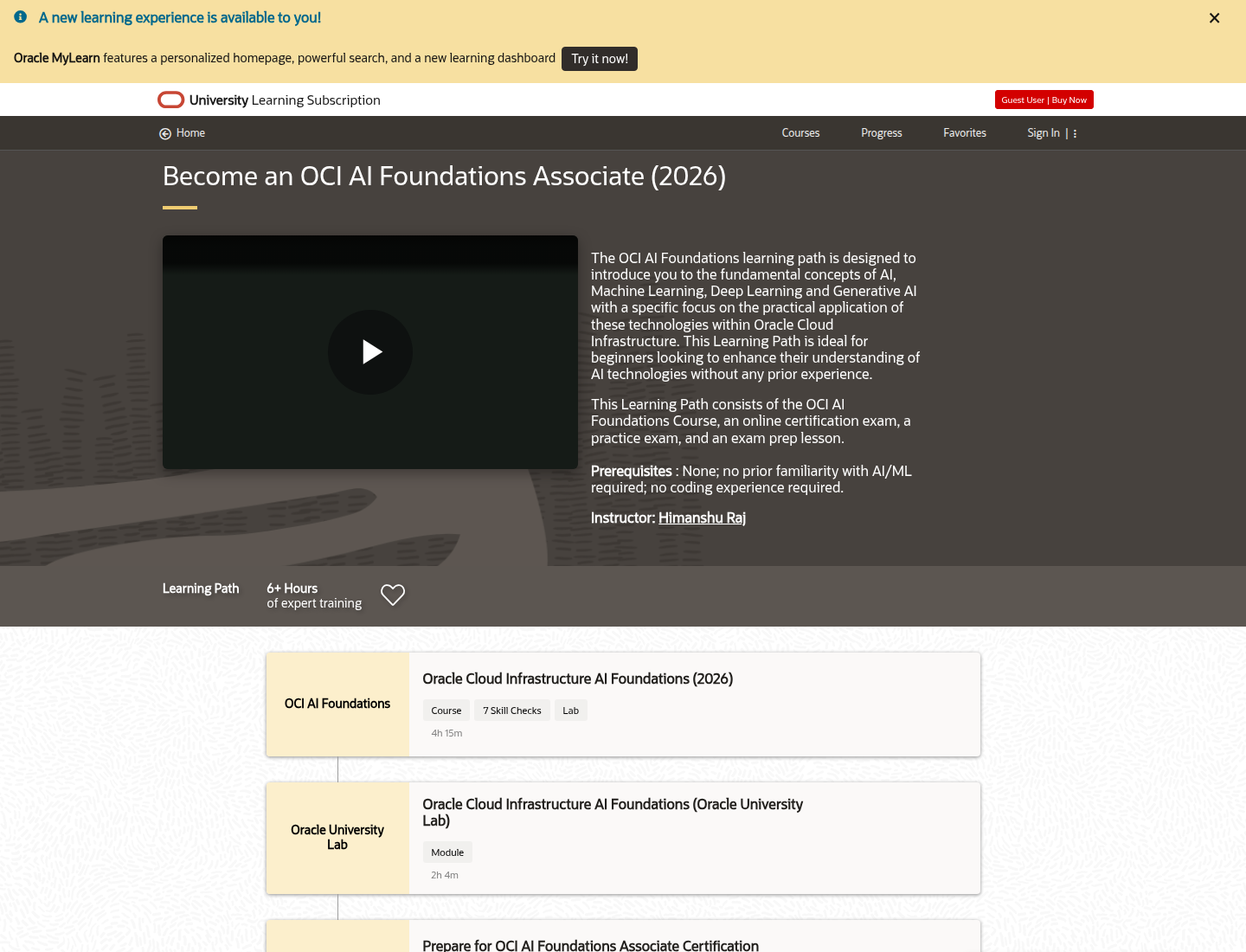
Oracle’s OCI AI Foundations Associate (2026) is a beginner credential for learning how artificial intelligence, machine learning, deep learning, and generative AI are applied in Oracle Cloud Infrastructure. It is not a machine-learning engineer certification and it is not a substitute for production cloud administration. Its value is as a low-friction bridge for IT professionals who need enough AI vocabulary and cloud context to support modern workloads.
Quick verdict
| Category | Details |
|---|---|
| Provider | Oracle |
| Credential | OCI AI Foundations Associate (2026) |
| Level | Foundations / entry level |
| Prerequisites | None; no prior AI/ML or coding experience required |
| Preparation | Oracle OCI AI Foundations course, skill checks, lab, practice exam, and exam preparation |
| Learning path time | Oracle lists 6+ hours of expert training |
| Exam | Online certification exam; Oracle’s exam catalog lists the foundations exam format as multiple choice and the exam attempt as free |
| Best fit | Desktop engineers, sysadmins, cloud support, service desk leads, and technical managers needing AI literacy |
Bottom line: this is worth doing when your immediate goal is to understand AI conversations, OCI terminology, and the operational shape of AI services. It is a weak standalone signal for an AI engineering job because it does not demonstrate substantial coding, model deployment, data engineering, or incident ownership.
What Oracle actually teaches
Oracle describes the 2026 learning path as an introduction to AI, machine learning, deep learning, and generative AI, with practical application in OCI. The path is explicitly designed for beginners. The published learning path includes the OCI AI Foundations course, an online certification exam, a practice exam, and an exam-preparation lesson.
The visible course sequence also includes skill checks and an Oracle University Lab. That matters for IT pros: even a foundations credential is more useful when the learner can connect concepts to a cloud console, services, identity boundaries, and basic operational workflows rather than memorizing definitions alone.
Why it can help desktop and infrastructure engineers
It gives you a shared vocabulary
Endpoint and infrastructure teams increasingly receive tickets involving copilots, model endpoints, retrieval, prompts, vector search, and AI data handling. A foundation-level credential will not make someone an AI developer, but it can reduce the translation gap between an IT administrator and an application or data team.
It provides OCI context without demanding a coding background
Oracle states that no prior AI/ML familiarity and no coding experience are required. That makes the credential accessible to support professionals who need to understand where AI services fit before taking on deeper OCI administration or development work.
It is a structured starting point
A six-hour-plus path is short enough to complete as a focused learning sprint. Use it to build a glossary, identify the OCI services relevant to your employer, and decide whether a deeper cloud, data, security, or developer credential is the better next step.
What it does not prove
Do not present this credential as evidence that you can:
- Build and deploy a production RAG or agentic application.
- Train, tune, evaluate, or monitor a machine-learning model.
- Design OCI networking, IAM, landing zones, or governance at enterprise scale.
- Troubleshoot GPU capacity, latency, data pipelines, or model-serving incidents.
- Secure sensitive prompts, embeddings, or training data in a real organization.
Those capabilities require labs and work experience beyond an introductory foundations path.
A practical study plan for IT professionals
- Complete the official course and skill checks. Keep a one-page glossary of AI, ML, deep learning, generative AI, and OCI service terms.
- Do the lab instead of passively watching. Record what identity, region, compartment, and service boundaries are visible in the workflow.
- Build one small architecture diagram. Show a user, data source, AI service, application, logging, and access controls. Mark what you can operate today and what requires another team.
- Use the practice exam diagnostically. Revisit concepts you cannot explain in plain operational language.
- Choose a follow-on credential based on your role. Infrastructure staff may need OCI administration or networking; security staff may need cloud security; automation-focused staff may need development and API practice.
Important 2026 timing note
Oracle’s 2026 MyLearn page says the learning path will be archived on 30 September 2026. That is a reason to verify the current path and exam details before starting, not a reason to assume the credential is permanently unavailable. Oracle may replace an archived learning experience with a newer version. Check the live Oracle page and exam catalog for the current route.
Final recommendation for an IT career plan
Treat the OCI AI Foundations Associate as a literacy credential. It can be a sensible first step for an IT professional who supports cloud users, manages endpoints in an AI-using organization, or wants to understand Oracle’s AI vocabulary without immediately committing to a deep engineering exam.
Pair it with a hands-on OCI lab, basic IAM and networking practice, and one small API-driven AI experiment. That combination will communicate more practical ability than the badge alone.