
Microsoft 365 and AI Services Administrator Associate (AB-650): Worth It for IT Pros?
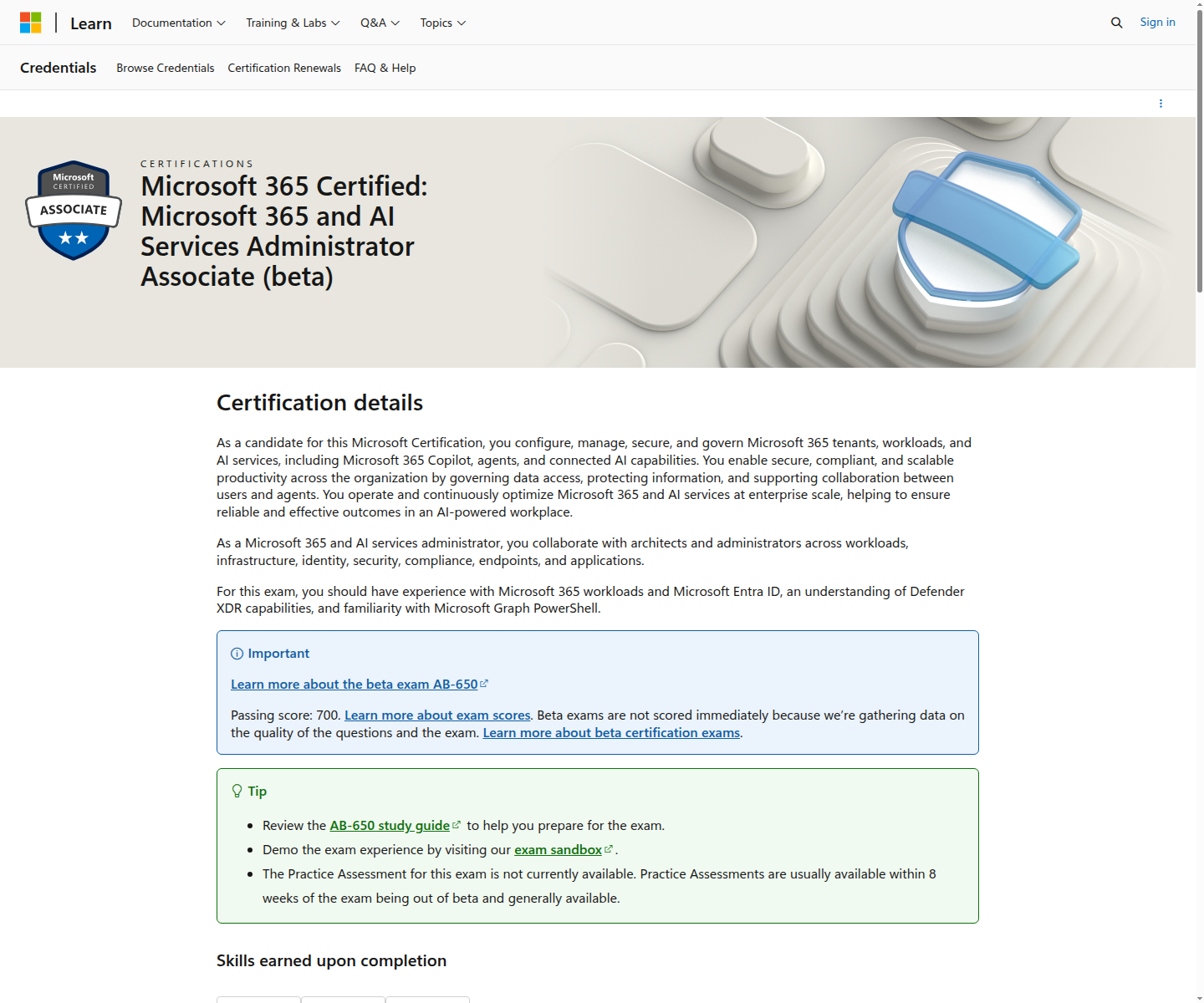
Microsoft’s Microsoft 365 Certified: Microsoft 365 and AI Services Administrator Associate is a new beta credential for administrators who configure, secure, govern, and continuously operate Microsoft 365 and connected AI services. It is earned through one beta exam: AB-650, Administering Microsoft 365 and AI Services.
Quick verdict
| Category | Details |
|---|---|
| Provider | Microsoft |
| Credential | Microsoft 365 Certified: Microsoft 365 and AI Services Administrator Associate (beta) |
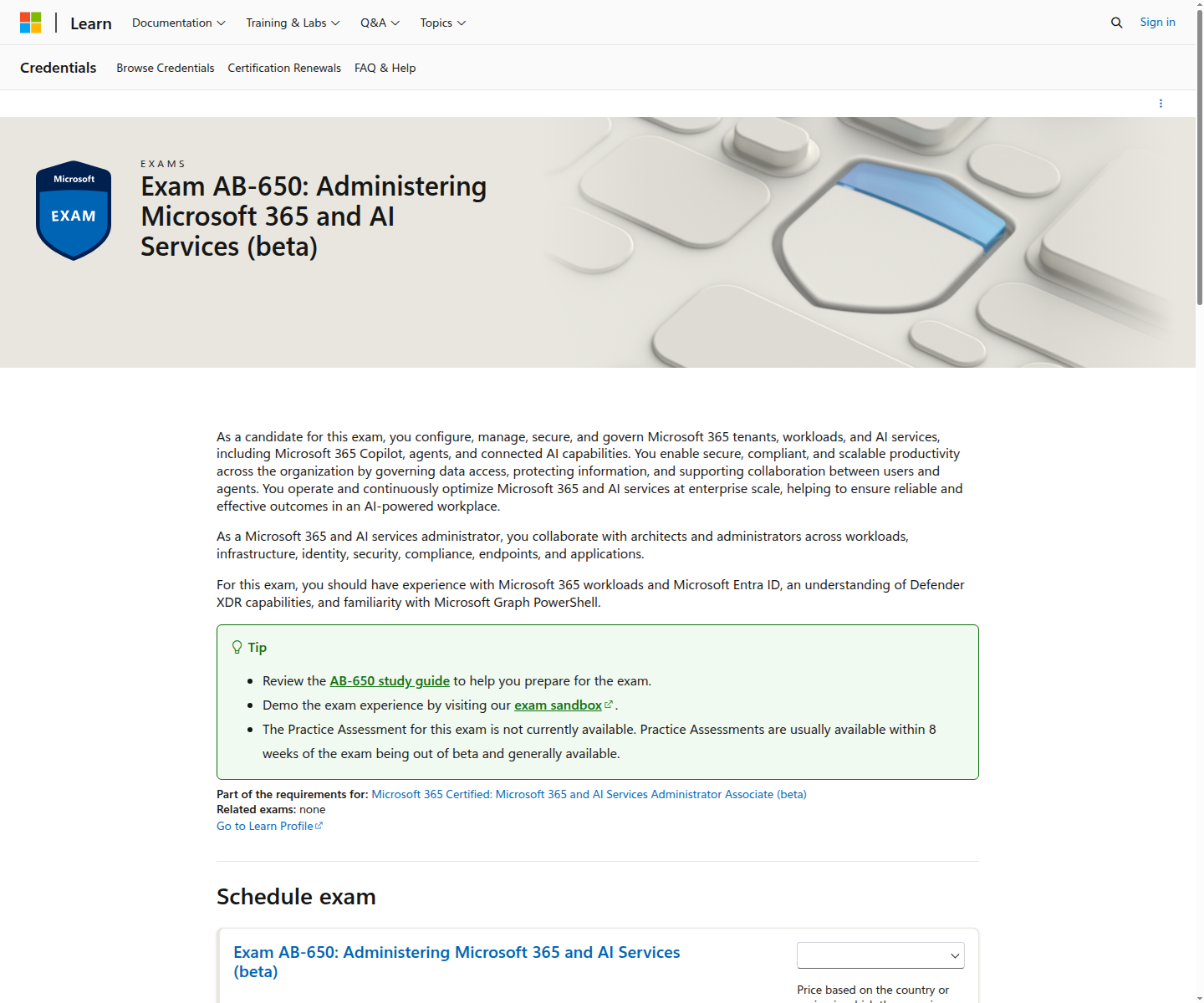
| Required exam | AB-650: Administering Microsoft 365 and AI Services (beta) |
| Best fit | Microsoft 365 administrators, endpoint/security administrators, and IT leads responsible for Copilot and agent governance |
| Core value | Validates administration and governance across Microsoft 365 workloads and AI services |
| Main limitation | It is beta, and Microsoft says beta exams are not scored immediately |
| Practice assessment | Not currently available on the official exam page |
Bottom line: This is a strong watch-and-prepare credential for Microsoft-heavy IT professionals whose work is moving from endpoint administration into AI service governance. It is not a developer certification and it does not prove that you can build a sophisticated model or agent. Its value is in operating AI safely at enterprise scale: identity, permissions, security, compliance, workloads, and service management.
What the certification validates
Microsoft describes the target role as an administrator who configures, manages, secures, and governs Microsoft 365 tenants, workloads, and AI services. The scope explicitly includes Microsoft 365 Copilot, agents, and connected AI capabilities.
The expected background is practical enterprise administration rather than pure data science. Microsoft lists experience with Microsoft 365 workloads and Microsoft Entra ID, understanding of Defender XDR, and familiarity with Microsoft Graph PowerShell. That makes the credential relevant to administrators who already handle tenant configuration, identity, endpoint controls, security operations, or compliance workflows.
AB-650 exam domains
The official exam page divides the assessment into three domains:
- Configure and manage Microsoft 365 tenants and workloads — 20–25%
- Govern and secure Microsoft 365 tenants and workloads — 40–45%
- Manage and secure AI services in Microsoft 365 — 35–40%
The weighting tells you where the credential is pointed. Governance and security are the largest domain, followed by AI-service administration. This is not simply a Copilot feature tour. A candidate should expect questions about how Microsoft 365 administration, security, compliance, and AI capabilities fit together.
Why it matters for enterprise IT
AI adoption creates administration problems that look familiar to IT but have new failure modes:
- Access and identity: Users and agents need the right permissions without receiving broad tenant access.
- Data exposure: Copilot and connected agents can make existing oversharing more visible and more consequential.
- Governance: Organizations need policies for approved services, data boundaries, retention, auditing, and acceptable use.
- Operations: Administrators must monitor service health, configuration drift, licensing, and user impact.
- Security response: AI-connected workloads must fit existing Defender, Entra, Purview, and incident-response processes.
For a desktop or endpoint engineer, this is a logical extension of device and identity work. The credential is most useful when you can connect a Copilot or agent change to conditional access, least privilege, device compliance, audit evidence, and support procedures.
Beta status and what it changes
Microsoft marks both the certification and AB-650 as beta. The certification page states that beta exams are not scored immediately because Microsoft is gathering data about question quality. The pages also show a passing score of 700 for the certification exam and state that no practice assessment is currently available.
That creates two practical risks:
- You may not receive a score immediately after taking the beta exam.
- Preparation resources and exam emphasis can change while Microsoft finalizes the assessment.
Treat the current Microsoft Learn exam page and study guide as the authority immediately before scheduling. Do not rely on a third-party list of objectives that may have been copied before the beta stabilized.
Preparation plan for IT professionals
A useful preparation sequence is:
- Map your Microsoft 365 foundation. Review tenant administration, core workloads, licensing concepts, service health, and delegated administration.
- Strengthen Entra and identity controls. Practice authentication, authorization, groups, roles, privileged access, and conditional access decisions.
- Review security and compliance operations. Understand how Defender XDR, Microsoft Purview, auditing, information protection, and retention relate to AI-enabled workflows.
- Study Copilot and agent administration. Focus on configuration, access, data boundaries, connected services, and operational controls rather than prompt tricks.
- Use Graph PowerShell hands-on. Build small reports or validation scripts for users, groups, policies, and service configuration. Record what the script can verify and what still requires portal evidence.
- Create an AI change-review runbook. Include owner, affected users, permissions, data sources, security controls, rollback, monitoring, and support communications.
- Read the live AB-650 study guide. Recheck domain percentages and any beta updates before booking the exam.
The best project is not a chatbot demo. Build a controlled pilot in which you document who can use an AI service, what data it can reach, which policies apply, how access is reviewed, and how an incident would be investigated.
Who should take it?
This credential is a good fit for:
- Microsoft 365 administrators adding Copilot and agent operations to their remit;
- endpoint or identity engineers moving into AI governance;
- security and compliance administrators responsible for Microsoft 365 data controls;
- IT leads who need a structured way to evaluate enterprise AI readiness;
- consultants implementing Microsoft 365 and AI services for customers.
It is less suitable as a first AI credential for someone without Microsoft 365 administration experience. It is also not the right target for a developer whose primary goal is building Python-based AI applications, training models, or deploying custom inference services.
What the credential does not prove
Passing AB-650 would not, by itself, demonstrate that you can:
- train or fine-tune a machine-learning model;
- design a production RAG system;
- write a complex Copilot Studio agent from scratch;
- operate Azure infrastructure independently;
- replace hands-on experience with Purview, Defender, Entra, or Microsoft Graph.
Use the certification as a governance and administration signal, then support it with evidence: a least-privilege design, a tested policy, an audit report, a Graph PowerShell validation script, and a clear operational runbook.
Final recommendation
For Microsoft-heavy IT professionals, the Microsoft 365 and AI Services Administrator Associate is worth preparing for, especially if the organization is adopting Copilot, agents, or connected AI services and needs administrators who can control the blast radius. The beta status means timing matters: verify the live Microsoft Learn details, expect delayed scoring, and plan around the absence of a practice assessment.
The credential is most valuable when it complements existing Microsoft 365, identity, security, and compliance experience. It should be treated as proof that you understand how to administer AI-enabled enterprise services—not as proof that you are an AI application developer.