Google Cloud Professional Cloud Developer: Worth It for AI-Focused IT Pros?
Google Cloud’s Professional Cloud Developer certification is not a prompt-engineering badge. It validates the ability to build and configure scalable, secure cloud-native applications—and the current scope explicitly includes advanced machine-learning capabilities and generative AI APIs. For an IT professional moving toward AI platform engineering, that makes it a practical bridge between infrastructure operations and production AI delivery.
Quick verdict
| Category | Verdict |
|---|---|
| Provider | Google Cloud |
| Credential | Professional Cloud Developer |
| Best for | Cloud developers, platform engineers, application engineers, and IT pros shipping AI-enabled services |
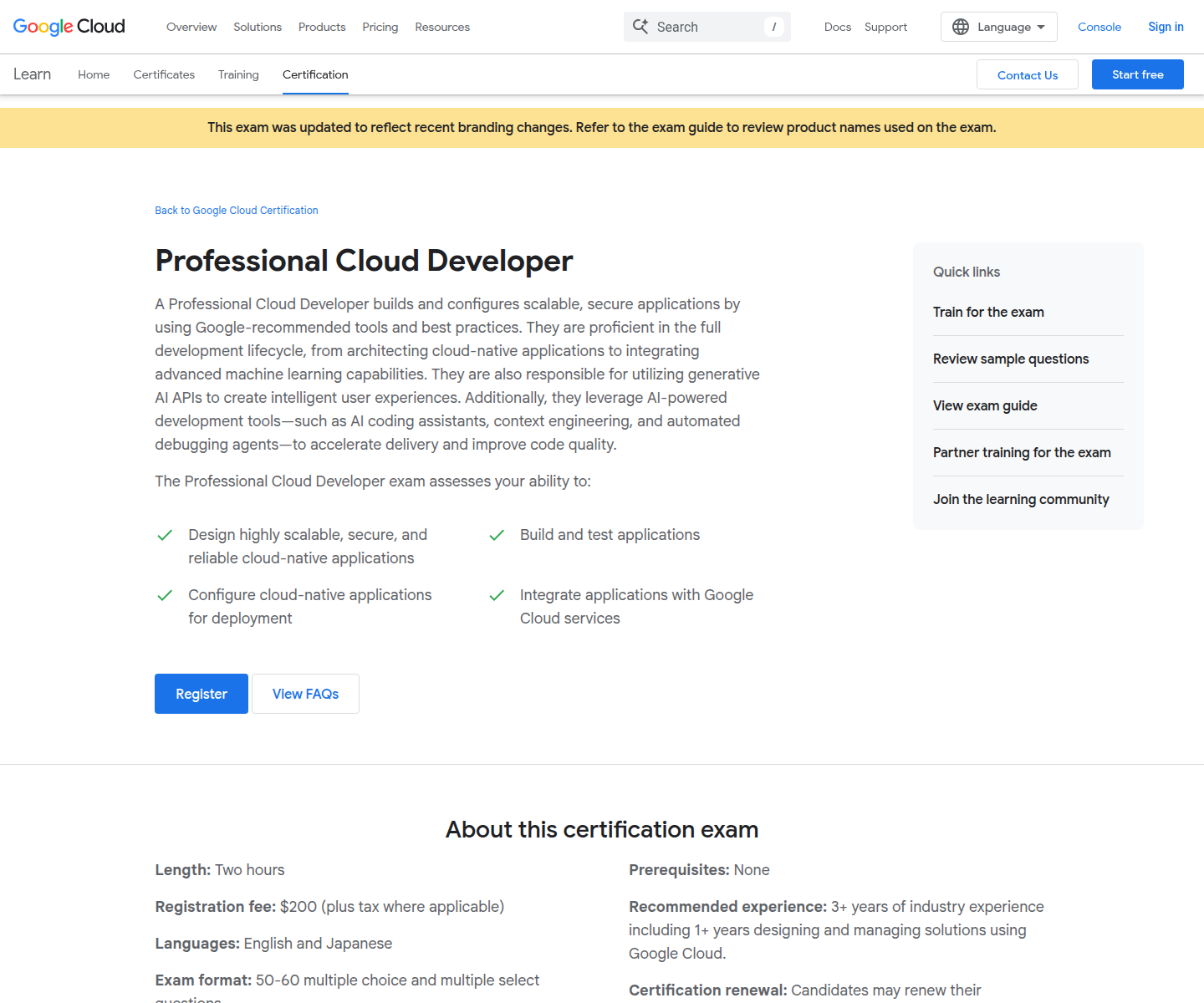
| Exam length | Two hours |
| Format | 50–60 multiple-choice and multiple-select questions |
| Registration fee | $200 plus applicable tax |
| Languages | English and Japanese |
| Prerequisites | None |
| Recommended experience | 3+ years in industry, including 1+ year designing and managing Google Cloud solutions |
| AI relevance | High for production application work; low for basic AI literacy |
Bottom line: pursue it when your career goal is to deploy reliable applications that call models, expose APIs, process data, and operate under security and observability requirements. Skip it as a first step if you only need an introductory AI overview or an end-user productivity credential.
What Google says the credential validates
Google describes a Professional Cloud Developer as someone who builds and configures scalable, secure applications using Google-recommended tools and practices. The official certification page says the role spans the full development lifecycle, from architecting cloud-native applications to integrating advanced machine-learning capabilities and using generative AI APIs to create intelligent applications.
That scope is important. This is an application-delivery certification with AI included—not a machine-learning research exam. You should expect decisions around:
- cloud-native application architecture
- APIs, services, deployment, and release management
- scalability, reliability, and performance
- identity, security, and protecting application data
- logging, monitoring, and troubleshooting
- integration of machine-learning capabilities and generative AI APIs
Why this matters for IT professionals working with AI
1. AI features still need ordinary production engineering
A chatbot, summarizer, or agent is still an application. It needs authentication, rate limits, secrets management, error handling, deployment controls, logging, and a rollback strategy. The model call is one component inside that operational system.
2. The certification targets the handoff between platform and application teams
Many infrastructure specialists can provision cloud resources but do not yet own the code path that consumes them. Many application developers can call an API but are less comfortable with enterprise reliability and security. Professional Cloud Developer is useful when your next role sits between those groups.
3. Generative AI APIs create new failure modes
Production systems must handle latency, token or quota limits, malformed output, prompt-injection attempts, unavailable models, and changes in model behavior. A developer who understands deployment and observability can turn those risks into measurable controls rather than treating the model as a black box.
4. AI workloads increase the cost of poor architecture
A slow or chatty integration can multiply inference costs. An over-permissive service account can expose sensitive prompts or retrieved documents. Missing traces can make it impossible to explain why an agent took an unsafe action. Cloud development fundamentals have direct governance and budget consequences.
Exam logistics and experience expectations
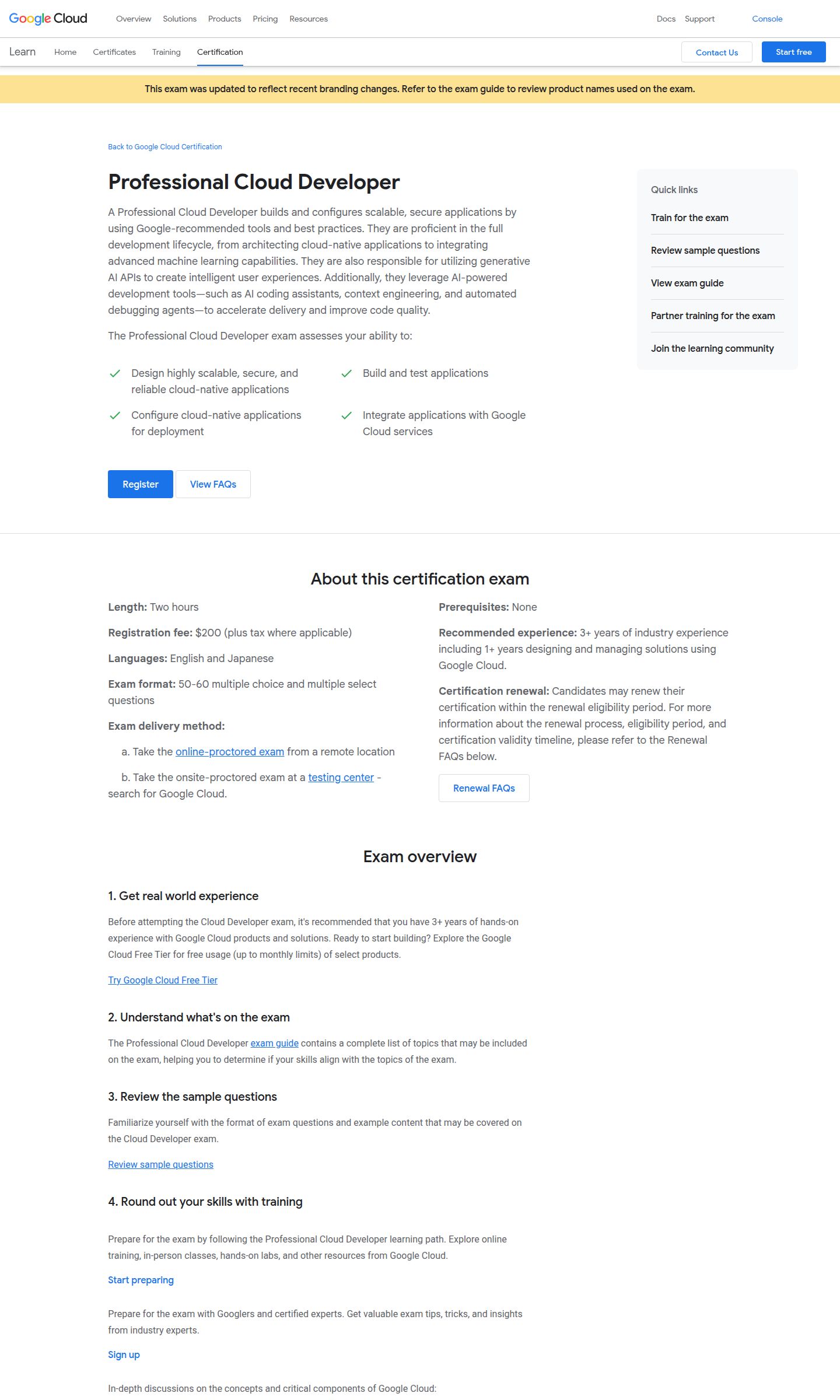
Google lists a two-hour exam with 50–60 multiple-choice and multiple-select questions. The registration fee is $200 plus applicable tax, and the exam is available in English and Japanese. Google lists no formal prerequisites, but recommends three or more years of industry experience, including at least one year designing and managing solutions using Google Cloud.
The recommendation is a useful signal for career planning: this is not positioned as an entry-level certificate. You can study the product names and command patterns, but scenario questions are easier when you have actually made tradeoffs between reliability, cost, security, and delivery speed.
A practical preparation plan for AI-focused candidates
Phase 1: Close the Google Cloud application gaps
Review the official exam guide and map each domain to a small working project. Build and deploy a service, configure identity, add logging, and test a failure path. Do not rely on passive video watching alone.
Phase 2: Add one AI-enabled workflow
Create a small application that calls a generative AI API behind a controlled backend. Include input validation, secret isolation, request limits, structured output handling, and a fallback response when the model is unavailable.
Phase 3: Operate it like an IT service
Add dashboards and alerts for latency, errors, quota usage, and cost indicators. Document who can access prompts, outputs, logs, and retrieved data. Test what happens when a dependency times out or returns an unexpected payload.
Phase 4: Practice scenario reasoning
For each practice question, explain why the selected design is appropriate and why the alternatives are weaker. Focus on least privilege, managed services, operational simplicity, graceful degradation, and the difference between a development shortcut and a production control.
Who should take it
This certification is a strong fit for:
- cloud or systems engineers who now support AI-backed applications
- platform engineers building internal developer platforms for AI teams
- application developers moving into cloud architecture
- DevOps engineers responsible for deployment and observability
- IT professionals who need credible evidence of production application skills
It is less suitable for someone seeking a purely conceptual AI credential, a data-science specialization, or a networking-only path. Those goals call for a different certification family.
ROI test
The $200 exam fee is only a small part of the investment. The real cost is preparation time and the opportunity cost of choosing this credential over a narrower AI, data, or security certification.
Use this decision rule:
- Take it now if you already deploy Google Cloud applications and want AI delivery responsibility.
- Prepare first if you operate infrastructure but have limited experience with application lifecycle and APIs.
- Choose another credential if your target role is model training, data engineering, security operations, or end-user AI adoption.
The credential becomes more valuable when paired with a portfolio project that demonstrates an authenticated AI API, controlled deployment, monitoring, and a short incident runbook. The certificate shows structured knowledge; the project shows that you can apply it.
Final assessment
Google Cloud Professional Cloud Developer is worth considering for AI-focused IT pros because it treats AI as part of a real application lifecycle. Its value is not the word “AI” alone. The value is learning to deliver AI-enabled software with the same discipline expected of any production service: secure access, predictable deployments, observable behavior, and recoverable failures.
If that is the direction of your career, this is a credible senior-level bridge from cloud operations into AI application engineering. If you want a beginner AI overview, it is more certification than you need.