Google Cloud Professional Cloud Database Engineer: Worth It for AI-Focused IT Pros?
AI systems are only as reliable as the data systems underneath them. A model-serving application still needs a database for identity data, application state, retrieval metadata, audit records, and operational history. Google Cloud Professional Cloud Database Engineer validates the ability to design, manage, migrate, and operate those databases on Google Cloud.
This is one certification—not a roundup. Its AI relevance is infrastructure-level: the official exam guide explicitly includes vector data and database technologies that support generative AI and large-language-model use cases.
Quick verdict
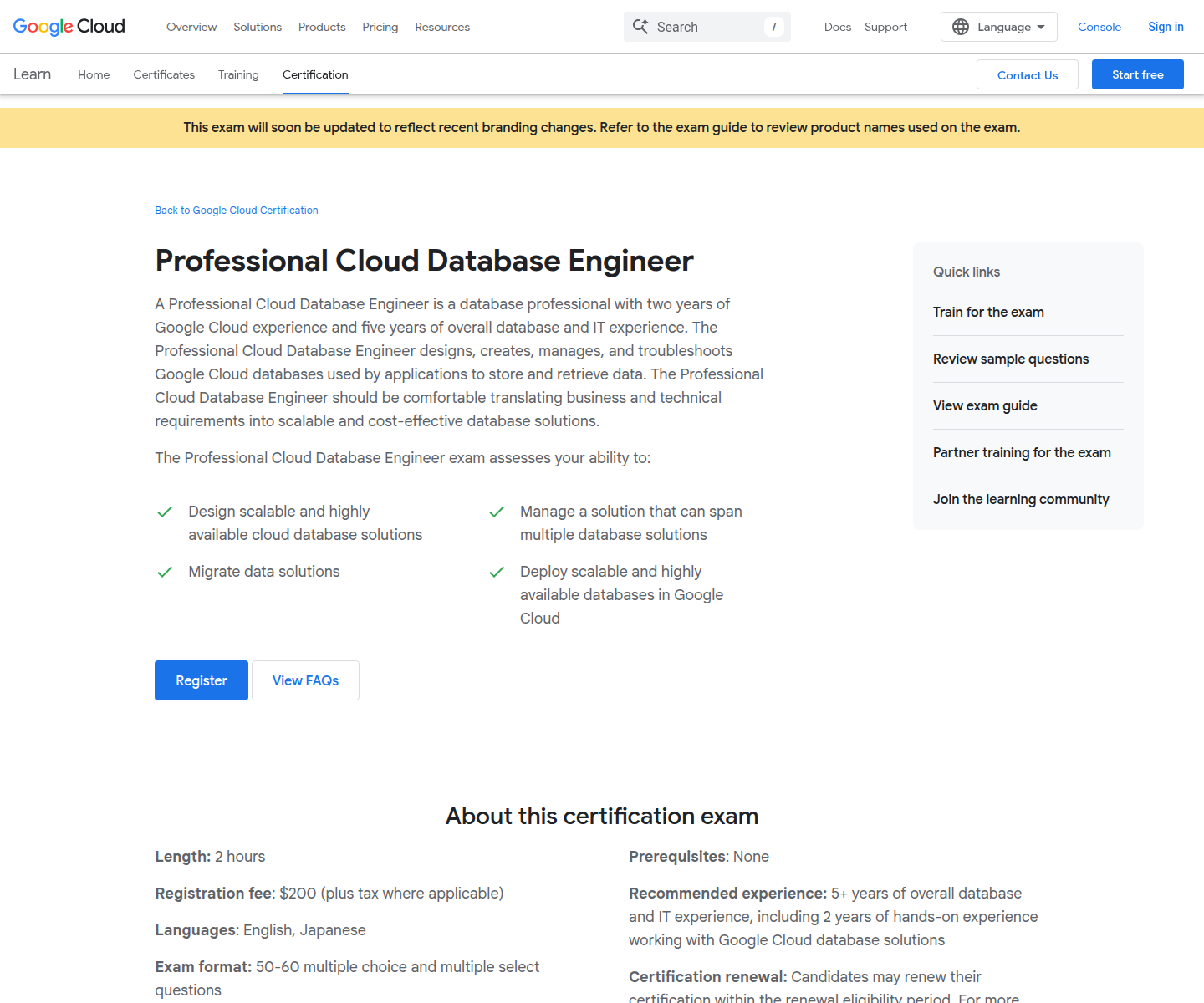
| Category | Verdict |
|---|---|
| Provider | Google Cloud |
| Credential | Professional Cloud Database Engineer |
| Best for | Database engineers, cloud/platform engineers, SREs, and IT pros supporting AI data services |
| Exam scope | Design, management, migration, and deployment of Google Cloud database solutions |
| Exam guide weighting | 32% design, 25% management, 23% migration, 20% deployment |
| Prerequisites | No formal prerequisite listed; practical Google Cloud database experience is important |
| AI relevance | High for AI data-platform reliability; low for model training or prompt engineering |
| My take | Worth it when your target role owns the data layer behind production AI applications |
Bottom line: take it when you want responsibility for resilient databases, retrieval stores, application state, or data migrations supporting AI products. Do not choose it as a beginner AI credential or as a substitute for a machine-learning certification.
What Google Cloud says the engineer does
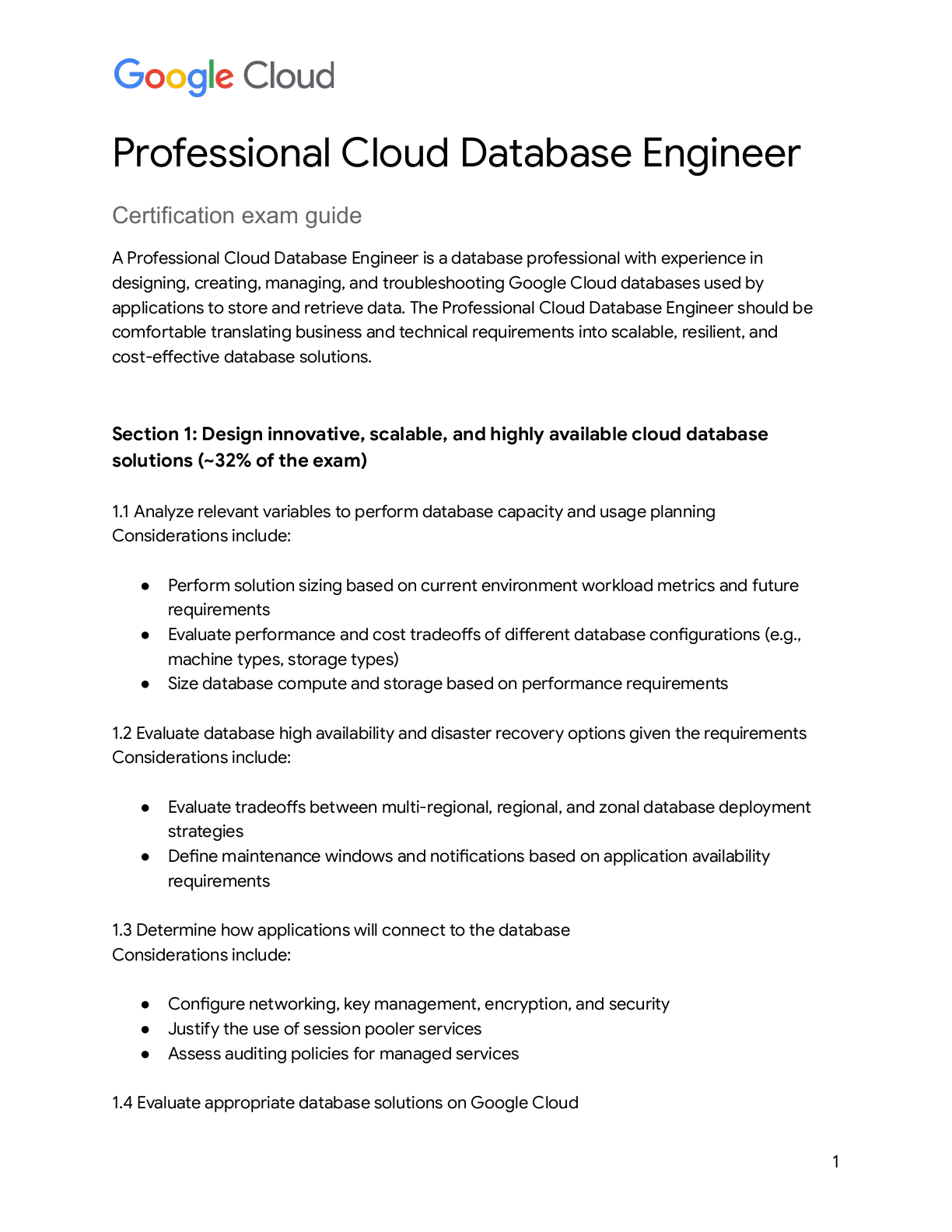
Google’s official exam guide describes the role as a database professional who designs, creates, manages, and troubleshoots Google Cloud databases used by applications to store and retrieve data. The role translates business and technical requirements into scalable, resilient, and cost-effective database solutions.
That means the credential is about engineering decisions rather than memorizing a single product. The guide expects candidates to distinguish SQL and NoSQL requirements, assess managed and unmanaged options, plan capacity, evaluate high availability and disaster recovery, configure connectivity and encryption, and account for cost and compliance.
The guide also calls out structured, semi-structured, unstructured, and vector data, plus database technologies for generative AI and LLM use cases. That is a meaningful AI connection, but it does not turn the exam into a model-development exam.
Why it matters for AI-focused IT professionals
1. Retrieval and application state are database problems
A retrieval-augmented generation system needs a place to store documents, chunks, embeddings, metadata, permissions, and freshness information. An AI agent also needs durable state and auditability. Poor indexing, weak access controls, or an unavailable database can make a model appear unreliable even when the model is working correctly.
2. The exam emphasizes production tradeoffs
The published domains cover capacity planning, high availability, disaster recovery, IAM, monitoring, troubleshooting, backup and recovery, cost optimization, migration, replication, and automation. Those are the controls that determine whether an AI service survives a quota spike, regional outage, bad deployment, or data migration.
3. Governance reaches the data layer
AI workloads can expose sensitive prompts, retrieved documents, and generated outputs. Database connectivity, encryption, identity, auditing, retention, and regulatory requirements therefore belong in the design conversation. An IT professional who can connect AI requirements to concrete database controls is more useful than one who only knows product terminology.
4. Database choice affects AI cost and latency
A design that is technically functional can still be too expensive or too slow. The exam guide expects candidates to evaluate machine and storage sizing, scaling, replication, query performance, and comparative service cost. Those same decisions influence retrieval latency and inference spend in production.
Exam domains to study
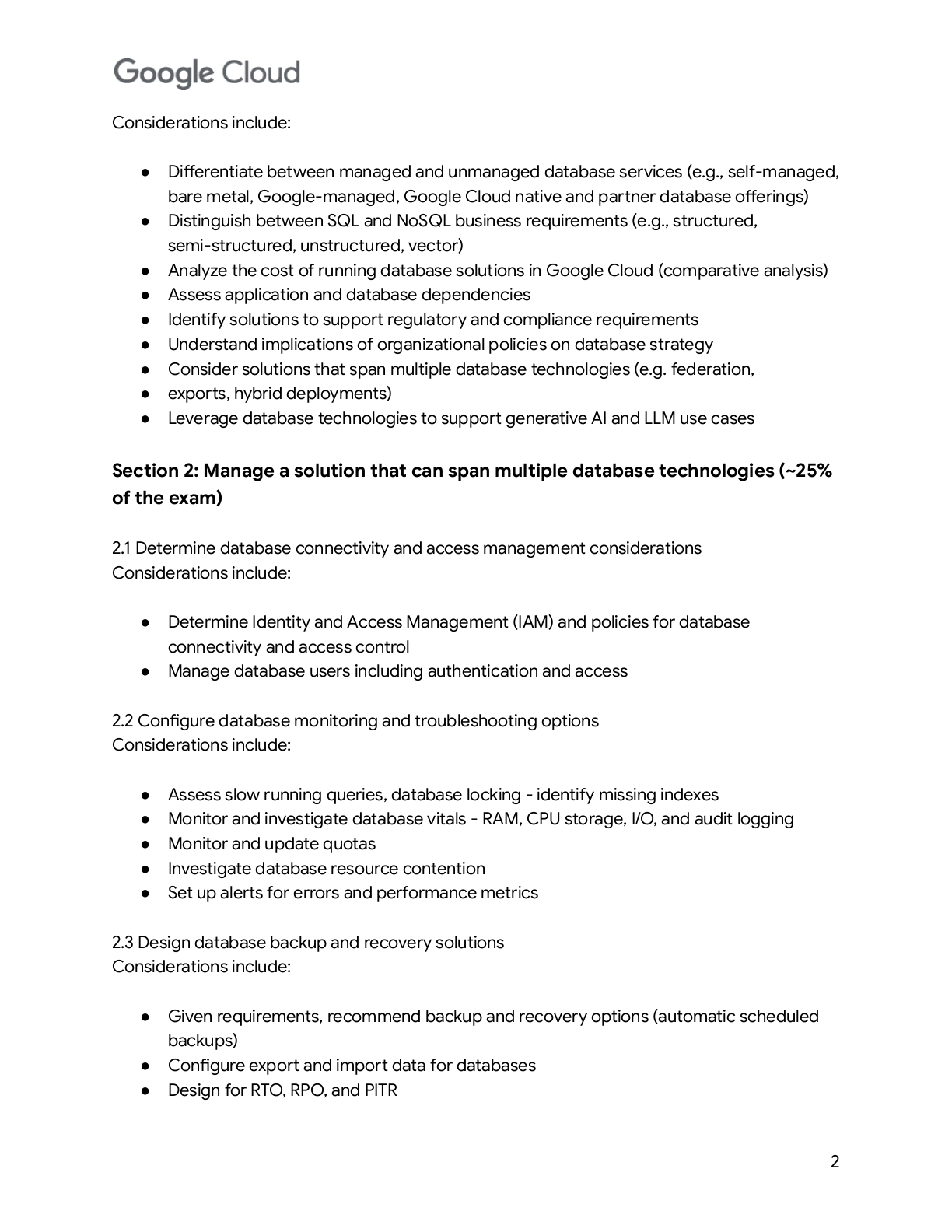
Google’s official exam guide divides the assessment into four domains:
- Design innovative, scalable, and highly available cloud database solutions — approximately 32%. Study capacity and usage planning, availability and disaster recovery, application connectivity, security, SQL versus NoSQL, vector data, cost, and compliance.
- Manage a solution that can span multiple database technologies — approximately 25%. Focus on IAM, users, monitoring, slow queries, locking, quotas, backups, recovery objectives, scaling, replication, cost, and automation.
- Migrate data solutions — approximately 23%. Prepare migration strategies, replication, zero or near-zero downtime, fallback plans, schema and data conversion, and tool selection.
- Deploy scalable and highly available databases in Google Cloud — approximately 20%. Practice provisioning, multi-region replication, read replicas, automated provisioning, and monitoring highly available databases.
The weighting tells you how to allocate preparation time: architecture and operations together account for more than half of the guide. A candidate who studies only service menus will miss the scenario reasoning around availability, recovery, security, and cost.
A practical preparation plan for IT professionals
Phase 1: Build the database decision map
Review the official exam guide and create a comparison table for the Google Cloud database services relevant to your target role. For each one, record data model, scaling pattern, availability options, backup and recovery behavior, security controls, operational burden, and cost drivers.
Phase 2: Build an AI-adjacent lab
Create a small service that stores application records and retrieval metadata. If you use embeddings or vector search, document the relationship between source documents, chunks, metadata, permissions, and results. The goal is not to build a production chatbot; it is to make database and AI dependencies visible.
Phase 3: Break the lab deliberately
Test a failed connection, slow query, missing index, unavailable replica, expired credential, quota limit, and incomplete migration. Capture the signals you would use to distinguish an application problem from a database problem.
Phase 4: Practice recovery and migration
Design a backup, point-in-time recovery, replication, and fallback plan. Then write a migration runbook with dependencies, validation checks, rollback criteria, and an explicit RTO/RPO assumption. This converts abstract exam topics into operational decisions.
Phase 5: Add governance
Apply least-privilege access, encryption, audit logging, retention rules, and separation between development and production data. For AI workloads, document who can access source data, embeddings, prompts, outputs, and logs.
Who should take it
This certification is a strong fit for:
- cloud and systems engineers moving into AI platform operations
- database administrators modernizing workloads on Google Cloud
- SREs responsible for availability, recovery, and observability
- platform engineers supporting retrieval, agent, or model-serving applications
- IT professionals who already understand networking, IAM, scripting, and production support
It is a weaker fit for someone seeking a first introduction to AI, a pure data-science credential, or a certification focused on end-user productivity. Those goals require a different learning path.
ROI test
The credential’s value depends on the role you want next. If your work involves databases, migrations, cloud reliability, or AI platform support, the exam domains map directly to responsibilities employers can recognize. If your target role is model training or prompt design, the database emphasis may be too indirect.
Use this decision rule:
- Take it now if you operate Google Cloud databases or own reliability for AI-backed applications.
- Prepare first if you have cloud administration experience but have not designed backups, replication, migrations, or recovery objectives.
- Choose another credential if your immediate goal is ML modeling, AI literacy, or application development rather than data-platform operations.
The strongest portfolio companion is a short architecture and incident package: a database-backed AI workflow, a threat and access model, a monitoring dashboard, and a migration or recovery runbook. The certification demonstrates structured knowledge; the artifacts demonstrate operational judgment.
Final assessment
Google Cloud Professional Cloud Database Engineer is worth considering for AI-focused IT professionals who want to own the data systems that make AI applications dependable. Its AI value is not a promise to teach model training. It is the more practical lesson that vector data, retrieval metadata, application state, security, recovery, and cost all have to work together before an AI service is production-ready.
If you are moving from general IT operations toward cloud databases and AI platform engineering, this is a credible senior-level bridge. If you only want an introductory AI overview, it is more specialized than necessary.