Cisco Certified Specialist - Data Center AI Infrastructure (DCAI): Worth It for IT Pros?
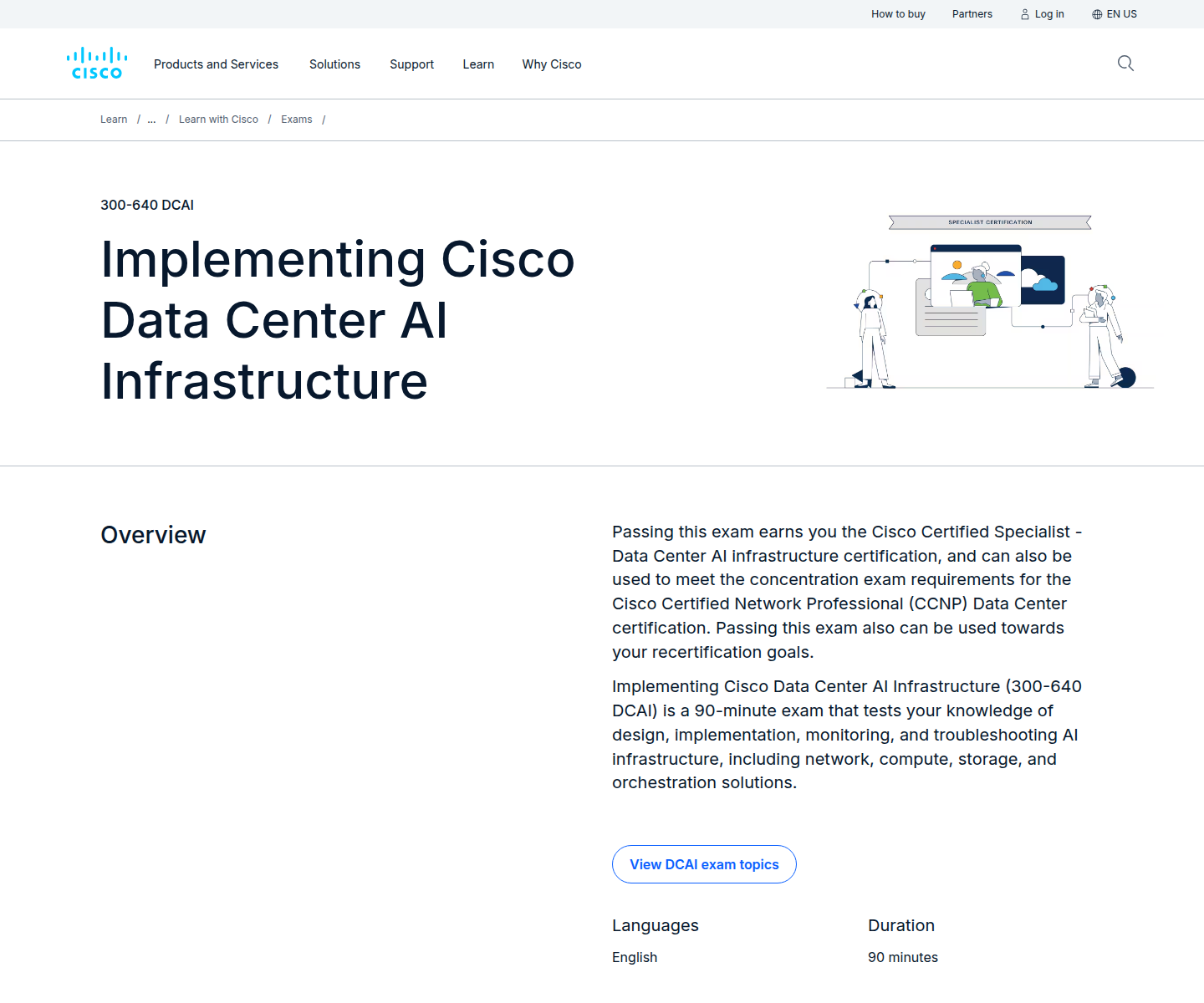
Cisco’s Implementing Cisco Data Center AI Infrastructure (300-640 DCAI) is a specialist exam for professionals who design, deploy, monitor, and troubleshoot the infrastructure underneath AI workloads. Passing it earns the Cisco Certified Specialist - Data Center AI Infrastructure certification and can also satisfy the concentration exam requirement for CCNP Data Center.
Quick verdict
| Category | Details |
|---|---|
| Provider | Cisco |
| Credential | Cisco Certified Specialist - Data Center AI Infrastructure |
| Exam | 300-640 DCAI v1.0 |
| Duration | 90 minutes |
| Language | English |
| Level | Specialist / professional infrastructure |
| Scope | AI fundamentals, infrastructure architecture, deployment, data management, operations, and troubleshooting |
| Best fit | Data-center, network, cloud, platform, and AI infrastructure engineers |
| CCNP relationship | Counts as a CCNP Data Center concentration exam |
Bottom line: this is a focused infrastructure credential, not a general AI literacy badge. It is worth considering when your target work involves GPU-enabled data centers, high-throughput AI networks, AI clusters, storage, orchestration, or operating AI platforms. It is a poor fit if your goal is primarily prompt usage, AI application coding, or end-user productivity adoption.
What the DCAI exam validates
Cisco describes the exam as testing design, implementation, monitoring, and troubleshooting of AI infrastructure across network, compute, storage, and orchestration solutions. The official exam-topics page divides the blueprint into four domains:
- AI Fundamentals and Applications — 20%
- AI Infrastructure Components and Architecture — 30%
- AI Infrastructure Deployment and Data Management — 30%
- AI Infrastructure Operations and Troubleshooting — 20%
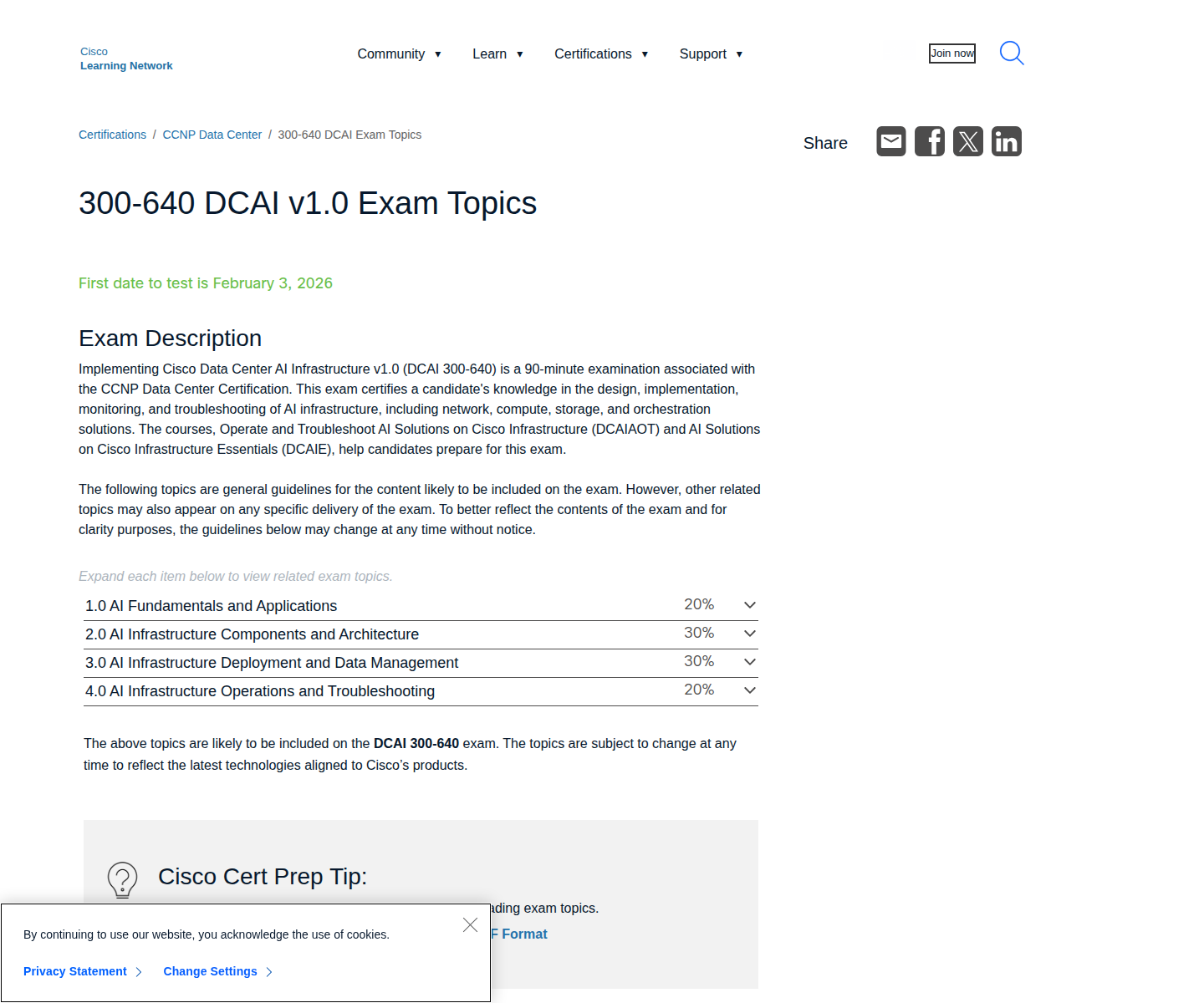
That weighting tells you where preparation time belongs. The exam is not just an overview of machine-learning terminology. Half of the blueprint is architecture and deployment/data management, while operations and troubleshooting account for another fifth. Candidates should be able to reason about how AI workloads are placed, connected, monitored, and recovered.
Why an AI infrastructure certification matters
AI projects often fail at the platform layer rather than the model layer. A model can be accurate in a notebook and still be unusable when the production environment has insufficient GPU capacity, poor east-west networking, storage bottlenecks, weak observability, or unsafe workload placement.
DCAI is relevant because it targets those operational constraints:
- Network engineers need to understand the bandwidth, latency, resiliency, and congestion behavior that AI clusters demand.
- Data-center engineers need to plan compute, GPU, DPU, SmartNIC, and storage resources.
- Platform engineers need to connect orchestration and workload-placement decisions to reliability and utilization.
- Operations teams need practical methods for monitoring and troubleshooting AI infrastructure rather than treating it as a special-purpose black box.
This is also why the credential is more specialized than Cisco AI Technical Practitioner. AITECH focuses on practical AI usage, prompting, ethics, coding, and agents; DCAI focuses on the physical and logical platform that makes large AI workloads operable.
Preparation path and training
Cisco’s AI Solutions on Cisco Infrastructure Essentials (DCAIE) training covers deploying, migrating, and operating AI solutions on Cisco data-center infrastructure. Cisco says it introduces AI workloads, architecture, design, and security practices. Together with Operate and Troubleshoot AI Solutions on Cisco Infrastructure (DCAIAOT), it prepares candidates for the 300-640 exam.
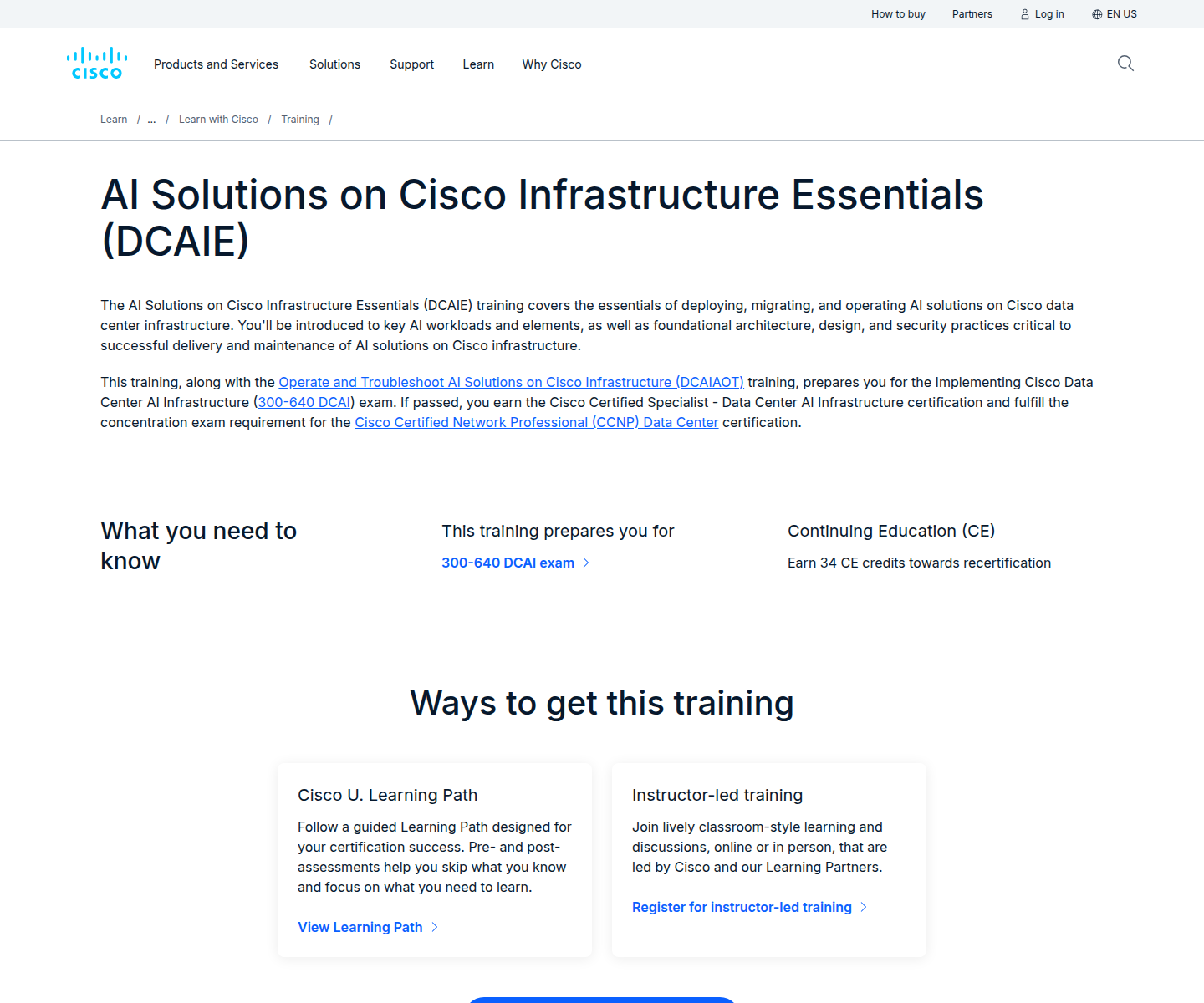
Cisco lists no mandatory prerequisite for DCAIE, but familiarity with Cisco data-center networking and computing is useful. A candidate without that background should first close gaps in Ethernet and fabric concepts, compute and storage architecture, virtualization, monitoring, and basic AI workload terminology.
A practical study plan
1. Map the four blueprint domains
Create a checklist from the official exam-topics page. For every topic, write one operational question: What fails if bandwidth is insufficient? How is data moved and stored? Which signal shows congestion? What is the rollback path when an AI workload cannot be placed?
2. Build a small AI infrastructure lab
Use a modest lab or cloud environment to document a workload path from data source to compute, network, storage, orchestration, and monitoring. The objective is not to reproduce a hyperscale cluster. It is to make dependencies and failure modes visible.
3. Practice troubleshooting, not just architecture diagrams
Write runbooks for GPU underutilization, storage latency, network congestion, failed scheduling, node health problems, and missing telemetry. Include the evidence you would collect before changing configuration.
4. Add security and sustainability checks
Document segmentation, identity, administrative access, data handling, and logging. Also consider utilization, power, cooling, and capacity planning. AI infrastructure has unusually high resource and cost consequences when it is poorly managed.
Who should take DCAI?
DCAI is a strong fit for:
- data-center network engineers moving into AI infrastructure;
- cloud and platform engineers supporting GPU or accelerator workloads;
- infrastructure architects designing AI-ready environments;
- operations engineers responsible for monitoring and incident response;
- Cisco professionals who want the CCNP Data Center concentration option;
- technical leads coordinating AI infrastructure delivery across network, compute, and storage teams.
It is less suitable for a desktop engineer who wants an introductory AI credential, an application developer seeking model/API development skills, or a security analyst looking for an AI governance specialization. Those goals require different evidence and different exam blueprints.
ROI test
The certification’s value depends more on your target role than on the AI label. It can strengthen a career narrative when you can connect the exam domains to a real project: capacity planning, AI cluster deployment, network modernization, storage performance, or infrastructure incident response.
Before registering, check three things:
- Do the jobs you want mention data-center AI, GPU clusters, Cisco Nexus/UCS, AI networking, or infrastructure orchestration?
- Can you practice the underlying infrastructure concepts rather than only memorize AI vocabulary?
- Would the credential also support a CCNP Data Center path or your employer’s Cisco environment?
If the answer to all three is yes, DCAI is a focused way to signal AI infrastructure capability. If not, a broader cloud, data, application, or AI fundamentals credential may better match your next role.
Final assessment
Cisco Certified Specialist - Data Center AI Infrastructure is a genuinely infrastructure-first AI credential. Its strongest value is the explicit connection between AI workloads and the engineering realities of network, compute, storage, orchestration, monitoring, and troubleshooting.
For IT professionals who want to operate the platforms that AI teams depend on, that focus is useful. It does not replace hands-on experience, and it will not prepare you for every AI application or model-engineering role. But for data-center and platform careers, the DCAI blueprint is specific enough to guide a serious lab project and a credible portfolio conversation.