
CompTIA DataAI: Worth It for AI-Focused IT Pros?
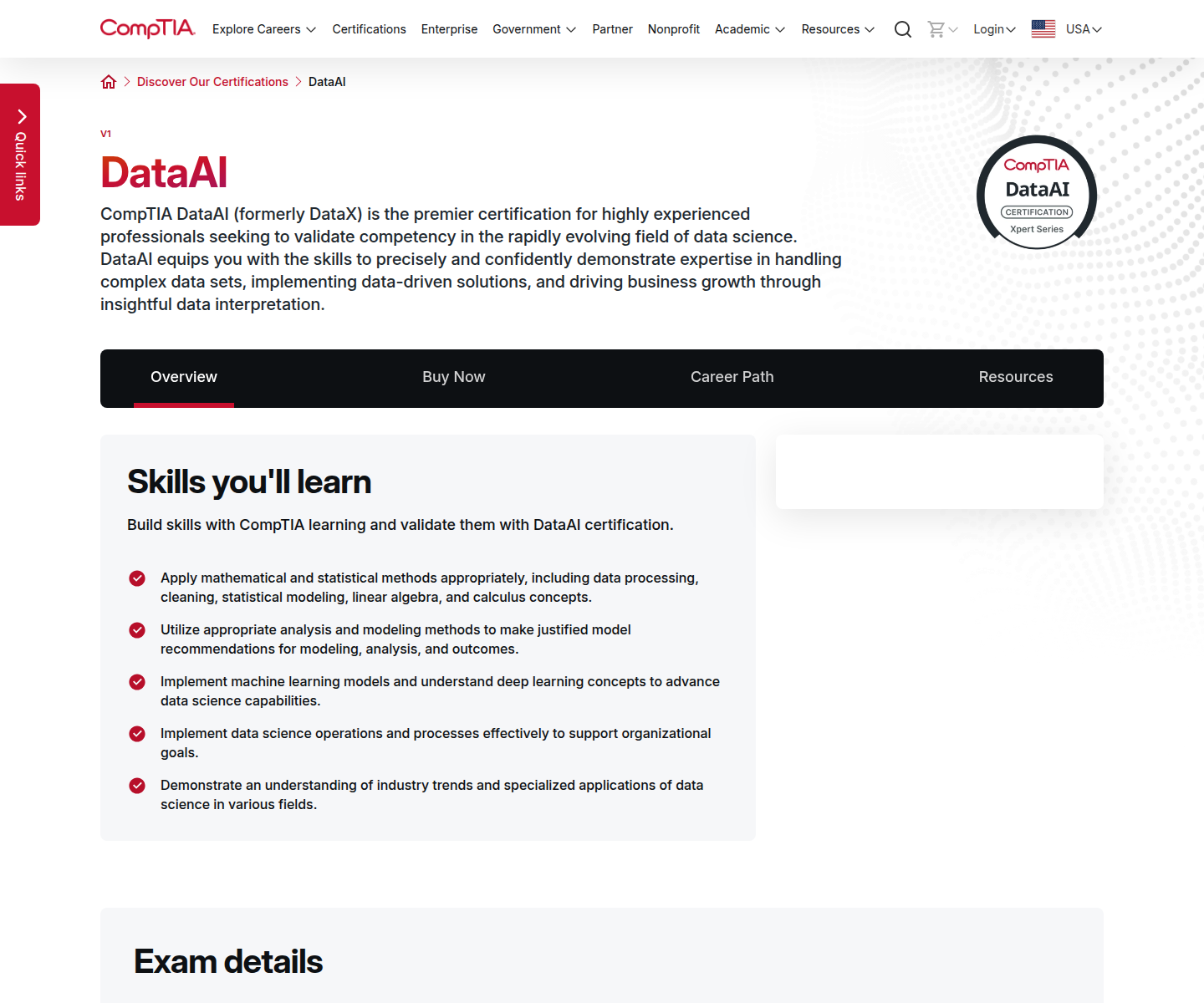
CompTIA DataAI is a senior-level, vendor-neutral data-science certification. It was formerly called DataX and is aimed at professionals who need to demonstrate competency across mathematical foundations, machine learning, data operations, and specialized data-science applications. It is not an entry-level AI literacy course and it is not a cloud-provider administration badge.
Quick verdict
| Category | Details |
|---|---|
| Provider | CompTIA |
| Credential | CompTIA DataAI, Xpert Series, version 1 |
| Former name | DataX |
| Best fit | Experienced data scientists, ML engineers, and technical leads |
| Main value | Vendor-neutral validation of broad data-science competency |
| Main limitation | Its scope is substantially deeper than what most desktop or help-desk roles need |
| Cloud alignment | Vendor-neutral; it does not substitute for Azure, AWS, or Google Cloud platform experience |
Bottom line: DataAI is worth considering if you already work with statistical modeling, machine learning, data pipelines, and model evaluation and want a vendor-neutral signal. It is a poor first AI credential for a desktop engineer who has not yet built a foundation in Python, statistics, data preparation, and ML concepts.
What DataAI covers
CompTIA’s official certification page describes DataAI as a credential for highly experienced professionals working with complex datasets and data-driven solutions. The published skills include:
- applying mathematical and statistical methods to data processing, cleaning, modeling, linear algebra, and calculus;
- selecting appropriate analysis and modeling methods and justifying recommendations;
- implementing machine-learning models and understanding deep-learning concepts;
- operating data-science processes, including ingestion, wrangling, version control, testing, deployment, and monitoring;
- understanding trends and specialized applications of data science.
That combination matters for IT professionals because production AI is more than a model API. Data quality, reproducibility, deployment environments, monitoring, and governance determine whether an AI workload survives contact with operations.
The exam profile
The official CompTIA page identifies DataAI as version 1 in the Xpert Series. Its objective areas include mathematical and statistical foundations, modeling, machine learning and deep learning, operations and processes, and specialized data-science applications. The page also references practical topics such as data ingestion, data wrangling, MLOps, CI/CD, containers, cloud, hybrid, edge, and on-premises deployment.
Before scheduling, download the current official exam objectives and confirm the live exam details. CompTIA can revise domains, weighting, delivery rules, or pricing; an older study plan should not be treated as authoritative.
Why it can help IT professionals
DataAI is relevant to IT when your role is moving toward the platform boundary around AI:
- Data engineering support: You can understand why ingestion, lineage, cleaning, labeling, and batch-versus-streaming choices affect downstream models.
- MLOps collaboration: You can communicate with data scientists about version control, testing, deployment, orchestration, and monitoring.
- Infrastructure decisions: You can evaluate cloud, hybrid, containerized, and on-premises environments without treating every AI workload as a generic server deployment.
- Model operations: You gain a structured framework for discussing evaluation, validation, leakage, tuning, and production performance.
- Vendor-neutral mobility: The credential is not locked to one cloud console or one model vendor.
The value is greatest for a systems or platform professional who already supports analytics teams and wants to move into data-platform engineering, MLOps, or AI infrastructure.
Where the credential is weaker
DataAI does not prove that you can administer Azure, AWS, Google Cloud, Kubernetes, Databricks, or a particular model-serving stack. A hiring manager may still expect hands-on evidence such as a deployed pipeline, monitored endpoint, secure data connection, or reproducible project.
It also should not be confused with a short AI fundamentals course. CompTIA positions AI Essentials as a beginner-friendly 2–3 hour course with a competency assessment. DataAI is a materially different commitment: its official objectives span probability, linear algebra, calculus, supervised and unsupervised learning, deep learning, data operations, MLOps, and specialized applications.
Preparation plan for an IT professional
A practical preparation sequence is:
- refresh Python and SQL enough to read data-preparation and modeling code;
- review probability, distributions, statistics, linear algebra, calculus concepts, and model evaluation;
- build a small project that ingests, cleans, splits, trains, validates, and monitors a model;
- practice explaining data leakage, bias-variance tradeoffs, regularization, cross-validation, and drift;
- compare batch, streaming, cloud, hybrid, edge, and on-premises deployment decisions;
- add version control, unit tests, CI/CD, containerization, and basic MLOps to the project;
- use CompTIA’s current objectives as the checklist and verify every term with a working example.
Do not rely on memorizing definitions alone. The certification’s value is strongest when the concepts map to artifacts you can show: a data lineage diagram, a tested pipeline, a model evaluation report, and an operations runbook.
Who should skip DataAI for now?
Skip it for now if you are:
- a desktop support technician seeking a first exposure to AI assistants;
- a junior administrator without statistics or programming experience;
- focused exclusively on one cloud provider and needing a platform-specific credential first;
- looking for a short, low-workload certificate rather than a broad data-science assessment.
Start with Python, SQL, an introductory statistics course, and a cloud or data-engineering foundation. Return to DataAI once you can explain and operate a complete data-to-model workflow.
Final recommendation
CompTIA DataAI is a credible specialist option for experienced IT professionals moving into data science, MLOps, or AI platform operations. Its vendor-neutral breadth is useful, but that breadth is also the reason it is not a sensible first certification for most support and desktop roles. Pair it with a real project and a platform credential if your target jobs require cloud or production operations.