AI Log Triage for Desktop Engineers: CMTrace + ProcMon Practical Workflow
Use AI safely to accelerate CMTrace and ProcMon troubleshooting with a repeatable workflow for desktop engineering teams.
AI Log Triage for Desktop Engineers: CMTrace + ProcMon Practical Workflow
If your ticket queue is full of “app failed,” “login slow,” and “randomly broken” with zero useful context, this guide is for you.
Desktop engineers already know how to troubleshoot manually. The bottleneck is usually the first 20–40 minutes: parsing noisy logs, identifying patterns, and deciding where to test first. AI can remove that bottleneck if you use it in a controlled way.
This article gives you a practical, production-safe workflow for combining CMTrace, ProcMon, and AI prompt ops without leaking sensitive data or trusting model output blindly.
By the end, you’ll have:
- A deterministic intake workflow for messy endpoint tickets
- A safe redaction pattern before AI analysis
- Prompt templates that produce useful hypotheses quickly
- Validation steps to convert AI suggestions into reliable fixes
- A governance checklist your manager and security team will actually accept
Table of Contents
- Why AI Helps in Desktop Troubleshooting
- The 5-Stage CMTrace + ProcMon + AI Workflow
- Stage 1: Gather Evidence Fast
- Stage 2: Redact Before You Prompt
- Stage 3: Prompt for Patterns, Not Final Answers
- Stage 4: Validate With Deterministic Checks
- Stage 5: Document and Operationalize
- Three Real Ticket Patterns You Can Solve Faster
- Governance and Security Guardrails
- FAQ
- Next Step CTA
Why AI Helps in Desktop Troubleshooting
AI is best used as a pattern accelerator, not as an autonomous decision engine.
In desktop operations, failure data is typically spread across:
- CMTrace logs from SCCM/ConfigMgr components
- ProcMon traces with dense event streams
- Event logs and script outputs
- User symptom narratives (often inaccurate)
The AI win is speed in the triage phase:
- Summarize repeated failures in long traces
- Cluster related errors by probable subsystem
- Propose ranked root-cause hypotheses
- Suggest first-pass validation commands
The AI risk is equally clear: if you feed raw logs with sensitive data, or if you apply suggestions without verification, you create security and change-control problems.
So the right model is: AI for hypothesis generation, engineer for verification and action.
The 5-Stage CMTrace + ProcMon + AI Workflow
Use this flow in production:
- Gather: collect minimal but sufficient evidence
- Redact: remove sensitive fields before model input
- Prompt: ask for patterns and ranked hypotheses
- Validate: run deterministic checks and controlled tests
- Document: close the loop with repeatable runbooks
Screenshot: 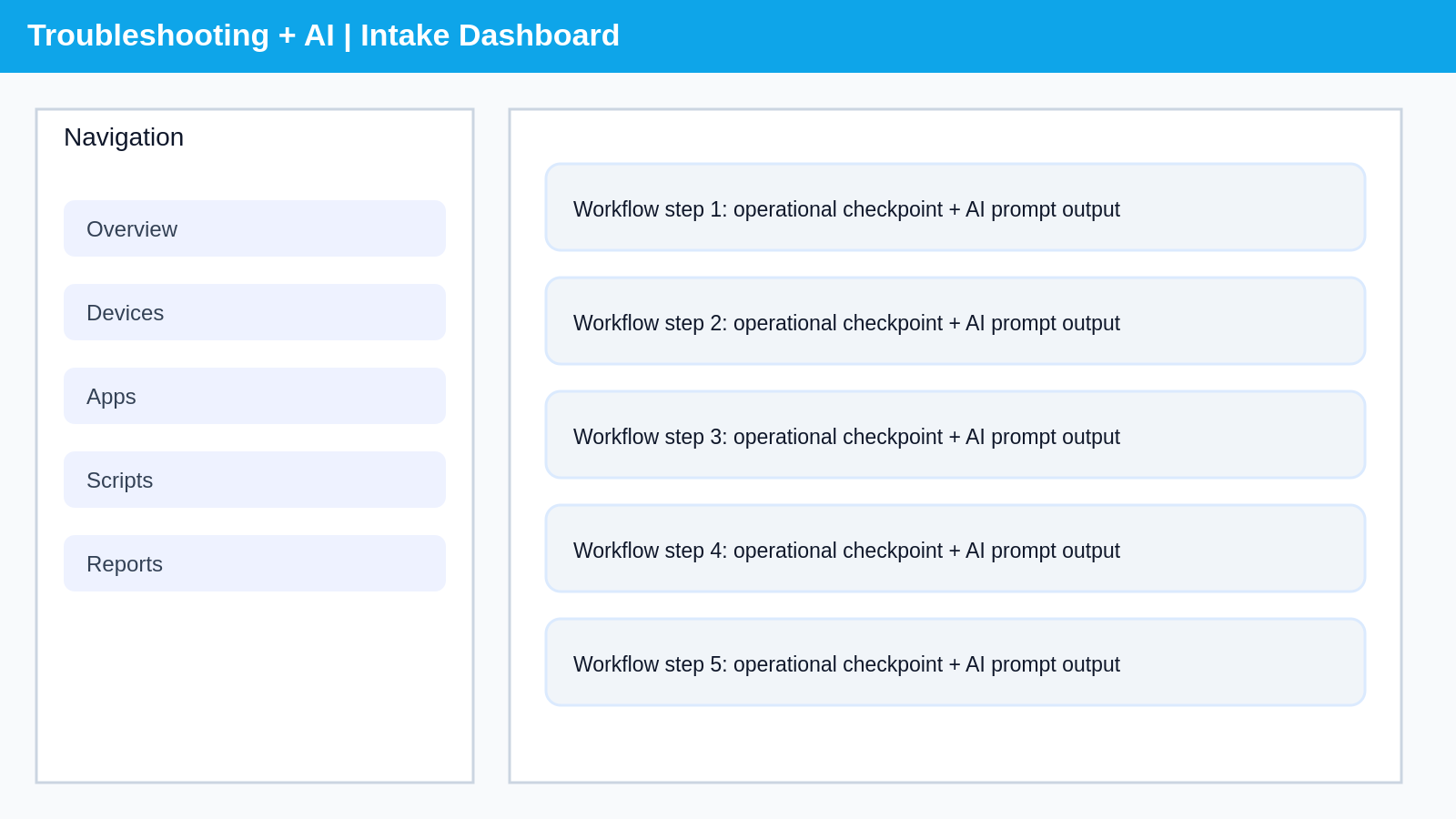
This process keeps velocity high without sacrificing safety.
Stage 1: Gather Evidence Fast
Start with a standardized intake bundle. Do not collect everything. Collect what narrows scope fastest.
Evidence bundle baseline
For app deployment or remediation tickets:
- Relevant CMTrace logs (client + app enforcement scope)
- Basic endpoint metadata (OS build, model, join/enrollment state)
- Recent policy/app deployment timestamps
- One reproduction timestamp from user or service desk
For performance or startup tickets:
- ProcMon short capture around reproduction window
- Event Viewer errors/warnings in matching timeframe
- Startup app/service deltas from last known-good state
For authentication/access tickets:
- Sign-in related event excerpts
- Policy assignment context (group/filter/ring)
- Device compliance/enrollment state
Practical rule
If you can’t explain why a log is included, don’t include it. Noise kills triage speed more than missing one non-critical file.
For packaging and deployment baselines, this companion guide helps: Deploy Apps with Intune Win32.
Stage 2: Redact Before You Prompt
Never paste raw enterprise logs into an external model endpoint.
Redact these fields first:
- UPN/email addresses
- Hostnames and internal domain names
- Internal IP ranges and server paths
- Tenant IDs, GUIDs tied to identity context
- Tokens, cert details, or anything credential-adjacent
A quick and safe model is replacing sensitive values with stable placeholders:
host-lt-224user-a12tenant-xsrv-app-01
This preserves relationship logic while preventing leakage.
Screenshot: 
Redaction quality checklist
Before prompting, verify:
- No personal identifiers remain
- No secrets or auth artifacts remain
- Timestamps are preserved
- Error codes and sequence order are preserved
If sequence and code fidelity are lost, AI output quality drops hard.
Stage 3: Prompt for Patterns, Not Final Answers
Bad prompt: “Fix this ticket.”
Good prompt pattern:
- Give scoped context (ticket type, environment, timeline)
- Provide redacted snippets
- Ask for ranked hypotheses with confidence levels
- Require validation commands/tests per hypothesis
- Request what extra evidence would increase confidence
Prompt template (copy/paste)
You are assisting desktop engineering triage.

Context:
- Ticket type: <deployment/performance/auth>
- Environment: Windows enterprise endpoint fleet
- Repro window: <timestamp range>
- Recent changes: <policy/app/update changes>

Data:
<redacted logs/snippets>

Task:
1) Identify top 3 likely root causes (ranked).
2) For each, provide confidence (high/med/low) and why.
3) Provide deterministic checks/commands to validate each.
4) List the fastest safe remediation path for the most likely cause.
5) List what additional evidence would reduce uncertainty.

Constraints:
- Do not assume missing data.
- Do not suggest destructive actions.
- Separate hypothesis from verified facts.
What good AI output looks like
- References exact error sequence, not generic advice
- Distinguishes symptom from cause
- Gives testable next checks
- Admits uncertainty when data is incomplete
If output sounds confident but untestable, throw it away.
Stage 4: Validate With Deterministic Checks
This is where senior engineers separate signal from guesswork.
Use a decision matrix:
- Hypothesis A has strongest log evidence -> test first
- Hypothesis B has medium support but low-risk validation -> test second
- Hypothesis C requires disruptive change -> hold until others fail
Screenshot: 
Validation discipline
For every suggested action:
- Define expected result before running command
- Run in pilot/single endpoint first
- Capture before/after evidence
- Rollback-ready before wider deployment
For PowerShell-based validation and automation hygiene, keep this reference handy: PowerShell Error Handling for IT.
The golden rule
AI may help you choose the first test. Only deterministic evidence lets you close the incident safely.
Stage 5: Document and Operationalize
Once resolved, convert the ticket into a reusable micro-runbook.
Include:
- Symptom pattern
- Root cause signal
- Validation steps used
- Final remediation and rollback notes
- Preventive guardrail (policy, package, monitoring)
Over 20–30 incidents, this becomes a high-value “triage accelerator” library for your team.
This is also where AI gets better for you: the more structured your internal incident writeups, the better your future prompts and outputs become.
Three Real Ticket Patterns You Can Solve Faster
Pattern 1: Win32 app install loops in required deployment
Common evidence:
- Repeat install attempts in CMTrace
- Detection rule mismatch after successful installer exit
- User reports app “installs every reboot”
AI can quickly cluster repeated detection mismatches and suggest checking detection logic precedence.
Deterministic validation:
- Confirm detection script/registry path exactly matches install outcome
- Validate 32/64-bit context mismatch
- Re-test on clean pilot device
Pattern 2: “Random slowness” after monthly patch window
Common evidence:
- ProcMon spikes around specific process chain
- Event logs show service timeout warnings
- Tickets concentrated on one hardware family
AI helps identify recurring process pairs and probable service dependency impact.
Deterministic validation:
- Compare process latency baseline pre/post patch
- Test service startup ordering adjustment in pilot ring
- Confirm no conflicting startup script changes
Pattern 3: Access failures after compliance policy updates
Common evidence:
- User can sign in locally but blocked for app access
- Compliance calculation lag vs policy expectation
- Assignment or filter edge cases for device subset
AI can map timeline inconsistencies and highlight likely policy-assignment drift.
Deterministic validation:
- Verify group/filter membership at incident timestamp
- Recompute compliance state and check latency
- Review recent policy changes by owner + change ticket
If you’re operating in modern endpoint environments, this ties closely to: Microsoft Intune for Desktop Engineers.
Governance and Security Guardrails
If you want this workflow approved long-term, you need governance upfront.
Minimum governance model
- Approved AI use policy for endpoint teams
- Mandatory redaction before model input
- Allowed data classes and prohibited fields documented
- Change-control link between AI suggestion and engineer action
- Incident record includes “AI-assisted” marker for auditability
Operational controls
- Keep prompts versioned in team docs/repo
- Standardize evidence bundle per ticket type
- Add peer review for high-impact remediations
- Track false-positive hypothesis rate from AI output
Your goal is not to look “AI-first.” Your goal is to be faster and safer than manual-only triage.
FAQ
Is CMTrace still useful if we already use cloud endpoint tools?
Yes. Many enterprise workflows still rely on SCCM/ConfigMgr-era traces, and CMTrace remains useful for line-by-line failure timelines.
Can AI replace ProcMon analysis entirely?
No. AI can summarize patterns, but ProcMon interpretation still needs context, process knowledge, and controlled validation.
What if security says no external AI tools?
Use internal/private model endpoints or keep AI usage to non-sensitive synthetic examples. The workflow still works with strict boundaries.
How much time does this save in practice?
Teams usually recover 20–40 minutes per medium-complexity ticket once templates and redaction habits are standardized.
Should junior engineers use this workflow?
Yes, with guardrails. It can improve triage quality and consistency, especially if seniors define validation playbooks.
What metric proves this is working?
Track mean time to first validated hypothesis, mean time to resolution, and repeat-incident rate after remediation.
Next Step CTA
Build your AI Triage Starter Pack this week:
- One redaction checklist
- Three prompt templates (deploy/perf/auth)
- One validation matrix template
- One incident closeout template with audit fields
Run it on your next five tickets. You’ll immediately see where your team is losing time—and where AI can remove friction without adding risk.