
Google Cloud Professional Machine Learning Engineer: Worth It for AI-Focused IT Pros?
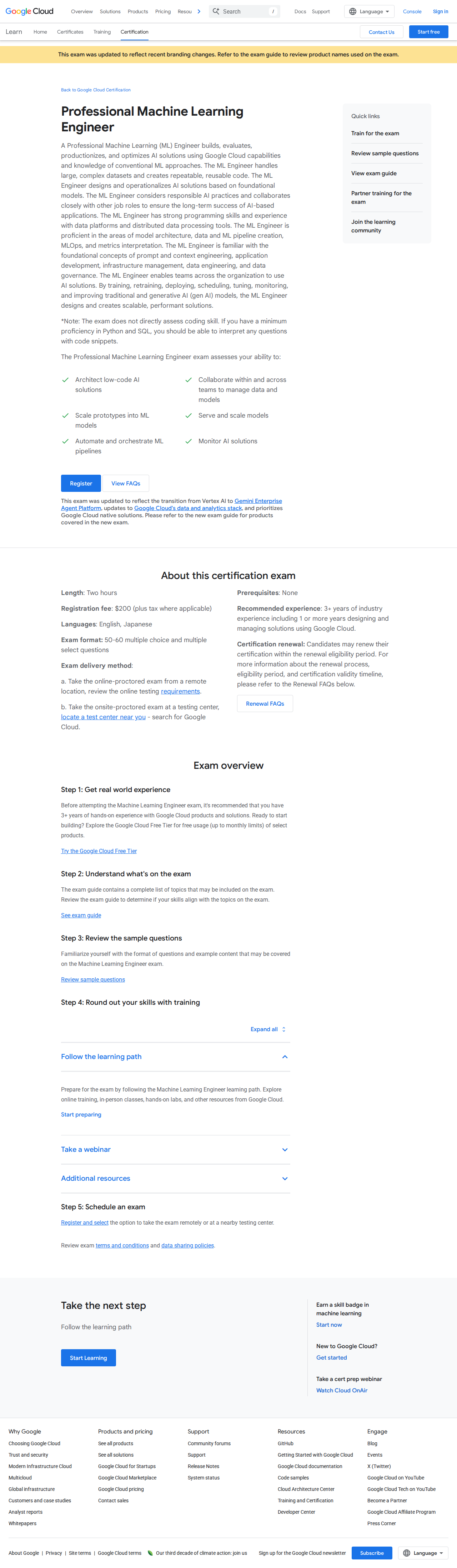
Google Cloud’s Professional Machine Learning Engineer certification is a serious production-AI credential. It is aimed at people who design, build, productionize, automate, and monitor machine-learning systems—not people looking for a quick introduction to chatbots or prompt writing.
Quick verdict
| Category | Verdict |
|---|---|
| Provider | Google Cloud |
| Credential | Professional Machine Learning Engineer |
| Best for | Cloud engineers, platform engineers, MLOps practitioners, and ML engineers |
| Exam length | 2 hours |
| Format | 50–60 multiple-choice and multiple-select questions |
| Price | $200 plus applicable tax |
| Languages | English and Japanese |
| Delivery | Online-proctored or onsite-proctored |
| Recommended experience | 3+ years in industry, including 1+ year designing or managing Google Cloud solutions |
| AI relevance | Very high for production AI and machine-learning platform work |
Bottom line: it is worth pursuing when your target role includes production ML systems, Vertex AI, model operations, or MLOps. It is not a sensible first AI credential for an endpoint technician who only needs practical AI literacy.
What the certification actually proves
Google frames the credential around the full machine-learning lifecycle. That includes preparing data, developing and evaluating models, building production ML systems, automating ML pipelines, and monitoring deployed solutions. The scope also includes generative-AI applications and responsible AI considerations.
That makes the certification different from a generic AI fundamentals badge. It tests whether you understand the operational decisions around a model:
- how data moves from source systems into training or inference workflows
- how models are evaluated before production use
- how pipelines are automated and made repeatable
- how deployed models are monitored for quality, drift, and failures
- how security, governance, and responsible-use requirements affect delivery
Google also states that the exam does not directly assess coding skill. You still need enough Python and SQL to interpret examples and reason about systems, but the credential is not a timed software-development exercise.
Why it matters to IT professionals moving toward AI
A systems administrator, cloud administrator, or endpoint engineer does not need to become a research scientist to contribute to an AI platform. The transition usually happens through operations: identity, networking, automation, observability, cost control, and reliable deployment.
The Professional Machine Learning Engineer credential becomes relevant when those responsibilities expand into:
- Platform enablement. You help teams provision and standardize environments for training, inference, and generative-AI applications.
- MLOps reliability. You operate pipelines, registries, deployment workflows, monitoring, and rollback paths rather than treating a model as a one-off notebook.
- Data and access governance. You connect model workflows to IAM, protected data, audit requirements, and organizational policy.
- Production troubleshooting. You investigate whether a bad result comes from the model, features, retrieval data, serving configuration, or an upstream pipeline.
- Cost and capacity management. You help keep accelerator, storage, batch, and serving choices aligned with the business requirement.
These are credible next-step responsibilities for an IT professional who already understands change control, incident response, automation, and cloud operations.
Exam logistics and preparation
The official certification page lists a two-hour exam with 50–60 multiple-choice and multiple-select questions. The fee is $200 plus tax where applicable. Candidates can use online proctoring or a testing center, and the listed languages are English and Japanese.
Google recommends at least three years of industry experience, including one year designing or managing Google Cloud solutions. That is a recommendation rather than a formal prerequisite, but it is a useful warning: memorizing Vertex AI product names will not substitute for understanding production systems.
A practical preparation plan should combine the exam guide with a small operational project. For example, build a support-ticket classification or internal knowledge-search prototype that includes:
- controlled data ingestion and validation
- a repeatable training or indexing pipeline
- identity-aware access controls
- an evaluation set and documented quality threshold
- deployment and rollback notes
- monitoring for failures, latency, cost, and data freshness
Who should take it
This certification is a strong fit if you are:
- a Google Cloud engineer moving into AI platform operations
- a DevOps or SRE practitioner supporting ML workloads
- a data engineer who now owns model-serving or ML pipelines
- an infrastructure architect responsible for enterprise AI foundations
- an ML engineer who wants a vendor-recognized production credential
It is a weak fit if you need basic AI vocabulary, work exclusively in Microsoft 365 without Google Cloud exposure, or want a short applied lab credential. In those cases, a foundational certification or a smaller platform-specific course can produce faster returns.
How it compares with nearby choices
The AWS Certified AI Practitioner is more accessible and better suited to foundational AI literacy. Microsoft’s Azure and Applied Skills options can be a better match for organizations standardized on Azure, Microsoft 365, and GitHub. Coursera professional certificates are useful structured learning programs, but they are not equivalent to a proctored Google Cloud professional certification.
The key distinction is depth: Professional Machine Learning Engineer is valuable because it signals familiarity with production ML decisions, not merely awareness of AI terminology.
Final recommendation
Yes—Google Cloud Professional Machine Learning Engineer is worth it for experienced IT professionals moving toward production AI, MLOps, or cloud platform engineering. It is expensive and too advanced for a first AI credential, but it has a clear connection to the systems, automation, governance, and monitoring work that makes AI usable in production.
Treat the certification as one part of a portfolio. Pair it with a documented ML or generative-AI deployment project showing access control, evaluation, observability, and incident handling. That evidence will usually carry more career weight than the badge alone.
Official sources:
- Google Cloud certification page: https://cloud.google.com/learn/certification/machine-learning-engineer
- Google Cloud Vertex AI overview: https://cloud.google.com/vertex-ai/docs/start/introduction
Research checked against Google Cloud’s official certification and Vertex AI pages on September 4, 2026. Exam pricing, objectives, languages, and delivery options can change; verify the provider page before registering.