CompTIA SecAI+: Worth It for AI-Focused IT and Security Pros?
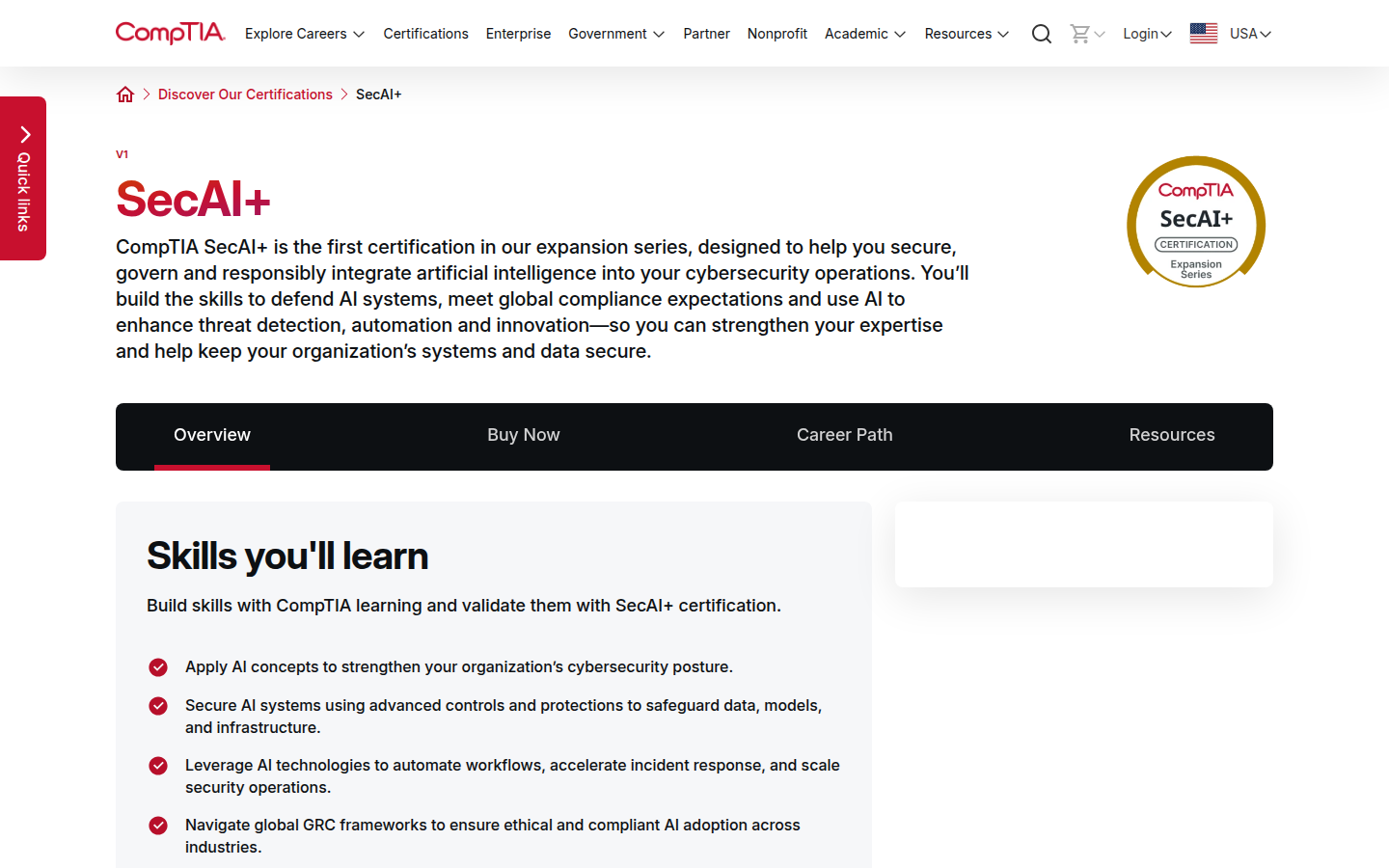
CompTIA SecAI+ is a new, vendor-neutral cybersecurity certification about securing, governing, and using artificial intelligence in security operations. It is not a general AI-literacy badge and it is not a replacement for Security+ or hands-on security experience. The practical question is whether its first exam, CY0-001, gives an IT professional a useful bridge between traditional security work and AI-enabled systems.
Quick verdict
| Category | Verdict |
|---|---|
| Provider | CompTIA |
| Credential | CompTIA SecAI+ V1 |
| Exam | CY0-001 |
| Launch date | February 17, 2026 |
| Format | Up to 60 multiple-choice and performance-based questions |
| Duration | 60 minutes |
| Passing score | 600 on a 100–900 scale |
| Languages | English and Japanese |
| Recommended background | 3–4 years in IT plus 2+ years of hands-on cybersecurity |
| Best fit | Security operations, cloud security, GRC, DevSecOps, and AI platform defenders |
| ROI | Promising for security teams adopting AI; weaker as a first-ever IT certification |
The facts above come from CompTIA’s official SecAI+ certification page. CompTIA estimates retirement roughly three years after launch, so candidates should treat this as a current-version credential and confirm the active exam version before purchasing preparation materials.
What SecAI+ actually validates
CompTIA divides the exam into four domains:
- Basic AI concepts related to cybersecurity — 17%
- Securing AI systems — 40%
- AI-assisted security — 24%
- AI governance, risk, and compliance — 19%
That weighting tells you where the credential is serious. The largest section is not prompting or AI vocabulary; it is the protection of AI systems, data, models, deployment environments, pipelines, and inference layers. A candidate should expect to reason about attack surfaces and controls across on-premises, cloud, and hybrid environments.
The syllabus also names AI-driven threats such as automated phishing, polymorphic malware, adversarial machine learning, and malicious use of generative AI. For a desktop or infrastructure engineer, the transferable skill is not memorizing threat names. It is learning to ask where an AI feature receives data, which identity can invoke it, what it can change, how activity is logged, and how a defender can contain misuse.

The practical security angle
SecAI+ is most relevant when AI is becoming part of an existing security workflow. CompTIA highlights anomaly detection, event triage, alert correlation, response orchestration, threat modeling, behavior analysis, and continuous monitoring.
A good study exercise is to design a controlled AI-assisted incident workflow:
- ingest a bounded set of security events;
- have an AI system summarize and correlate them;
- require a human approval step before remediation;
- record the prompt, evidence, decision, and action;
- test what happens when the input contains malicious instructions or sensitive data.
This turns the exam topics into operational judgment. AI can accelerate investigation, but an analyst still needs evidence, authorization boundaries, rollback, and an audit trail. The same logic applies to an AI assistant that proposes an Intune remediation, a PowerShell change, or a firewall rule: treat generated actions as untrusted recommendations until reviewed and tested.
Governance is not filler
The 19% governance, risk, and compliance domain is large enough to affect the credential’s value for enterprise IT. CompTIA specifically references ethical and legal standards, GDPR, and the NIST AI Risk Management Framework.
For IT professionals, the useful preparation questions are concrete:
- Which data may be sent to an external model?
- How are model, prompt, retrieval, and tool permissions separated?
- Who owns an AI system’s risk acceptance?
- How are model changes, evaluations, incidents, and vendor claims documented?
- What evidence would an auditor need to reproduce a security decision?
These questions make SecAI+ more than a narrow SOC automation exam. It can support people who administer identity, endpoints, cloud services, data platforms, or DevSecOps controls around AI systems.
Preparation plan for IT professionals
1. Refresh security fundamentals first
Do not begin with model terminology alone. Review identity and access management, network segmentation, logging, vulnerability management, incident response, secure software delivery, and data protection. SecAI+ assumes cybersecurity experience rather than teaching the whole discipline from zero.
2. Learn the AI attack surface
Study training data, model files, data pipelines, embeddings, retrieval sources, prompts, plugins, APIs, inference endpoints, and monitoring. For each component, map confidentiality, integrity, availability, abuse, and recovery concerns.
3. Practice governance as a technical workflow
Create a small AI-use register for your team. Record the business purpose, data classification, provider, identities, integrations, retention, evaluation method, human approval points, and incident owner. This is the kind of practical bridge that connects GRC language to systems administration.
4. Use performance-based thinking
CompTIA lists performance-based questions. Practice selecting controls and explaining tradeoffs rather than only recalling definitions. When reviewing a scenario, state the asset, threat, control, evidence, and rollback path.
Who should take it?
SecAI+ is a reasonable choice for a security analyst, cloud security engineer, GRC specialist, DevSecOps practitioner, security-minded systems administrator, or IT lead who is responsible for AI adoption. It can also give a desktop engineer a structured path into securing Copilot-like tools, AI-enabled endpoint operations, and enterprise automation.
It is a weaker first choice for someone with no security foundation, someone seeking a machine-learning engineering credential, or someone who needs a platform-specific implementation certification. Those candidates may get more immediate value from foundational security training, a cloud security credential, or a hands-on project using the AI platform their employer actually runs.
Bottom line
CompTIA SecAI+ is new, focused, and unusually practical in one important way: it treats AI as both a system to defend and a capability that security teams must control. The 40% securing-AI domain, 24% AI-assisted-security domain, and 19% governance domain make it relevant to real enterprise questions about permissions, data, monitoring, response, and accountability.
Take it if your role already includes cybersecurity and your organization is introducing AI into operations. Do not treat it as a substitute for security fundamentals or production experience. Its strongest ROI will come when you pair the certification with a small, documented AI security project that demonstrates safe integration rather than just exam completion.
Official source: CompTIA SecAI+ Certification V1